Software
Houzz Logo Print
stevegreer41

Deodar with horizontal trunk - will it stand?

11 years ago
last modified: 11 years ago
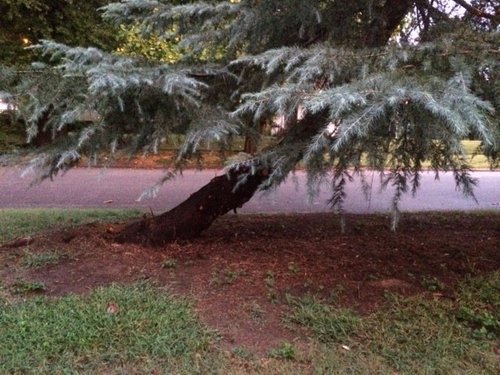

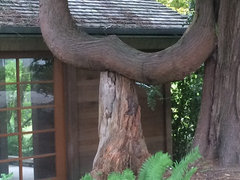
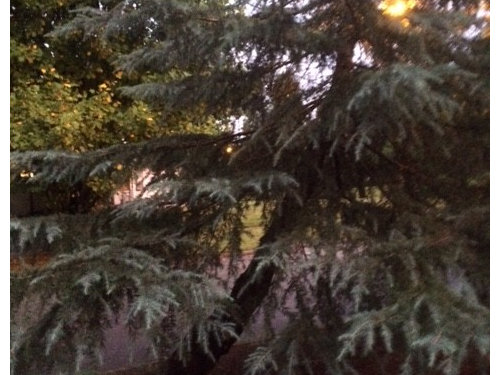
I have a young deodar that was planted ten years ago. It's about 16' tall. Its lower trunk has grown at a 40-45 degree angle before straightening to vertical (see picture). I'm concerned that it will uproot itself and fall over. Do you think it can continue to stand with this growth habit? If not, could its trunk be braced to stabilize it?

Comments (16)

  • 11 years ago

    Steve, do a search using the terms "reaction wood" and "compression wood". There you will learn that the tree has already compensated for this gravitational challenge. Now that doesn't mean the tree can't fail. Only a fool would make such a pronouncement. But do know that the tree has a plan in place already!

    +oM

  • 11 years ago

    when i used to give garden tours... nobody cared about all the perfect specimens ...


    but they all went nuts on the oddities ...


    there is nothing you can do ... enjoy it for what it is ...


    if it falls.. it falls ... but dont worry about it...


    and dont think you can ever outsmart ma nature.. presume whatever you dream up ..... will probably make the situation worse ...


    ken

  • 11 years ago

    Ever see trees sweeping outward over a lake or stream? They are reaching for life-giving sunlight and they are using their already-present abilities to produce specialized types of wood tissues to hold themselves up in this predicament. Likely the same things are going on here, albeit I do not know the history of this particular specimen. But again, trees already "know" how to handle this kind of thing.

    +om

    Steve G thanked wisconsitom
  • 11 years ago
    last modified: 11 years ago
    Hmmm...looks like it had a poor root system with deflected, kinked, and/or bent roots when you planted it. Hopefully it doesn't keep drifting over until the first 2-3' of trunk are laying on the ground. I think it is unlikely to break, just uproot.

  • 11 years ago

    I'd say let it go and watch the show.

    How much snow do you usually get?

    I have two severe leaners and I'm just watching them to see what they do.

    One's a Coast redwood and the other a Douglas fir.

    Mike

    Steve G thanked Mike McGarvey
  • 11 years ago

    smivies - The tree was in a pot for a number of years before I had a place to plant it, so the roots may gave been constricted. However, the trunk was straight when I planted it in the ground. I am concerned about drifting over, as you said. The growth pattern wasn't obvious while the tree was younger and bushier, but since I noticed it, the weight of the tree seems to be levering the root ball upward.

    miketann - I live in Memphis, so snow is limited to a few inches and is usually brief.

  • 11 years ago
    last modified: 11 years ago

    The tree was in a pot for a number of years before I had a place to plant it, so the roots may gave been constricted.

    Root-bound and on its way to failure, if it were mine it would be cut down now.

    Think about this: the root systems of wild trees growing in the ground, where their roots have never been deflected by nursery containers or cut back by gardeners or nurserymen are typically wider reaching than the branch systems of the same specimens. Sometimes considerably wider reaching. So when you planted your cedar, without cutting the roots or pulling them open you had what was supposed to be a bigger mass than the size the top was at that time trapped inside the pot.

    That hugely compressed wad of roots is still there, forming a ball that the now much larger and heavier top of the tree is pivoting over on.

    I've had foundation shrubs fall over in snow about 20 or more years after planting. When pulled out these could be seen to have roots like turnips, due to having been left too long in 4 inch pots at a production facility.

    Another point to consider is that successful deodars form huge trees spreading over a wide area - if you somehow managed to prop the one shown up in such a way as to allow it to get considerably farther along in its development you would then have the problem of it trying to swallow the access route visible behind it in your picture.

  • 11 years ago
    last modified: 11 years ago

    Maybe you could remove a few lower limbs, especially on the downward side.

    Is the tree threatening anything? If not, why not let it go and see what happens?

    That's what I'm doing.

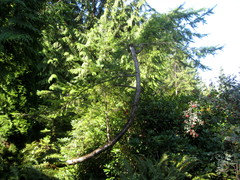
    Here's my Pseudotsuga menziesii, Douglas Fir, that is leaning. The top broke off in the last ice storm we had a few years ago. Several branches have joined the fight for apical dominance. I'll probably remove them in a year or two.

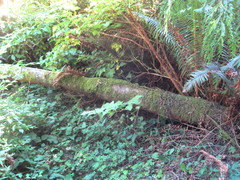
    It's leaning further than the first picture indicates. Here's the rest of it.
    It's not quite laying on the ground. A strip of bark running on top of the trunk died from the stress. You can barely see it next to the dead fern frond draped over the trunk.

    This area could use a little manicuring. ;-) You guys didn't think landscaped the whole ten acres, did you?!!

  • 11 years ago

    Depends on how bothered an involved party is by the appearance of instability and implied impending disaster (for the tree, if nothing else) a leaning tree presents.

  • 11 years ago

    if it were leaning toward the house.. and it were huge.. it would be gone ASAP ...


    if not.. you might spend the next 20 or 40 years.. enjoying its oddity ... yep.. could topple any time... IN THE NEXT 40 YEARS ... maybe never...


    KEN

  • 11 years ago

    With now-included info that tree is not exhibiting phototropism but was, in fact, straight at planting indicates root failure of some kind, with resulting lean, likely increasing over time. Not at all what I thought we were looking at....at first.

    +oM

  • 11 years ago

    Yes, that changes things. My trees are going toward the light and so far the rootballs are holding steady.

    Steve, I doubt your tree will remain upright for very few winters, light snowfall considered.

    Mike

  • 11 years ago

    You know, depending on when lean occurred....how many years back, that is, it still strikes me as odd to see upward turn of upper trunk portions. That suggests some time in current position, not a tree that has been leaning over recently. somebody's confused here. It might be me-wouldn't be the first time-but we've got some inconsistencies in this story.

    +oM

  • 11 years ago


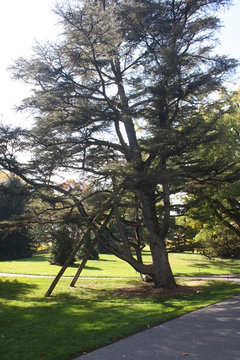
    Steve G, here's another cedar that needs some help. You could try a prop on a reduced scale.

    Steve G thanked sam_md
  • 11 years ago

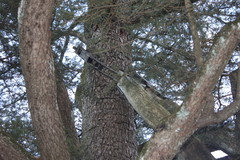
    Thanks for the idea. I also recently saw this bracing employed at the botanical gardens in Bellevue, WA. A suitably-sized stump, or similar object, might prevent the trunk from leaning further and take pressure off of the roots.