Software
Houzz Logo Print
tonytranomaha

American Persimmon

11 years ago
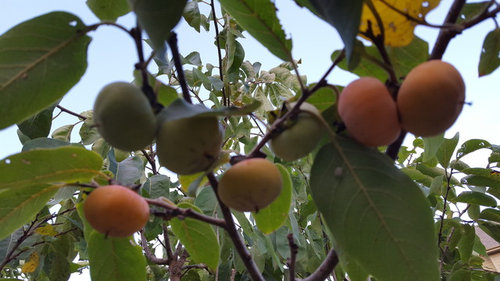
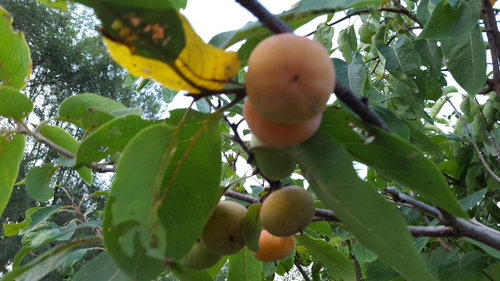
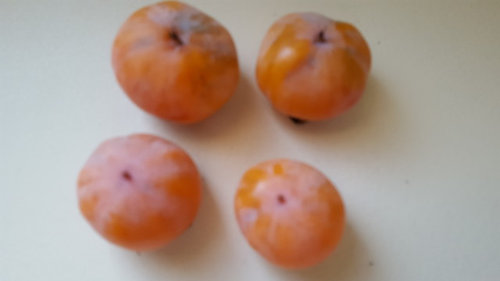
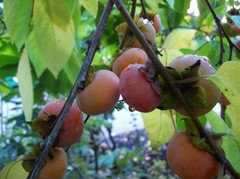
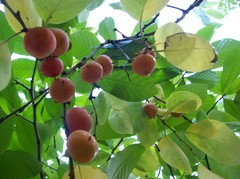
Even though the American persimmon lacks in size compare to Asian persimmon (Kaki) but the fragrance make up for it.

Tony

H-120


Knightville


Lena


Meader


Comments (21)

  • 11 years ago

    Those persimmons are looking good Tony. A lot more reliable in zone 6 for me than kakis though in zone 7 kakis have been preferable. The biggest issue has been harvesting. Unless the trees are pruned to stay on the small side, harvesting is the most difficult and labor intensive part of raising this fruit. I find that I need to hand pick each individual fruit by cutting it off the tree - that's a lot of time to spend per fruit on a fruit of that size. Same process for kakis, but at least you end up with a bigger fruit for your effort. And since I need to be up on a ladder to do this job I want to take as many fruit as I can each time I go up, which means picking lots of semi-ripe fruit, which aren't guaranteed to ripen to the highest quality.

    So far this year I have had some truly excellent persimmons from my Osage and Garrettson trees- deep translucent orange color, very sweet and flavorful without off-flavors, and gelatinous texture, almost juicy.

  • 11 years ago

    Nice persimmons, Tony. I hope that I can take scion wood from you next spring so I can grow my own persimmon trees.

  • 11 years ago

    Creek.

    How is the Great Wall Asian persimmon doing this year? Mine died back to the ground last Winter and now it has two 5 feet tall whip. I plan to head it off at 3 feet next Spring to get a better tree form.

    Tony

  • 11 years ago

    Second year in a row that I've had dieback on the Great Wall. Two years ago it was only one year wood, but last year I had older wood die back. The regrowth has been vigorous and dense, and although most has been from adventitious buds, which started late, the new growth appears well lignified at this point in the season and hopefully, if we have a mild winter here, will make it through . Because of the late start, this winter I'll probably protect for anything below 0 F, maybe even higher.

  • 11 years ago

    Creek,

    Just harvested some Claypool H-118. I was surprised that they were 2 inches or a little bigger and great tasting too.

    Tony


  • 11 years ago

    This will be the first year that I'd consider my H-118 to be a mature tree, and yes, the fruit is as large as any of my other varieties, while the persimmon crop as a whole has smaller sized fruit this year. Last couple of years the H-118 had had small, not so good tasting fruit and I had even considered topworking it - at this point glad I didn't and looking forward to trying them when they ripen.

  • 11 years ago

    Shaping up to be the best year in some time for American persimmons in terms of fruit quality. Lots of demand at home for these. Variety here is Osage - a bit small but excellent flavor.

  • 10 years ago

    Nice looking fruit, especially like the color on osage.


  • 10 years ago

    Tony,

    how do you like the flavor of Lena compared to your other varieties?


  • 10 years ago

    I'm in the habit of considering each year as it happens as the definitive year for evaluating the merits of American persimmon, and this year in my orchard Lehman's 100-46 is the standout winner, so I plan next year to continue my efforts to topwork a number of my trees to this variety as well as to Prok and Rosseyanka.

  • 10 years ago

    Creekweb, if you don't mind sharing, I'm curious what state(s) your
    orchards are in. Do I remember correctly that you said you have two
    locations, one in zone 6 and one in zone 7?

  • 10 years ago

    I remember that Col. Sanders wanted to serve persimmon pudding in his restaurants but the supply was not available. What a shame that idea never did happen. I believe it would have been an instant hit.


  • 10 years ago

    Maybe We should pitch that idea again and have folks in Indiana like Jerry Lehman and others growers to supply the American persimmons.

    Tony

  • 10 years ago

    If there were enough growers interested in doing this I believe it could be pulled off. Processing would be an issue but could be overcome. At one time there was a small industry in Indiana selling canned persimmon pulp.

  • 9 years ago

    I have 30 persimmon seedlings that are going to be going into their 4th year in 2017. I would like to start grafting specific varieties of persimmons to these seedlings. They are growing in 5 ft Plantra tree tubes and have reached the top of the tubes and then some. These are Yates and Prok seedlings. What varieties would be good to graft? how long should the scion wood be; how many grafts can I get out of a scion wood stick? Is it possible to leave some of the rootstock branches in place to have a 2 in 1 style tree or would it be best to have the graft be the main tree? I have heard that Persimmons usually have about 3 out of 10 being a female tree and I do not know which are female since there has not been any flowers or fruit produced as of yet. Besides England's are any other places to order scion wood? I am south of Des Moines Iowa in zone 5.

  • 9 years ago

    Cliff England would be a good source for scionwood; Edible Landscaping is another though their selection would not be as extensive. They often sell the wood by the foot. I usually cut the wood so that there are 2 buds along with a section used to juxtapose cambium on each piece. It's a good idea to graft early fruiting varieties (such as NC-10 or J-59 or others) and some good mid-season (such as Prok, 100-46 or Yates). It is possible to have the graft grow along with the rootstock variety, but I don't recommend it, as it creates a higher maintenance tree with lower percentage of takes and at greater risk of self-pruning the graft. The genetics would predict an equal probability of male and female seedling trees, but in practice I agree that there seems to be a preponderance of males, though it would be tough to guess the ratio.

  • 9 years ago

    Creekweb thank you for your suggestions. I have looked for other sources for scion wood and the best I have found is England's. I had not thought about the self pruning as a possibility and will keep that in mind as I do the grafting. I had not thought of the NC-10 or J-59 or early varieties I was looking for mid season and late varieties. I think it might be good to have early, mid and late to make a longer season and more manageable to harvest.

  • 9 years ago

    Creekweb, do you have favorite late varieties that you would recommend for areas with long enough seasons. I haven't hardly fruited any named selections yet, but based on the wild trees, I would say September is mid-season for persimmons here in zone 7 North Carolina. I can definitely find some early ripening trees in August, but by the second half of October (which often means still before even the first fall frost) I mostly can't find any fresh persimmons any more. Do you think there's hope for fresh persimmons in the second half of October or even into November here? I know Shane11 likes Ruby as a late variety, but I don't know what he means by late (and we're located in the same area.) Shane11, where would you put early, mid, and late on the calendar?

  • 9 years ago

    Ruby ripens the latest of all the varieties I have tried. It ripens over a long span but the majority of fruits ripen after all others are gone. The majority ripen near the end of October and 1st part of Nov. though there are sometimes a few into the 1st part of December, but not every year. Most of the quality varieties such as early golden and yates ripen the majority of their fruits in September, sometimes with a few starting in the middle to end of August. I think weather plays a big part in ripening. Some years I will not get a single ripe fruit until September and other years I may get a lot at the end of August - from the same varieties. How hot the summer is likely plays a big role. And while not advertised as such ruby always has the largest fruits compared to early golden and yates - or any other variety American I have grown and I have tried many in the past.

  • 9 years ago

    That's very good to hear about Ruby, particularly the dates you normally harvest the fruit. I have Ruby grafted in two places. Both trees are doing well, but one is further along than the other. I would guess I'll get my first taste of Ruby from the one tree this coming year. How long has it been since you planted your Ruby and how much fruit do you expect to get in an average year at this stage? I assume its productivity is about the same as the other varieties you grow, but I don't know what to expect from an average variety. Most of my trees either haven't hardly started to bear yet or they're wild trees that are quite large and bear abundantly. It seems like a good, large tree can yield at least a gallon/day, if not multiple gallons, daily for a month or more.

    I think the first persimmon I grafted was in 2009. It got off to a slow start (probably in part because I grafted too high on a rootstock that I could have let size up another year or two first), but it's probably 20' tall now (but spindly compared to other fruit and nut species that would be that tall), and I have yet to get anywhere near a gallon of fruit from it over a whole season. I had hoped for more from a tree as big as it is now.