Software
Houzz Logo Print
mike_mcgee

Screening options

10 years ago
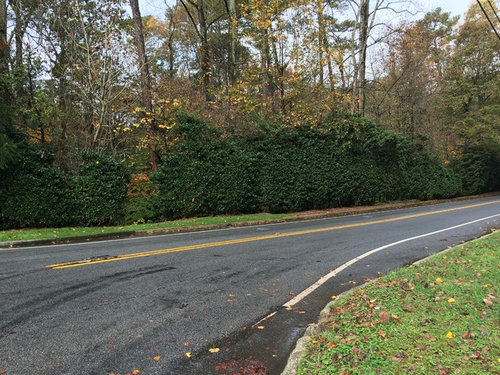
The previous owner of my property planted leyland cypress trees around the fence line for screening. Due to various issues, they're not doing well, and I want to replace them with something else for screening. (It might be better to have a mix of screening plants / trees rather than the monoculture of leylands.)


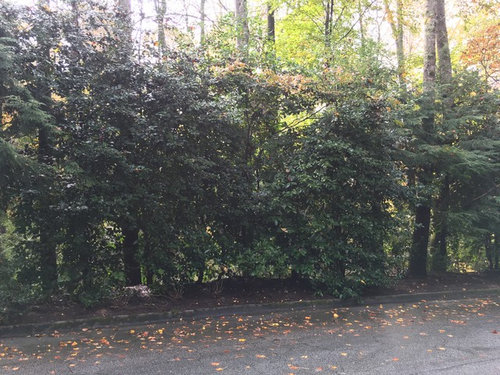
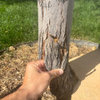
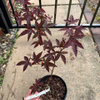
I've attached some photos of some screening I've seen around town. Can anyone tell me what they are? I'm open to other suggestions, too.


Thanks,

Mike in Atlanta


Comments (10)

  • 10 years ago

    First pic might be holly. Holly would be a very good choice for your situation, too. Sun or shade it will grow well. The more sun the better though.

    Dax

  • 10 years ago

    Not evergreen but some of my viburnum here still have a full set of leaves.

    Weeping willow also if room permits.

    My scarlet oak holds its brown leaves all winter.

  • 10 years ago

    Just my own opinion, but a bunch of holly or other more or less evergreen stuff crowding the edge of a woods like that ruins the effect of being able to see depth, to see into the woods. It also reminds me of the absolute scourge that is common buckthorn, which is now closing in on near-every little patch of woods in this area. Not a look I'd reach for at all.

    Conversely, native woodland edge shrubs, things like gray dogwoods, etc. have the decency to themselves shed their leaves at the same time as the native trees, once again, allowing for a delightful depth of field.

    +om

  • 10 years ago

    use some sort of holly or maybe some chinese privet *yes I know privet is invasive (at least where I leave) but it will do the job*

  • 10 years ago
    last modified: 10 years ago

    Everyone is entitled to their opinion, which like a certain part of the lower anatomy, everyone seems to have. But the last, make that the very last thing we need to be doing is to foster further use of junk invasives. And again, opinion being what it is, I'd ask-do you really think that looks good-that picture at the top of this thread? I sure don't. And again, it reminds me of how buckthorn is closing every view off here, destroying the ability to see into areas. All you see is buckthorn, with some more buckthorn behind that. This is another such effect.

    +om

  • 10 years ago

    "It might be better to have a mix of screening plants / trees rather than the monoculture." It's nice you are considering that, since it has a higher chance of looking good for longer, though I can't make specific suggestions in your area. It gives you a mix of bloom time and foliage color and texture, and if one plant is unhealthy or dies, you don't have to try to find a matching plant.

    Dave's questions:"Can you post a pic of your particular screening situation? Fenceline? Plenty of sun? How wide can the planting become? How high? Are you planning on shearing?" really need answering before specific suggestions can be made for your situation. Photos will be useful, both of the actual area to be planted as well as views toward the screening area as seen from common areas you will be, such as the window next to where you commonly are, a pool, or a patio/deck area. Keep in mind that densely twiggy deciduous plants (in my area forsythia and Physocarpus/ninebark for example) can make good screening along with evergreens. You may want to look at trees placed stragegically to block certain sights, large shrubs, tall grasses or clumping bamboos, and perhaps evergreen vines on a trellis to work as part of a mixed screen.

    I would agree with Tom that planting invasives is not the answer, especially since the person who plants them often isn't the one who has to deal with them; it's property owners wherever the birds deposit the seeds, often many miles away.

    Mike McGee thanked NHBabs z4b-5a NH
  • 10 years ago
    last modified: 10 years ago

    Sorry for the slow response, for some reason I didn't get the notification of replies!

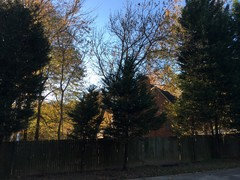
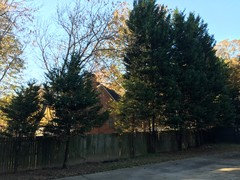
    The USDA site says I'm in zone 8a. Attached are some photos of the area in question. The area gets plenty of sun and the fence is 6' tall. You can see some of the Leylands have already died (root rot) and others are suffering. The healthy ones are taller than they need to be. I only want to provide screening between my house and the one next door, so it doesn't have to be as tall as the Leylands, but it does need to be taller than the fence. I actually own 20 - 30' on the other side of the fence, so my plan is to take down the Leylands on my side of the fence and plant new screening on the other side. There is a fairly steep hill descending on the other side of the fence, if that matters, but I do have a fairly wide area to play with.

    I'd like as low maintenance as possible; evergreens so I don't have to deal with fallen leaves, and preferably no shearing.

    On the other side of my property I have some fragrant tea olives, and they have grown tall enough to provide good screening, but it took a while. I also have some green giant arborvitae, but one of them already died after blowing over in a storm.

    Thanks for all of the suggestions. Looking forward to your replies with this information and photos!


  • 10 years ago
    last modified: 10 years ago

    Those Leylands are really close to the fence. Who maintains the fence? Does it need to be stained? Pressure washed? Or no maintenance?

    I would consider a mix of Chindo viburnum (grows pretty fast), Osmanthus x fortunei (although spiny) -- fragrans is a better choice, Fosters holly or East Palatka holly ( or similar hybrid that grows tall and more narrow), Photinia serrulata, Prunus Caroliniana 'Bright n Tight', and maybe throw in a Camellia sasanqua for some color. You could even work in a close grouping of three Trachycarpus palms. Maybe even a Little Gem or Teddy Bear magnolia.

    But I would remove all the Leylands first! I know, a lot of work, right?!

    Mike McGee thanked Dave in NoVA • N. Virginia • zone 7A
  • 10 years ago

    Murdering is too good for these horrors - wars have been fought for less in the UK - so much so we had to bring in special laws (High Hedges bill) to control the planting and neighbourhood blight created by these grim hybrids. Nothing wrong with a nice species hedge, imo...and if it includes heps and berries, so much the better.

    Mike McGee thanked User