Software
Houzz Logo Print
birdy50

kitchen outlet wiring difficulties

10 years ago
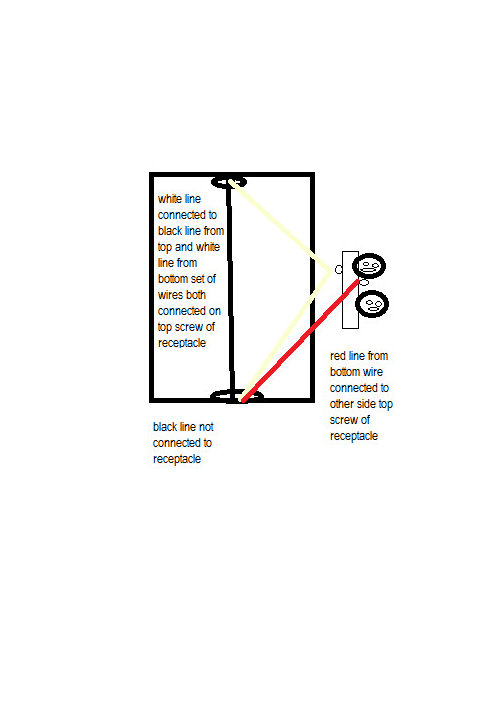
I'm renovating my kitchen with new cabinets and after pricing an electrician to add around 7 new outlets, thought it would be better to do myself. Sheesh, so expensive. In mapping out the current outlets and how I would upgrade to GFCI protected (this is a 1957 house and never upgraded) I found one outlet by the sink that had its own 20amp breaker. Nothing else on it that I could find anywhere in the house. Assuming this was the load in, I thought this would be a perfect start to the GFCI and then connect 3 new outlets to that line. After turning off the breaker, I opened the receptacle and what I found completely puzzles me. Any feedback or advice would be extremely appreciated.

There is a black wire not connected to the receptacle that runs from the top through to the hole in bottom of box. Going where, I have no idea. There is a white wire coming from the top of box that connects to the top screw of receptacle. Then another set of wires comes from the bottom hole of box- one white, one red. The white wraps around the same screw as the white line from the top. The red goes to the other screw at the top of receptacle.

In turning the breaker off, the black remains live. All else is neutral. Power on, the red and black are live. White are neutral.

Best I can figure, some jack wagon has a live wire running who knows where all over the house. How I can trace that, I have no idea. Why are both whites on the same screw? Where is that white and red line going to if this is the only receptacle on that breaker? The outlet works, so I do I just leave as is and move on to another receptacle to work with adding new outlets? I'm baffled.

Comments (11)

  • 10 years ago

    Greg, I did as you advised and went to tracking which breaker powered that live black wire running through the box. It wasn't any of the breakers associated with the kitchen, but there is a 15amp breaker right above the 20amp that powers this outlet, and we didn't know what it went to. Turns out, it's that live black wire, and for whatever reason, an outlet in the bathroom 2 rooms away. Assuming I do the pigtail on those 2 white wires (with both breakers off) and connect the two breakers, would it be safe to switch this outlet over to GFCI and run other new outlets down the line from it? Do I need to do anything with that black wire?

  • 10 years ago
    last modified: 10 years ago

    The fact that one is a 15 amp and one is a 20 amp worries me. What is the size of the wires? 14 gauge is only appropriate for 15 amps. Hopefully they are 12 gauge (which is proper for 20 amps) and the one breaker is undersized.

    You can install a GFCI in this box (provided there's enough physical room given all of the other connections) and then run your other outlets off of the load size of the GFCI so that it protects the downstream outlets too.

    Do I need to do anything with that black wire? Nope.

    However, if this renovation is being permitted then you'll have to bring the whole electrical system (for the kitchen) up to modern day codes in order to pass inspection. I'm not an electrician, so I don't know the code off the top of my head but I think at minimum you need two 20A circuits that serve the counter top. So just extending this one circuit may not meet your needs (especially if that breaker has to be downgraded to 15A for safety).

    This might be why an electrician would charge 'so much' for the work. They have to do it to code and can't just kludge together a quick fix.

    birdy50 thanked greg_2015
  • 10 years ago

    How are you determining that the black wire has power?

  • 10 years ago

    From what I can tell it's 12, but I had a very hard time trying to figure it out. I'll have another GFCI on the other side of the kitchen, so the 2 for code will take care of that. I wonder if it might be better to take that bathroom outlet off that breaker and wire it into another breaker that serves the bathroom. Then I could terminate the black line in the kitchen outlet and move on from there. Would that work? Presumably, power is drawn from the breaker that the kitchen outlet (minus the black line) is on, so I could just cap that black and have that breaker that was powering the black line and the bathroom outlet powering nothing, right?

    Also, where is my ground? You've been monstrously helpful, thank you!

  • 10 years ago

    Ron- with a voltage tester

  • 10 years ago
    last modified: 10 years ago

    "Also, where is my ground? "

    I was just about to ask that. From your picture, it suggest that the wire could be run in conduit? ( the usual reason that the black wire would just run through) If it IS in EMT, then everything is (should be) grounded by the conduit, but you either need a ground pigtail for the receptacles, or a special grounding receptacle. If it is NOT in conduit, then;

    CAUTION: The permission to replace nongrounding-type receptacles with GFCI-protected grounding-type receptacles doesn't apply to new receptacle outlets that extend from an existing ungrounded outlet box. Once you add a receptacle outlet (branch-circuit extension), the receptacle must be of the grounding (bonding) type and it must have its grounding terminal grounded (bonded) to an effective ground-fault current path in accordance with 250.130(C).

    Chicago has some different codes on this such as requiring conduit, and some states, such as Massachusetts, require you to start any new wiring from the properly grounded panel. [no circuit extensions allowed on Romex without a ground, or grounding by 250.130(c)]

    210.7

    (B) Multiple Branch Circuits. Where two or more branch circuits supply devices or equipment on the same yoke, a means to simultaneously disconnect the ungrounded conductors supplying those devices shall be provided at the point at which the branch circuits originate.


    HOWEVER, since the circuits need to be on an AFCI breaker, you should in most cases need to use a 2-pole breaker. There are some exceptions.

  • 10 years ago

    Ron- with a voltage tester

    Not to be snarky, but exactly what sort of "voltage tester." It's quite possible that a disconnected line will read voltage with some high impedence testers (especially non contact ones).

  • 10 years ago

    From what I can tell it's 12, but I had a very hard time trying to figure it out.

    How did you figure it out? It's really important that you get this right. Is there writing on the wire? Do you have a wire gauge tool to check the measurement? Or did you just eyeball it and assume?

  • 10 years ago

    Ron- Greenlee GT-11 voltage detector.

    Greg- I can't uncover any writing on the wires, but I compared it to some 12 gauge I had on hand and it seemed similar.

    Fred- The wiring up in the attic is mostly all in conduit, so that might be a possibility.

  • 10 years ago

    I actually have one of those. If it tells me a wire is hot, I'd be careful, but it does give false positives.


Sponsored
The Creative Kitchen Company
Average rating: 5 out of 5 stars52 Reviews
Columbus Area Kitchen Remodeling and Refacing Professional