Software
Houzz Logo Print
modernstory

Does this kitchen faucet comply with plumbing code?

10 years ago

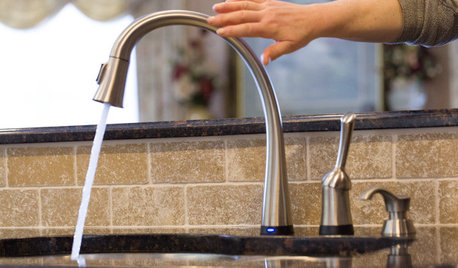
We, well, I, would prefer a white kitchen faucet for our oversize kitchen sink. There are few faucets that meet this criteria. The one I found is a Paffoni Ringo, made in Italy. It is sold here by, as far as I can see, just one vendor. It can also be ordered for way less money from Italy. The US vendor claims that it complies with US plumbing code and that it is installed all the time in US, but does not provide any more specific information, as in code letters. The company in Italy gave me the French plumbing code that the faucet complies with.

Any suggestions, other than installing one faucet and switching out after C of O inspection? I think DH would fall apart with worry if we did that.


There is a Brizo Solna that would be ok except that the spout is quite thick, and unappealing.

Please help!

Comments (19)

  • 10 years ago

    What do you want? A mind reader? How would anyone know?

  • 10 years ago

    Just as helpful as always, geoff.

    OP - If you have the plumbing codes the faucet meets, you can always apply for an exception with your local inspector. Generally, as long as you are up-front about it and it's a reputable company and reputable codes, the inspector won't have a problem with it. Paffoni is sold by quite a few vendors in the US so it likely already meets code - just verify with the vendor.

  • 10 years ago
    last modified: 10 years ago

    I believe most faucets must have little or no lead content in the brass, or be stainless steel.

    @alice: "Generally, as long as you are up-front about it and it's a reputable company and reputable codes, the inspector won't have a problem with it."

    You seem to be pretty confident, speaking for an inspector you don't know, don't know the jurisdiction, etc.

    The best be would be to email Paffoni and ask them if they meet this spec:

    Section 1417 of the Safe Drinking Water Act (SDWA) establishes the definition for “lead free” as a weighted average of 0.25% lead calculated across the wetted surfaces of a pipe, pipe fitting, plumbing fitting, and fixture and 0.2% lead for solder and flux. The Act also provides a methodology for calculating the weighted average of wetted surfaces.

    The Act prohibits the “use of any pipe, any pipe or plumbing fitting or fixture, any solder, or any flux, in the installation or repair of (i) any public water system; or (ii) any plumbing in a residential or non-residential facility providing water for human consumption, that is not lead free.”

    Additionally there is a prohibition on introducing a pipe, any pipe or plumbing fitting or fixture, any solder, or any flux that is not lead free into commerce; unless the use is for manufacturing or industrial purposes.

    If Paffoni is such a good product, I'd expect them to have the proper documentation, and meet current specs. If not Paffoni, then their importer / distributor.

  • 10 years ago

    Getting a code stamp requires time and money. A non-US company with only a small sales base in the US wouldn't go to that expense. That doesn't necessarily mean their products are inferior - it's a business decision, which is why I suggested, if the faucet does not have a US code stamp, the OP take the codes his/her faucet does meet to the local inspector and see if an exception or variance may be issued.

    FYI - "lead free" is a legal definition allowing a faucet to leach up to 11 ppb lead with a standardized test protocol. In CA, the standard for kitchen faucets is 5 ppb - if they are higher they can still be sold but must include the ubiquitous prop 65 warning.

  • 10 years ago

    Good of you to edit your post to include some useful information, gb.

  • 10 years ago

    @alice: "Getting a code stamp requires time and money"

    Why oh why would one want to do business with a company that can't afford to get the proper testing. Maybe they can't afford to be in business.

  • 10 years ago

    Perhaps they simply aren't that interested in being in business in the US. Do you honestly not understand economics at all?

  • 10 years ago

    modernstory-

    Getting back to your original question...let me suggest that you could contact your local code department -- anonymously, if you prefer -- and ask them if they have any advice, or if they are even concerned. Personally, although I am environmentally cautious, I would not worry too much about whether a good quality Italian faucet can document that it meets U.S. standards; some European faucets may even exceed U.S. standards, but haven't bothered to jump through the hoops to prove it.

    It may even be that your code department is not going to make you produce any documentation about a faucet. My impression, from recent remodels I am aware of, is that inspectors often don't get very concerned about the brands of faucets installed. While permanent plumbing, like copper piping, is there for the longterm and understandably should be subject to inspection, fixtures can be changed out easily, typically without a permit (at least where I live), and inspectors recognize this. All localities are different, but this is my experience.

    modernstory thanked kudzu9
  • 10 years ago

    Thank you all for your input. Was hoping for ideas on how best to approach this.

    I emailed Paffoni a few weeks ago. The faucet is approved for French and Italian code. This is the second Italian faucet sold here that I wanted to use and not put through the US approval process. As Americans tend to have their particular taste in faucets, not enough of these modern faucets with simple lines would be sold to warrant the expense of going through the compliance process.

    What a shame, as it deprives us of great looking faucets.

    I am thinking of calling a neighboring township anonymously to start. I will report back and look forward to getting your thoughts on having my dream faucet installed.

    When back home, I will post photos of the faucets.

    Thank you so much!


  • 10 years ago

    other than installing one faucet and switching out after C of O inspection? I think DH would fall apart with worry if we did that

    Pretty sure no one would notice, or care... the paranoia isn't worth it.

    If you feel bad, you can install a different fixture before you sell.

    Also, as kudzu said, installing a fixture doesn't require a permit.

  • 10 years ago

    I can't for the life of me imagine a plumbing or building inspector catching this or even caring if they did. I would personally install the faucet and have the documentation ready if they happen to ask about it. Typically you can say, "we imported it from Europe," and they will not care.

    Quite often foreign companies grant exclusive distribution rights to a distributor in a foreign country who then jumps through the hoops for that country's regulations and standards. While they may be a small company doing business, there are some rather large U.S. companies who have done the same thing in foreign countries.

  • 10 years ago

    @bry911 & Vith & Others: The OP clearly posted on here because she was trying to ascertain, as she put it "The US vendor claims that it complies with US plumbing code and that it is installed all the time in US,"

    She must have been made aware by someone of the new EPA rules and the building code. It's our (collective) fault to allow this runaway government - but that's where we are.

    With the new rules on the amount of lead in brass, you can't even sell the several year old stock on your shelf.

    I discovered these regulations, two years ago, when I gutted and remodeled my own bathroom.

    Considering HD, Lowes, Menards, etc, there is a ton of unpermitted work being done everyday. If my wife wanted that faucet, I'd install it. Would never think of getting a permit.

    However, there are states - like CA and MA (I've read about it) that are big into enforcing these needless regulations.


    modernstory thanked geoffrey_b
  • 10 years ago
    last modified: 10 years ago

    Geoffrey_b

    Thank you so much for your inout.

    The job site is in Westchester County NY. My DH called a neighboring township yesterday, he was told by the building inspector that the only issue is the water pressure that the faucet can handle. Personally, I think this building inspector does not know what he's talking about

    The faucet is for a coop. There is a permit in place because we did a kitchen renovation and other changes were done, so a C of O has yet to be approved. That is my big concern about using a faucet that our runaway government wouldn't approve of. I believe this is just a way to force people to buy from American companies, who make their products in China, as opposed to, say, small Italian or Swedish companies who cannot afford to put their product through the code process.

    What do you think about using the desired faucet?

  • 10 years ago

    I can understand the sentiment that people don't want to have their faucet choices restricted just because it helps protect them from drinking water with some lead in it, but this isn't some kind of plot to manipulate the market place. I don't view lead in faucets as being as big as big a deal as the fact that soldered plumbing joints used to contain lead... until the government changed that practice. I'm sure my existing faucets contain lead, and, while it is a concern for me, I haven't changed them out yet since there is a workaround: I flush them out by running the water for a few seconds before using the water for drinking purposes. And I will change them out one of these days.

    I haven't counseled the OP not to install her Italian faucet because I suspect that it probably meets the U.S. standard. But overall, I don't mind that the government occasionally does something that seeks to protect my health and/or the environment.

  • 10 years ago

    kudzu9

    Unfortunately, the operative word is "occasionally". When the parts of a so called American made faucet are actually made in China, I see that as misrepresentation of a product. The Brizo Solna, which in the white version is "made in America", is put together with parts made in China.

    Sadly, because of the powerful industry lobbies, much of the time the regulations are there to protect corporate America. Protecting citizens, not so much.

  • 10 years ago

    Better check to see if it is compatible with American plumbing pipe sizes first. Custom adapters can add up to quite a bit.

  • 10 years ago

    @modernstory: "What do you think about using the desired faucet?"

    Since you already spoke to the building inspector, and his only concern was the mechanical properties of the faucet I'd install it.

    However if it has 'unusual' requirements like center-to-center spacing for the water lines, or other quirks, then I'd go with a readily available product in the USA.

    Not to worry you, but how available are parts and support? Can you readily get a cartridge, etc?

    Remember: Don't love something that can't love you back :)


  • 10 years ago

    modernstory-

    I agree that some regulations are crafted in a way that they protect corporate interests. However, having been employed both in regulated industries and as an environmental regulator myself, I am a little more positive in my view of regulations benefiting citizens. I've been involved in this stuff long enough to remember when there were no recalls, when car manufacturers -- kicking and screaming -- were forced to equip cars with seat belts, and when the Cuyahoga river used to regularly catch on fire. Most regulations I've been involved with the development of fit the definition of a compromise: neither industry nor environmental groups were happy. And some people just don't like regulations at all...regardless of the intent.