Software
Houzz Logo Print
richs2k6

Drought Tolerant Plants

10 years ago

I did a lot of research and came up with a list of plants I'm interested in introducing at the hotel I work at. The landscaping is shabby and I want to go as drought tolerant as possible. Any feedback would be appreciated such as how difficult the plant is, how long it blooms, what does it look like when not in bloom,etc.

The link to the pdf file is here...

https://www.dropbox.com/s/autkkiupy6a1qwp/plants_front_entrance.pdf?dl=0

Thanks!

Comments (12)

  • 10 years ago

    Check for water requirements. Drought tolerant does not mean low water consumption.

  • 10 years ago

    The areas I am working in are on either side of the front entrance (from the road) to the hotel I manage. They are about 9x15 feet. I want to go as drought tolerant as possible for a few reasons. We save money on water, we are on a water restriction so we can't provide a lot of supplemental water that would allow us to grow many different types of plants and lastly I like the desert look to begin with.

    Because it is a relatively small area I am trying to stick with plants that are compact, in the range of 3-4 feet so I can get more of a variety in the area. Right now I am leaning towards (each side):

    Very Front: succulents such as small aloe plants (Aloe Blue Elf, Aloe brevifolia - Short-leaved Aloe), 2-3 agave (Quadricolor,Queen Victoria Agave), a few perennials mixed in between such as Chrysactinia mexicana (Damianita) or something similar (any suggestions?)

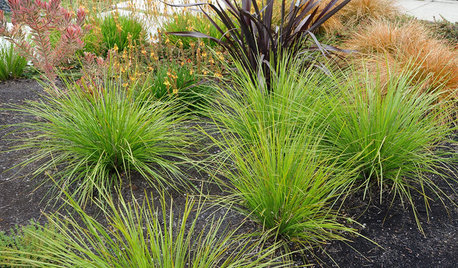
    Middle: 3-4 Mexican Feather Grass with Anigozanthos mixed in

    Back: I was thinking of a sage such as the Cleveland Sage and the hybrid waxflower.

    Around the edge I was looking for some succulents to mix in. One that I've read about that is native to CA and is very hardy is the Chalk Liveforever. Another would be Cotyledon orbiculata 'Cinderella' - Pig's Ear.

  • 10 years ago

    Heads up... I admire your efforts, but drought tolerant plants need a few years of REGULAR water to become established before you can expect them to get thru the dry periods. It doesn't happen overnight or in just a year.

    -Babka

  • 10 years ago

    I like the plants on you list. We are in zone 10b, Sunset 24 and have a few of the plants.

    Personally I love the Cleveland Sage. I grew up in an area adjacent to some wild coastal areas and the smell is nostalgic and quintessentially Californian. We plantedat our door so people coming can smell it.

    We also have the native California Sage which we bought at Rancho Santa Ana Botanical garden. It is thriving, last year it shot up a strange 5 foot tall flower stalk that lasted at least 6 months.

    We have tried all sorts of lavender and a few have died and a couple are thriving. I wish I could tell you which ones are doing well but I can't remember.


    A couple other non native but drought tolerant plants that are doing well in our garden are Lions Tail. I grew so fast we cut it all the back and it back in no time. Orange flowers.

    Rosemary doing great.

    Pride of Madeira are doing well (one is a little leggy but still very healthy). We haven't got the flower spikes yet. Hopefully this year.

    Feathery Cassia (our inexpensive Palo Verde look alike) is thriving. Lots of yellow flowers twice a year,

    No soil amending whasoever. Very little water (we use shower warm up water in the summer).

    What we didn't have luck with were Manzanitas. Tried three. All died.

  • 10 years ago
    last modified: 10 years ago

    I would not recommend the Mexican Feather Grass, it's pretty but has been found to be very invasive. They will end up taking over the area and are not super drought tolerant anyway.

    What you should be really after is "Low water use" plants, not drought tolerant. Gry_falcon is right, many of those don't look very good especially if they don't get much water.

    "Drought tolerant" can mean just that; it tolerates drought. It means they will live through a drought but it doesn't mean they look good doing it. Many will lose leaves or turn brown if they don't get enough water, they green up when rains return. Good trait in the wild, not so good in a commercial landscape. And if you try and keep them green and lush with more water they often die outright or are very short lived. Most natives fall in this category.

    And Babka is also correct in that you will get your water savings in a few years, not in the first couple as they all need normal watering to become established.

    Some I can recommend that are low water use and look good are;

    Lantana

    Rosemary

    Aloes and yucca (be sure to check the cold tolerance of what you get, some are frost sensitive)

    Salvia leucantha "Mexican bush sage"

    Dymondia

    Euryops (get leggy in 5-7 years but grow fast and are cheap to replace)

    Many dwarf pittosporums such as Pittosporum tobira "Creme de Mint"

    Senecio cineraria "Dusty miller"

    Erysimum "Bowel's Mauve"

    Festuca gauca "Blue Fescue"

    Limonium perezii "Sea Lavender"

    Nepeta "Cat Mint"

    Scaevola "Mauve Clusters"

    Carissa spp. "Natal Plum"

    Grevillea spp. (some newer ones are quite compact)

    Punica granatum "nana" "Dwarf Pomegranate"

    Rhaphiolepis indica "Indian Hawthorn"

    Mugo pine

    Many of the dwarf and shorter Phormiums, but beware some "revert" to the larger species when older, but the dark bronze "Jack Spratt" seems to stay small.

    A lot of these plants are very common. They also may seem boring and are in many commercial plantings. But that's for a good reason, they work, they look good almost all year, and are easy to find.

  • 10 years ago

    Damianita can get pretty ugly between blooming periods. It gets brown and needs to be cut back to revive it. Mexican feather grass is an invasive plant and should not be included. There are other grasses that aren't invasive, such as zebra grass or muhlenbergia. Natal plum has very scratchy thorns, so it may be a problem where the public would come into contact with it. Dudleya is a native succulent, but very hard to find, at least in Southern Ca. You can have a nice landscape with just succulents. Look at Debra Baldwin's books for ideas.

  • 10 years ago

    Nassela tennuissima has not been shown to invade wildlands in California. It cannot compete with native annual grasses. It is not listed as invasive by Cal IPC although they do list it as a weed. It also requires a very narrow definition of native to consider it exotic as it is native to western Texas. Natives can't be invasive by definition although they can be aggressive and N. tennuissima is definitely aggressive on disturbed urban soils like most pioneer species. It will pop up in every crack and crevice it can.


    It is also very drought tolerant. I don't know how it could be considered otherwise. I have some on a sandy south facing hillside that receive no supplemental irrigation that survived a 3" rain season and 4 years of drought.


    Now should you plant it? Probably not. While it looks great in the spring whe it is actively growing, once it sets seed, it looks like an old dirty troll doll. The seeds are like velcro and clump together. While this is great for the propagation of the species, it looks terrible. I have to rake it out periodically to keep it looking even halfway decent. It also needs a good hard pruning every fall to keep the spring growth looking its best. Plus it is short lived requiring careful cultivation of a mass if you don't want it to look awful in 4-5 years.

  • 10 years ago

    OK Nil13, you're right that by definition; a native can't technically be invasive. I meant that in a small area garden space it can take over by re-seeding and choking out other plants.

    I've seen where in parking lots Mexican feather grass (Nassela tennuissima) has jumped out of the planting beds and started growing all over the lot itself, in the cracks and especially alone areas where the water drains. And you're really right about it looking awful later in the year.

    As it is short lived, I think it's better in a meadow type setting where newly seeded plants can take over for the older dying out ones. Not good for commercial plantings. It is drought tolerant, but again one of those ones that look terrible while "tolerating" drought.

  • 10 years ago

    I've come to warn you about Lantana. It is drought tolerant, I'll give it that. But if the ones eternally invading my yard are representative, it's also fast-spreading, thorny, hairy/scratchy, makes you itch, reeks of cat urine, and is immortal. I've hacked down, dug up, and poisoned these things and they're back practically the next week. Save yourself.

  • 10 years ago

    Lantana montevidensis (in the original post) is sterile, so they do not spread by reseeding. There are also other cultivars that are sterile. I have used them often as a quick groundcover-filler, then easily pull them up when the permanent plants begin to fill in. I have never had a problem with them coming back.

  • 10 years ago

    I love feather grass- some of mine are years old. When they get seedy I just use a plastic 'fro comb' on them to comb out the seeds in clumps- it just takes a minute and then they look good again. They survive with NO water in the hottest tightest cracks between concrete steps and bricks. Once in a while i find a tiny baby somewhere else and just move it to where it's wanted- not invasive at all on my property.

    And I love "Little Lucky" dwarf lantana in pots. It bloomed all summer.