Software
Houzz Logo Print
gardesaccount

What nut tree should I plant?

10 years ago

Hi everybody,

I'd like to plant a nut tree in New York. Does anyone here have experience with that?

Here are some considerations:

Almond

Chestnut

Chinquapin

Hazelnut

Hickory

Pecan

Walnut

Some of these might be too big but I suppose they could be controlled with pruning.


Comments (32)

  • 10 years ago

    If by too big you mean wide, then a shagbark hickory would be my choice. How do you define "too big"?

    tj

    Garde thanked tsugajunkie z5 SE WI ♱
  • 10 years ago
    last modified: 10 years ago

    New York city, or state? Walnut, Hazelnut and Hickory would probably the toughest and most reliably hardy in New York. Not sure you can grow Almond there. Chestnut is prone to disease. Hazelnut is the smallest if you don't have space. Pecan, Hickory and Black Walnut are natives.

    Garde thanked edlincoln
  • 10 years ago
    last modified: 10 years ago

    There has been some mention of Black Walnut here and there. edlincoln, are you growing them for wood? Or for selling for people wanting them for their wood? Or is the fruit edible?

    Garde thanked tete_a_tete
  • 10 years ago

    How big a space will the tree have available? Chestnut gets huge, even the hybrids are pretty big. Chinese hybrids don't take the blight, and are smaller and more bushlike.......but still large. Black walnut is large too, and can be brittle if exposed in a windy location. Hazels come in tree form and bush form, the bush type being about 15 feet tall for the largest.

    Garde thanked jocelynpei
  • 10 years ago

    Have you researched the climate (minimum and maximum temperature), and pollination requirements of any of these types of trees?

    You Cornell Extension service should have plenty of information for you.


    Garde thanked rhizo_1 (North AL) zone 7
  • 10 years ago

    I'm growing a few Black Walnut as decoration/screening/wildlife/windbreak trees. I figure edible nuts are a bonus. The nuts are perfectly edible...the only reason they aren't grown commercially for nuts is they are harder to crack and a bit more likely to get bugs in them. I hadn't heard they were brittle where wind was concerned...one reason I'm growing them is wind resistance. I can't deny they get huge. Pecan and hickory do as well.

    Hazelnut would probably be the easiest to prune to a small size.

    How much space do you have to play with?

    Garde thanked edlincoln
  • 10 years ago
    last modified: 10 years ago

    I have a definite bias towards hazels, trazels, filberts et al. - lovely trees. useful young timber, catkins, nuts, and in a limited space, would always be my top nut choice. If I was thinking walnut, guess I would be thinking about the more precocious Broadview, Buccaneer varieties, or maybe Franchette or Lara.... not really wanting to wait for years for nuts.

    Garde thanked User
  • 10 years ago

    do you have any idea how many decades it MIGHT take.. before you harvest a single nut???


    how big is your lot or garden??


    ken

  • 10 years ago

    Nut trees don't take all that long, ken.

    Garde thanked rhizo_1 (North AL) zone 7
  • 10 years ago

    I will reply with more details about the location as soon as I figure that out. Thank you in the meantime for these very detailed, helpful replies.

  • 10 years ago

    i am glad you can intuit.. on an undecided named tree... and make such a blatant comment ... besides not knowing.. size.. type of transplant... planting.. aftercare ... etc ...


    some will come sooner.. some will come later ...


    i wonder how OP doesnt know where he is going top plant this thing.. you either have a property... or you dont


    ken

  • 10 years ago

    Ken, please refrain from posting on my discussions if you can manage that. Everyone else here has managed to provide useful replies without writing in a lazy, rude way. Thank you again to everyone else.

  • 10 years ago

    I'm in the windiest province in Canada, so black walnut get shredded here if exposed. That might not be the case for other locations. Take whatever advice you get with the location of the reply in mind. Here, we get minus 25 C. and lots of wind, so what grows here must be cold hardy and windfirm, and able to keep its first year twigs alive in cold, dry winds. You might be quite different than I am, locationwise. Having said that though, hazels grow well here, and american chestnut and its hybrids (no blight here yet), heartnuts, butternuts and Carpathian walnuts, even black walnuts if out of the wind. Beech is not quite as large and the nuts are tasty, even chinkapins might grow, small nuts on a mostly bushform tree.

    When you find out more about your coldest/warmest temperatures, rainfall amounts, winds, that kind of thing, let us know and we'll all suggest stuff.

    Garde thanked jocelynpei
  • 10 years ago

    A Broadview walnut (in the UK), bred for precocity, will be producing nuts within 4 years...so I think, with careful selection, The wait for productive capacity need not be such a huge criterion in selection - certainly less important than soil, climate, size etc.

    Beech, once grown for pig forage, would probably not be my choice given the unpredictability of mast years...but hickories have recently appeared on my radar - as timber trees as well as nut bearers. Very interested in the possibilities but largely experimental, whereas a little filbert is always a joy.

    Garde thanked User
  • 10 years ago

    jocelynpei : I just planted Black Walnut in a very windy coastal area. Not nearly as cold as you, but very windy. You've worried me a bit.

  • 10 years ago

    Windy is relative, grin. We are at the head of a river valley, and if the wind is on shore, it will blow over the drumlin just inland of the shore, and then scour down the valley. You might be OK, play it by ear? Any tree with a broad, spreading crown will have trouble with 120 to 140 km/hr winds. If it's 90 km/hr at the airport, it will be a bit more than that here, with an on shore wind. I don't know what Hurricane Juan was at the airport, but it made very tiny toothpicks of two black walnuts here. Just partial trunks left of each, sigh.

    Try them at your place and hope for lesser winds?

  • 10 years ago

    Seguin chestnuts are supposed to stay fairly small for a chestnut: http://www.burntridgenursery.com/SEGUIN-CHESTNUT-Castanea-seguinii/productinfo/NSCHSEG/

    I have one in my yard that's growing nicely so far. We'll see how it handles our MN winters; it's currently -10F outside.

    Garde thanked nick_b79
  • 10 years ago

    Garde, generally speaking, what is your NYS location? There's a big difference between say, most of NYC, compared to Rochester or Tupper Lake.

  • 10 years ago

    I don't know the precise location yet; however, I plan to donate them to a community garden in NYC which has expressed interest in adding nut trees. It sounds like a couple of hazelnut trees may be the way to go.

  • 10 years ago

    Garde, read the descriptions carefully if you are looking at hazelnuts. Here, the native American hazelnut, Corylus americana, is a shrub, not a tree, so if you honestly want a tree, perhaps you should check out Campanula's UK filbert which sounds like it's actually a tree. American hazelnuts are suckering and so will slowly take up expanding territory, and mine reach perhaps 6 feet tall. According to what I've read, they need more than one clone to produce well, and I've only ever harvested a very few since the squirrels and chipmunks like them.

  • 10 years ago

    Solid advice, NHBabs and, as rhizo_1 also suggested, I'm reading up on hazelnut pollination. My research has only just begun but the cultivars Yamhill and Jefferson sound good and Eta as a good pollinator. I appreciate the firsthand experiences and other knowledge shared here.

  • 10 years ago

    Yamhill is tasty with slight chestnut notes to the flavour when fully ripe. Turkish tree hazel grows like a birch tree, definitely a tree. The nuts have a harder shell, but also tasty. C. heterophylus based tame hazels are tall bushes, up to 15 feet.

    C. americana based ones, and even the C. cornuta based hybrids are bushes. Whinkler, here, is a mid sized bush, and it's a selection out of american hazel. Het 3 is a large bush. Grimo 186-M is a large bush that can be pruned to a tree shape....but stays to about 12 feet or so. I'm in the Gulf of St Lawrence. (eastern Canada)

  • 10 years ago

    One more thing, it has been 30 years since I grew hazels and gave up on them after finding none for here were catkin hardy or able to resist the blight. I only got back into them in a small way in 2012......so look up anything I say, in case memory plays tricks on me.

  • 10 years ago

    I grow mostly filberts and cobnuts, never really having had room for a Turkish hazel - it would be helpful to know what you were looking for - primarily nuts? Both c.avellana and c.maxima are relatively neat little trees - mine do tend to be multi-stemmed though whereas the trazel, c.colurna can get to a large size. I have a couple on order for the woods (dithering because the weather has been wet wet wet). And there are some gorgeous red-leaved variety, including a recent red;leaved filbert, c.maxima (can't recall varietal name) which has terrific catkins and good nuts. True, pollination can be an issue but tbh, they all seem to have a degree of self-fertility. I had never eaten fresh cobnuts till I grew my own and was astonished at the revelation of sweet, milky, tender flesh. Rampaging squirrels does mean netting though - an annual lark which I do not enjoy.

  • 10 years ago
    last modified: 10 years ago

    'Here, the native American hazelnut, Corylus americana, is a shrub, not a tree, so if you honestly want a tree, perhaps you should check out Campanula's UK filbert which sounds like it's actually a tree.'

    Ah, you have solved a mystery for me, NHBabs. My mother was talking about hazelnuts the other day, describing them as shrubs. Yet the one and only hazelnut that I knew (and she knew it too) was a tree, no doubt about it, in the back garden of a house that we lived in for a year in England. (Decades ago.) (She tends to have a selective memory, my mother, when she gets a bee in her bonnet. And she'd become fascinated with the new-found knowledge that truffles grow not only at the base of some oaks, but hazelnut too.)

    We don't grow oaks or truffles or anything but sometimes I dream of such things.

  • 10 years ago

    The native English hazel, Corylus avellana, is grown as a shrub and frequently was, and sometimes still is, coppiced. So it is usually seen in a multi stemmed form. However, if left unpruned it will form a small tree. But nothing like as big and chunky as C colurna, which I first discovered as a street tree in Kensington. A few have recently been planted in streets where I live.

  • 10 years ago

    So the English ones are trees and the American ones are mostly shrubs?

  • 10 years ago

    Not exactly - since most of the C avellana in woods here have been coppiced at some time in the past or browsed by deer they tend to be multi-stemmed. Only if neglected do the grow into small - trees and they are still usually multistemmed since the plant tends to sucker. afaik C americana behaves the same way. But I don't know that for sure.

  • 10 years ago
    last modified: 10 years ago

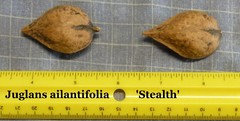
    Heartnuts are real nice trees, too. They're the size of Persian walnuts. Juglans ailantifolia is the Genus/species.

    Grafted varieties are the way to go. Grimo Nut Nursery in Canada has some real nice cultivars.

    These are photos of heartnuts from Grimo:

    J.ailantifolia 'Campbell CW-1'


    J.ailantifolia 'Imshu'

    J.ailantifolia 'Imshu'

    J.ailantifolia 'Locket' - one I would choose

    J.ailantifolia 'Simcoe 8-2' - This is the other I would choose... personally.

    J.ailantifolia 'Stealth'

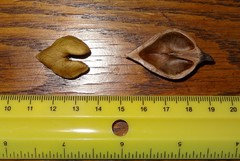
    J. ailantifolia 'Stealth'

    You will need two different cultivars for pollination. Heartnuts are Japanese walnuts. The nut meat is very tasty like Black walnut vs. the more dry flavor of Persian walnuts. To crack them you set them sideways (as is shown on photo 2 of 'Stealth'/'Imshu') and tap them with a hammer (if you don't have a strong piston type cracker.) They make a "snap" sound and the nut separates in half or putting your fingernails between the suture line will open them up "super easily" and the nut meat falls right out, literally. This is the nut meat of a heartnut:

    Above is 'Fodermaier'. A friend has an old tree growing close to my home.

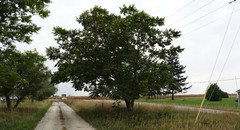
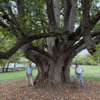
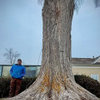
    Here is a very old specimen of a Heartnut tree. My friend's 'Fodermaier' that's 35-40 years old:

    They would be a great tree, set of trees... for a community garden. They have semi-large leaves that make them very attractive. The climate of New York City would be ideal for them, as-well. Remember though... you need grafted varieties to ensure what you're getting. A seedling heartnut could turn out to have a nut that isn't heart-shaped. And, grafted-trees ensure you get nuts that when easily cracked, the nut meat falls out very easily.

    Dax

  • 10 years ago

    They make really GOOD nut butter too. (Heartnuts)

  • 10 years ago

    They have a lot more oil than Persians that's why I compare them more toward Black walnuts, so... I can see why they'd make good nut butter too. And they aren't as strongly-flavored as black walnuts. They're the perfect walnut in my opinion.

    Good to hear Jocelyn, thanks for the tip!

    Dax

Sponsored
Peabody Landscape Group
Average rating: 3.5 out of 5 stars8 Reviews
Columbus' Reliable Landscape Design & Contracting