Software
Houzz Logo Print
talley_sue_nyc

Which worktable for my small projects?

10 years ago
last modified: 10 years ago
I only do small stuff occasionally, and I live in an apartment. I have to work in the passageway, or the living room, or basement, etc. And everything needs to store away.

I got a battery-powered circular saw (Ryobi One+), and I need a worktable for cutting things with it. I'm only really going to be cutting smaller pieces of wood; any ripping will probably be done at the lumber yard. I'll be working w/ scraps, or molding, or something like that.

I want to be able to clamp the wood very securely before I cut.

I was going to try to jury-rig a support by attaching 2x3s on edge to the top of a plywood platform, and then clamping that to a small table. And set the wood on the 2x3s as if they were sawhorses, and position things so that the cut line is between the 2x3 supports, and the blade of the saw comes out of the wood in the gap between them.

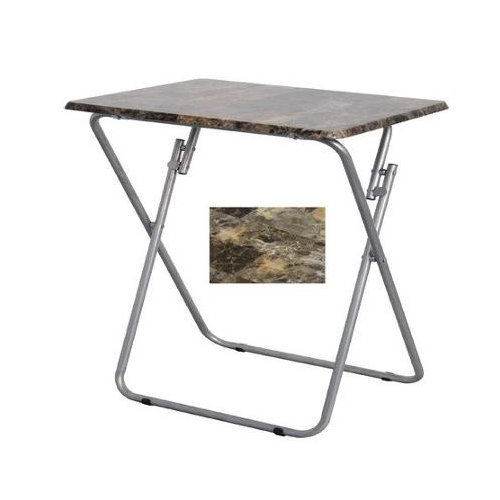
I have the 2x3s, the plywood, and the tray table. The table is pretty sturdy; I use it as my sewing machine table, and I set the machine right near the front edge. My only worry about stability is whether it would be too easily jostled because it's not heavy. And, of course, the corners of the legs are rounded, so if I were applying much pressure at the side edges, it might roll.

So picture this below, but w/ a plywood thing w/ 2x3s on top of it.

But then I saw these:

B&D's Workmate 125, $30

(their smallest). I like that it serves as its own vise

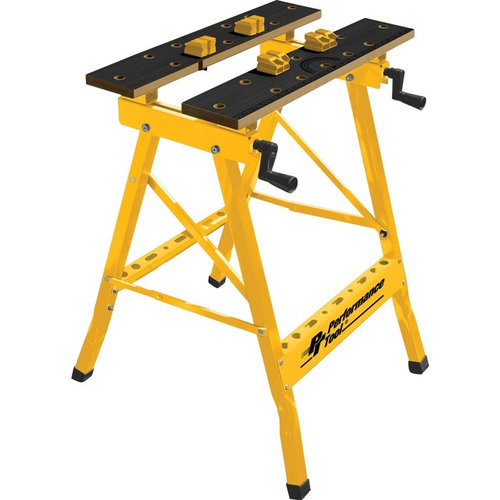
the Performance Tool bench, $38

(I can't tell for sure if this becomes a vise or not--but I think so)

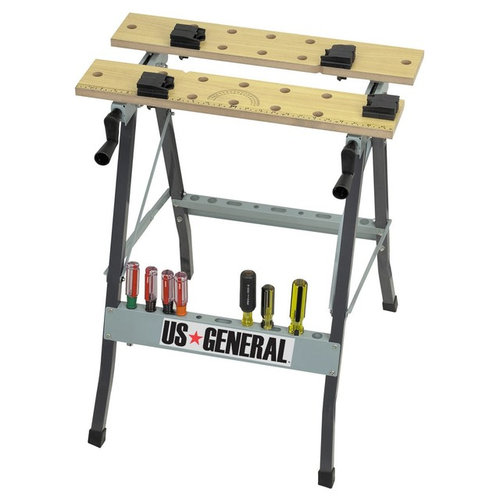
Harbor Freight's version from U.S. General, $20 on sale

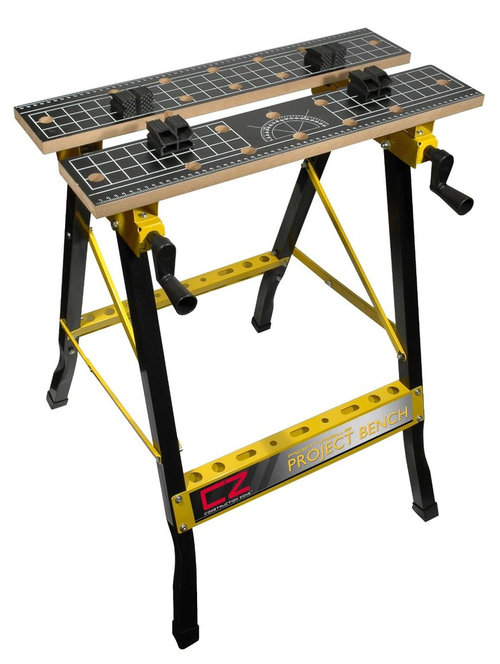
and Construction Zone


What do you think?

They seem lightweight, but they're pretty popular. They look like they'd be stable enough; the Performance Tool page on Amazon shows someone cross-cutting wood off the end of the bench. (That would be a worry for me--whether they would tip under the weight of the saw.)

http://amzn.com/B002UBPZIE

Got any input?

(I have no idea how to use the little knobby things that go in the holes.)

Comments (21)

  • 10 years ago
    last modified: 10 years ago
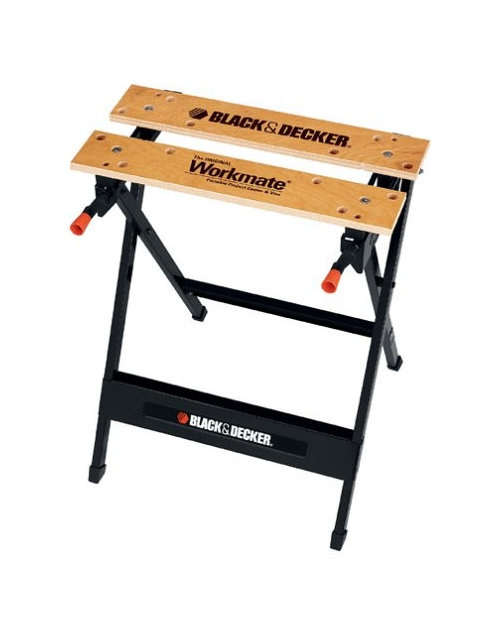
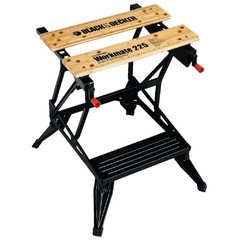
    Then there's the whole "Should I round up? Will I get enough extra value, really, for the extra money?" question, bcs B&D makes an entire line of these things. But I don't really want to spend the most amount of money. This is the next one up.

    What's the advantage of the step on this one? Would I end up tripping on it?


    Oh--It's for putting your foot on to help anchor the worktable (I found a U.K. video about a larger version).

  • 10 years ago

    I have two of the Workmate 225 types(much older than those). the ability to put one's foot to hold it down is necessary sometimes.

    The others are more cheaply made and flimsy.

    talley_sue_nyc thanked User
  • 10 years ago

    Depending on your location, you can often find them at garage sales. I believe any of them would be an improvement over your trey table.

  • 10 years ago

    Thanks for the tips! I was trying to think what I'd used the last time I cut wood w/ my jigsaw, and I remembered that I'd just clamped the wood to a classroom-style chair with a hard, thick seat! We still have that chair.

    But I think I'd like something dedicated.

  • 10 years ago

    I have "vintage" workmate (model 400, I think) but use it mostly to hold my miter saw. I was doing some planing on one last weekend and definitely needed to hold down with my feet. A friend of mine has one of these and is very happy with it. Menards, if you are near one, has them on sale once in a while.


    Keter work station

    talley_sue_nyc thanked bobismyuncle
  • 10 years ago

    I also have a vintage Workmate 400 that has held up through 30 years of home improvement and shop projects. I still pull it out whenever I need a bench outside the shop. I finally invested in a real portable miter saw station, but until recently it always served that purpose for me. Yes, having the vise to hold work or tools is incredibly useful. It's not heavy enough for serious planing, but way better than nothing! I would not want it to be lighter duty than the one I have.

    talley_sue_nyc thanked rwiegand
  • PRO
    10 years ago

    I have never cared anything for workmates or their ilk. I thought I had replied to this earlier, but I would recommend a set of folding stanley sawhorses, and a hollow-core door slab as a work surface. It breaks down and stores in a small area, and sawhorses are more versatile than a workmate, as you can make a table 8ft long with a piece of plywood or mdf. The sawhorses adjust in height from 27-36 inches, so you can match the heights of other surfaces, find a comfortable working height, etc.

    talley_sue_nyc thanked Sombreuil
  • 10 years ago

    I have the performance one which works well, however the vise handles are cheap plastic, and one broke off.

    talley_sue_nyc thanked sloyder
  • 10 years ago

    As always, Casey is right on with the slab and sawhorse suggestion. That's always my primary jobsite worktable. The clamping top on the workmate however has often shown its worth. I probably never would have bought one (it was a gift from my dad), but since I have it I use it, and it has been quite useful, often easier than fumbling with clamps to ancho the top to the sawhorses and then the work to the top.

    talley_sue_nyc thanked rwiegand
  • PRO
    10 years ago
    last modified: 10 years ago
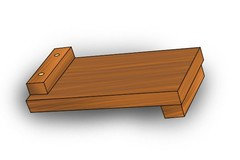
    The handiest little helper jig (the bench hook) for a benchtop; a very ancient idea:

    The lower lip grips the bench, the backstop catches the workpiece, and it keeps the top from getting sawed into.

  • 10 years ago

    Sombreuil, the sawhorse solution is too complicated--and too large. You think it folds up flat--but that's TWO sawhorses, PLUS a door, and I have to get them out and put them away every single time.

    And I guess you've worked with it, but I don't see how a hollow-core door is any less flimsy than one of these. Doesn't it slide around on the sawhorses?

    Oh--I see rwiegand says you clamp the door to the sawhorses. What a pain! And, it isn't really any heavier, is it? I guess it's got two sets of supporting legs, for some greater stability.

    I don't need a worktable 8 feet long. (I don't have ROOM for a worktable 8 feet long.) I just need to be able to cut boards that are anywhere from 6 inches long to, oh, 48 inches long. That's all. I don't need a full workshop setup, or anything close to it.

    And I saw the bench hook--but I don't understand how you use it.

    My idea was to clamp the wood to the workbench, hanging just slightly off the edge or over the middle gap, so it can't move around, and cut, with both hands on my saw. How does a bench hook factor into that?

    i'll have to go look on YouTube, but if anybody has any info that, I'd love the help.


  • 10 years ago

    I love all the stories of the vintage Workmates, but most of the reviews on Amazon point out that the new ones are much flimsier. "Considering what you pay, they work well enough, but they're flimsier," is that the trend seems to be.

  • 10 years ago

    Here's another option (last two plans in the list). I saw this in person a few weeks ago. It's used by a furnituremaker / contractor that does a lot of work onsite. TYou can use it as two sawhorses (low, for hand sawing) or for a high table for detail work, planing, drilling, etc. http://www.woodchoppintime.com/free-plans/   It's designed to be made from a few tools and home center lumber. I think the "I Can Do That" video on its construction has gone behind the paywall, but might be worth the few dollars to see it.http://www.woodchoppintime.com/free-plans/

  • 10 years ago

    I'm such a gadget hound, and I absolutely love homemade jigs. I'd love to make my own table.

    But I'd probably need one of those tables above just to -make- one of these.

    I have a ton of "make your own folding workbench" plans on my Pinterest page. But I'll have enough trouble getting around to an actual project for my home; if I try to make the workbench, I'll never get to the real project.

    But I love looking at the plans--thanks for the link!


  • 10 years ago

    You might consider looking at some the woodworking magazines, they have all had many plans for work benches and tables over the years. Another simple idea might be one of the folding "banquet" tables topped by a sheet of sacrificial particle board or MDF cut to the appropriate size.

  • 10 years ago

    The "sacrificial" top on an existing table is part of what I was going for w/ that oversize tray table (it's pretty big; about 3/4 the size of a card table).
    I don't have room anywhere for a table as big as a banquet table. I have to work in the passageway, or in the living room. I've put a banquet table in the living room, at Thanksgiving, and there isn't much room to work. Plus, I'm only cutting one piece of wood at a time, and it's not a large piece.

    But I suppose I could just get a sheet of particle/MDF instead of making some fancy thing w/ 2x3s. As few cuts as I would probably make (what--48 in a year, maybe?), it would take a while for that sacrificial top to become ruined. I could shift the board I'm cutting around from place to place, turn the board end to end, flip it over....

  • 10 years ago

    Years ago, when I was first getting really serious about woodworking I made a European Cabinetmaker's Bench per Tage Frid's plan. I found it a great exercise in that it included mortise and tenon in a variety of variations, dovetail, rabbet, groove, straight cuts, curved cuts, and just about any fundamental woodworking task you can think of. Still use it regularly. But yes, bootstrapping is always an issue -- how do you make something as complicated as a bench without a bench?

    Popular Woodworking Magazine has been a little obsessed with workbenches of various sorts over the last few years. You might check out their site for some other ideas.

    Of course, portable and fold down sort of work against what you want in a bench -- heavy and rock-solid.


    > talley_sue_nyc quote:

    I'm such a gadget hound, and I absolutely love homemade jigs. I'd love to make my own table.

    But I'd probably need one of those tables above just to -make- one of these.

    I have a ton of "make your own folding workbench" plans on my
    Pinterest page. But I'll have enough trouble getting around to an actual
    project for my home; if I try to make the workbench, I'll never get to
    the real project.

    But I love looking at the plans--thanks for the link!

  • 10 years ago

    I think some of my links are from Popular Woodworking Magazine.

    And yeah, bobismyuncle, you're right--the two things (portability and stability) are sort of on opposite ends of the spectrum.

    I saw this really great video on YouTube of a guy in England (I think, by his accent) who customized a small Workmate w/ all sorts of jigs, etc., and he screwed his to the floor. (I don't see how you could screw any of these above to the floor--and I can't do that anyway, of course).


    That's why that silly chair worked as well as it did--it was actually sort of heavy (had a resin seat and back, substantial metal tubing for the frame...). But it was an awkward height (too low), and hard to clamp to (the seat wasn't flat; I was often afraid that I'd break the resin seat).

  • 10 years ago

    Oh, speaking of sacrificial tops:

    There's a video from Family Handyman (I think) about how to make a jig for ripping plywood, and the editor in the video says he just lays one of those big sheets of rigid pink insulation on the driveway, and puts the plywood on it. He said, "It will take a while for the cuts that get made in the insulation to ruin it enough that you need to replace it." I don't remember how he clamped his jig to his plywood; maybe the ends of the plywood sheet stick out just a little bit beyond the pink insulation.

    I thought about getting one of those insulation sheets to use as a sacrificial top, but I don't know if I could clamp with it in the middle.


  • 8 years ago

    AN UPDATE:

    My husband made the discussion moot--he bought me the smallest Workmate for Christmas in 2016. I didn't get time for any projects until just recently, so I put it together and used it to make a few small things. It works really well!

    It is lightweight, but that turned out to be a good thing, because I had to carry it around a lot (we worked outside in my niece's apartment-building parking lot).

    I'm glad of being able to clamp both sides of the cut to the table, so I can have both hands on my saw.

    And the size is great for storing in my overcrowded storage closet. It sets up and breaks down quickly, which is important in my apartment-living setup.