Software
Houzz Logo Print
cynthiamatte

Positive,Negative or zero reveal for my undermount sink.

13 years ago
I am having my fabricator coming next week to do a template of my countertop. I was reading that I will have to make a decision regarding the sink and whether I want a positive, negative or zero reveal. I don't know which option to chose. Has anyone recently had a new undermount sink installed and were you happy with your decision? Please provide pictures if possible. Thanks!

Comments (47)

  • 13 years ago
    The kitchen in the house I bought has a large L-shaped section with a Corian top .. and the double sink is part of it. I would never do that again; if the sink begins to look worn, I don't know how you'd replace it. I replaced the countertop & sink in the master bathroom; the sink is undermount and I like that better than having a lip above the countertop.
  • 13 years ago
    As to the "reveal" question - I'm guessing, but I think it means how much of the sink lip will be seen. Positive would be some showing, negative might be a overlap of counter, and zero would be flush? Good luck.
  • PRO
    13 years ago
    last modified: 13 years ago
    We typically overhang the counter 1/8" inboard of the sink edge. Sinks, expecially cast iron and porcelain vary from the templates provided. It is advisable the countertop fabricator has the actually sink on hand if you chose one of the other reveal relationships.
  • 13 years ago
    I think ours would be described as either zero or negative reveal--probably the 1/8" that lewis + smith describes as standard. I like it this way because when I wipe crumbs or liquids off counters into the sink they fall straight to the bottom rather than scattering against the sink wall. It's a small point, but the ease of wiping off counters is one of the things I appreciate most about an undermount sink in general, having had an overmount one for years and hated the bump at the edge.
  • 13 years ago
    Thanks all for your responses. I think that the zero reveal is the one I will go with. Feeny, your comment about ease of keeping sink clean made up my mind.
  • 13 years ago
    We had a zero under mount stainless steel done in our kitchen and I love it! Looks very nice, and no rim means easy cleanup.
  • 13 years ago
    Thanks 2irishwoman. Had the fabricator template my countertop this past weekend. Chose the zero reveal with an 1/8 inch overhang. Installation is in a few weeks. i appreciate all the good advice I received which made the process much easier.
  • 9 years ago

    Yes, you are correct. A negative reveal is when the countertop extends over the edge on all sides of the sink. For a zero reveal, the countertop meets the edge of the sink and fits flush with sink bowls.

  • 9 years ago

    So I understand the zero, negative and positive reveal. Not sure if you can answer this, but Im confused on the difference between an under mount and a drop in farm / apron sink. I want an apron sink with a positive reveal.. Do which would I be looking for, an under mount or drop in?

  • 9 years ago

    I have a quartz counter top and an under mount sink with a slight positive reveal--the exposed sink rim is slanted downwards, about 1/8th of an inch. With the slant, anything wiped off the counter into the sink would not rest on the slanted sink rim. I think you are looking for an under mount apron sink, because reveals are not applicable to drop in. In other words, zero, negative and positive reveals are applicable to under mount.

  • 9 years ago

    I thought it was bad when I didn't understand televisions anymore. Now I don't understand sinks.................

  • 9 years ago

    hahahahaha, love it.

  • 9 years ago

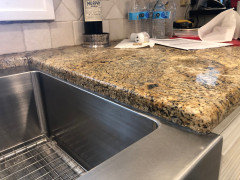
    I gave my sink template to the quartz counter fabricator. Here is a photo of my under mount sink with a positive reveal--about 1/8th inch of the slanted sink rim is exposed. With the slanted rim, any food, liquid wiped off the counter does not sit on the slanted sink rim.

  • 5 years ago

    Hey karencwon, do you see any benefit to having what you have 1/8" positive reveal versus zero-reveal (flush)?


  • PRO
    5 years ago

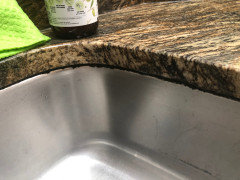
    A negative revel makes a hard-to-see-and-clean crud ledge. A flush reveal can make an elongated silicone joint that will fray, catch crud, and turn black:

    A slight positive reveal makes both of these impossible. No maintenance, no mildew, no crud, and you can see it's clean with your own eyes.My customers get a slight positive reveal or their money back.

  • 5 years ago

    Joseph, I wondered about the coloring of the silicone over time....with a zero-reveal (flush). Do you feel that with a slight positive reveal that you see the silicone less? I'm asking that b/c your pic seems to suggest that.

    .

    I figured that flush (zero-reveal) was best....but you're saying otherwise. The fabricator today said they would do flush, but you're making me think I should call them first thing tomorrow.


  • PRO
    5 years ago

    " Do you feel that with a slight positive reveal that you see the silicone less?"


    I promise you'll see the silicone less. There is virtually no exposed silicone with a slight positive reveal. because it's the only way you make a crisp distinction between the sink flange and the bottom of the stone.


    I'd call them first thing. Fabricators love negative reveals because they don't have to be as accurate.

  • 5 years ago

    are you talking 1/4" or 1/8" positive reveal? Which is best? Appreciate your advice. I know you've seen a lot out there. ;-)


  • 4 years ago

    OK Joseph, my husband is a by the book guy, so what are your dimensions for a slight positive reveal? Thank you in advance, wish you are in Houston!!!!

  • PRO
    4 years ago

    Kath:


    I spent last weekend in Houston.


    A slight positive reveal depends upon the radius between the sink wall and the sink flange. A Kohler Whitehaven has about a 3/4" radius, an undermount stainless steel has about 1/8", so the slight positive reveal for the Whitehaven will be much larger than the slight positive reveal for the stainless undermount. Begin the reveal at the end of the radius.

  • 4 years ago

    So Joseph for a stainless steel undermount farmhouse sink, with a mounting flange radius of 1", the reveal will be 1/8", (Kraus KH410-30), correct? It is very hot in Houston right now as it has been, hope you did not melt too much! My husband thinks the reveal should be 3/8, but I strongly disagree. :)

  • PRO
    4 years ago

    Strong 1/8" reveal on that sink please.

  • 3 years ago

    Joseph
    What kind of reveal would you do with this sink: KRAUS KBU32 Premier 32-inch 16 Gauge Undermount 50/50 Double Bowl Kitchen Sink with Smart Low Divider https://a.co/d/10cXkkp

    Quartzite countertop

    Thank you!

  • 3 years ago

    KRAUS KBU32 Premier 32-inch 16 Gauge Undermount 50/50 Double Bowl Kitchen Sink with Smart Low Divider https://a.co/d/10cXkkp

  • PRO
    3 years ago

    I'd do a slight positive reveal for reasons mentioned previously, plus it protects the bottom of the stone from chipping; the others do not. Test the quartzite for silicone bleed, please.

  • 3 years ago

    But won't that slight 1/8" reveal ledge be a crumb catcher and won't debris get caught in that 1/8" reveal ledge and under the countertop? Genuine question. (I've had an overmount sink my entire life and never worried about anything!!).

  • 3 years ago

    The 1/8” positive reveal ledge is slanted to the basin. This means the sink edge is exposed and extends 1/8” beyond the counter. A positive reveal prevents debris getting caught.


    A negative reveal is the opposite of a positive reveal, the countertop hangs slightly over the sink edge, hiding the sink rim completely. The counter ledge’s exposed underside can attract mold.


    I know what you mean, it was a learning process for me to understand my sink mounting options!

  • PRO
    3 years ago

    "But won't that slight 1/8" reveal ledge be a crumb catcher and won't debris get caught in that 1/8" reveal ledge and under the countertop?"


    No. I've probably installed a thousand sinks this way and have never gotten that callback.

  • 3 years ago

    Do I want a 3/8” positive reveal or 1/8” positive reveal?

  • PRO
    3 years ago

    1/8".

  • 3 years ago

    Joseph Corlett
    Please advise on installation of the sink below. (Positive reveal, edge cut for soapstone or granite, etc.)

    Create Good Sinks 39" Apron Front, Workstation Sink
    https://www.creategoodsinks.com/collections/apron-front-sinks/products/39-apron-front-workstation-sink-double-bowl-large-bowl-left-5lad39c

  • 3 years ago

    evierh - I apologize for stealing Joesph away from your post.

  • 3 years ago
    last modified: 3 years ago

    I like a positive reveal; however, a zero reveal requires precision in the cut. So, it is not true that it doesn't. With reveal you have a little wiggle room, you may not notice that the "ledge" is not perfectly even. To get the counter as perfectly flushed as possible with the sink requires a higher accuracy in cutting.

  • PRO
    3 years ago

    TJ:


    I just saw your request. I'd advise a slight positive reveal.

  • 2 years ago

    Joseph Corlett Have you ever done a positive reveal on the front and back, with a negative or zero reveal on the sides?

  • PRO
    2 years ago

    If so, it would be due to circumstances beyond my control such as the size of an existing sink cutout.


    I have turned non-ledge sinks into workstation sinks by installing a larger front and rear reveal.

  • 2 years ago

    Thank you for all your insight Joseph regarding positive reveals! I'm jumping in with a question too. Can a slight postive reveal as you recommend be as small as 1/16th? What would you say this positive reveal is?


    I am wanting a minimal reveal for an Elkay workstation sink (similar to photo above) for the sliding accessories to not be hindered. However, my sink hasn't a perfectly straight edge. It protrudes more in the middle than on the ends when I place a piece of quartz on it to simulate the reveal.. Would 1/16th (if that is what is in above photo) be enough.? Recommendations? Are there ways to hide the bulge?

    Here's my sink:

    https://www.build.com/elkay-efru30169rtwc/s1736858?uid=4109182


    Thanks in advance!

  • PRO
    2 years ago

    "Can a slight postive reveal as you recommend be as small as 1/16th?"


    Yes.


    "What would you say this positive reveal is?"


    Looks to be about 1/8" to me.


    Go with a strong 1/8" please. You'll never see the bulge.

  • 2 years ago

    Love that sink! Can you tell me if it has rounded inside corners for cleaning? I don’t see the information on the specs.

  • 2 years ago

    Yes it does!

  • 2 years ago

    Thank you Joseph!

  • PRO
    2 years ago

    I wrote a blog about this issue a while back. Some may find it helpful. How to Properly Cut a Countertop for and Undermount Sink.

  • PRO
    2 years ago

    "The revealed flange will now have water and debris sitting on the grout line, causing degradation of the caulk. What you see below is a common situation. The flange was used as a top tier and water sits at the grout line. In this case, and others I have seen, mold grows. The exposed flange can collect dirt and grime, requiring regular cleaning. If you zoom in on this photo, you can see the mold in the grout."


    Dino:


    Respectfully, what you're showing is fabricator error causing failing caulk. Any sink with any type of reveal that has black/brown crud is leaking. Sinks leak because fabricators use leaking blocking or clips to secure sinks instead of a strap system. Strapped sinks don't have failing caulk lines that get contaminated by leakage because the sink is constantly pushed against the stone bottom which clips and blocking can't do.


    I've done a slight positive reveal on thousands of undermount sink installations and have never gotten this callback. You could let water and crud sit on that reveal for a month or two and the silicone isn't going to contaminate. It can't happen. How much water and crud can fit on 1/8" anyway? The silicone doing the waterproofing work is between the stone bottom and the sink flange, unexposed.


    The problem with the flush reveal you advocate for is a possible elongated silicone joint. As the bottom of the top and the sink flange curve, the silicone joint becomes thin to infinity. This thin silicone joint quickly frays, catches water and crud, and turns black and contaminated as I showed in my previous picture. This is not the first time I've seen this.


    There is no better and tighter joint than a slight positive reveal.

  • PRO
    last year

    Karen and Joseph,

    "The 1/8” positive reveal ledge is slanted to the basin. This means the sink edge is exposed and extends 1/8” beyond the counter. A positive reveal prevents debris getting caught"

    and "Elongated Silicone Joint"

    I have a hard time understanding what that means. Do you think you can provide a sketch?

  • last year

    My Elkay ELUHH3017TPDBG Lustertone that i bought calls for a 1/2" positive reveal or a negative reveal. Could I do a 1/8" reveal instead? https://www.elkayfiles.com/care-cleaning-install-warranty-sheets/1000005239.pdf

Sponsored
Bella Casa LLC
Average rating: 5 out of 5 stars17 Reviews
The Leading Interior Design Studio in Franklin County