

Pseudolarix amabilis
I've done several posts about this tree now, but it's just because I want one so dang bad. I know at one point Forestfarm had them in the tubes, but currently they're out of stock. In early winter I got some seeds from Sheffields, but out of the 25, only about 10 seemed viable, and I managed to not have any success with them. So does anyone know where I can find a nice, small Pseudolarix amabilis that won't break the bank? Thanks.
Kyle
Comments (34)
Related Professionals
Atlanta Landscape Architects & Landscape Designers · Saint Cloud Landscape Architects & Landscape Designers · Logan Landscape Architects & Landscape Designers · Ogden Landscape Architects & Landscape Designers · Amherstburg Landscape Architects & Landscape Designers · Hot Springs Landscape Contractors · Brunswick Landscape Contractors · Portsmouth Landscape Contractors · Altoona Landscape Contractors · Kalispell Landscape Contractors · Bend Landscape Contractors · London Landscape Contractors · Morgantown Home Builders · Eau Claire Home Builders · Sheboygan Home Builders 10 years ago
on a lark... call gee tree farm stockbridge MI ...
historically.. they havent been much on internet lists ...
no clue if they have it in stock
kenKyle (East TN, 6b/7a)
Original Author10 years agoThe funky nursery says they're closed for the season. I haven't yet tried to call though.
 10 years ago
Yes, it's a little early for nurseries to be open. We just got hit with 12" of snow. :(
 10 years ago
Just a warning that they are very slow growing when small. Camforest has some large ones on their oversized items list for a reasonable price, but you'd have drive there to get one.
Kyle (East TN, 6b/7a)
Original Author10 years agoThis is one tree that I have no problem being patient with, if I can ever get my hands on it.
 10 years ago
Found a source for you! 2.5" pot size for $8 + $6 shipping. I have no experience with them but it's worth a shot.
Kyle (East TN, 6b/7a)
Original Author10 years agoThanks so much Garen! Just ordered two. Hoping for the best.
- 10 years ago
Glad I clicked on this...I had no idea the Odyssey Bulbs guy was selling perennials and woody plants now. He's considered a reputable bulb seller FWIW.
- 10 years ago
Hey Kyle, I have another source for you if you want to try a bigger one as well. It's a 12-18" 1 gallon on sale this week. Singtree is great. I have a lot of plants from them.
Kyle (East TN, 6b/7a)
Original Author10 years agoI really appreciate it, Garen. I'm going to get one from there as well.
- 10 years ago
What is it that makes this tree so appealing to you? I've never seen what I consider a real good looking one. The species Larix is a much better looking tree, in my opinion. I will add though, I haven't seen very many of them. Just at the University of British Columbia, Kubota Gardens, and Kew Gardens. There's one in Seattle at the Carl S. English Jr. Botanical Garden also. That makes four. Not much for a good evaluation, but enough to get a good idea.
Mike
- 10 years ago
I agree that for the most part Larix are better looking. However Pseudolarix is a far more reliable grower in the south than any Larix species, though future trials of new Larix collections could change that. (Not new species, just new locations in the wild for seed) With my L. mastersiana, for example, it's too early to be sure it will really thrive in our humidity and tropical storm induced summer wetness. (Rhododendron 'Crapistrano', as Hank Schannen liked to call it, did great for me for 5 years until a torrential summer rainfall caused it to died practically overnight. )
- 10 years agolast modified: 10 years ago
Also I wouldn't rule out that they simply look somewhat better in our climate...maybe the OP has seen a particularly riveting one somewhere in the SE. I find their overall shape more like an open-branched hardwood tree...perhaps something like a smaller Quercus cerris, than the bolt-upright alpine look of Larix.
Kyle (East TN, 6b/7a)
Original Author10 years agoActually, I have seen what I consider to be a riveting one in the UT gardens. It probably isn't riveting by most standards, but it was the first one I ever saw, and I instantly fell in love. Deciduous conifers in general just intrigue me.
I also like Larix, but I've never seen one in person, and from many past threads I've read on here, they would probably struggle in my zone. I would certainly be willing to try some though.
- 10 years ago
Kyle, here in Wisconsin, we've got lots of tamarack, AKA eastern larch. In the north especially this tree is common. But there are some amazing outlier populations heading southward nearly to Milwaukee. I don't expect this geography to mean much to you, but my point is, in conferences I've attended, it is considered a serious threat that one single summer of severe drought/heat could take those excellent southern (for us) populations out. This tree is considered very threatened by climate change. To wit, a few years ago-was it 2012?-we did have a too-dry summer, and boy did those things look tough. Now I only ever see these particular larch from my car windows, but it appeared some insect got into them-perhaps larch sawfly larvae-and completely defoliated them. Bad bad bad...but they also appear to have remarkable ability to bounce back, as those groves of which I speak have returned to top form since.
Not sure what my point is here, except to say yes, larch is vulnerable to heat and drought. Doesn't at all mean you shouldn't try a few.
- 10 years agolast modified: 10 years ago
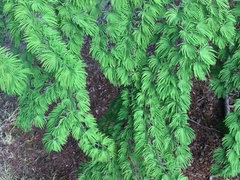
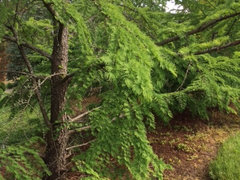
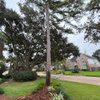
First time I saw Pseudolarix ambilis in person was at the Rowe Arboretum in Cincinnati. The new foliage up close is beautiful and looks otherworldly to me. It reminds me of a cluster of sea anemone.
Pseudolarix ambilis - Rowe Arboretum May 2014
Kyle (East TN, 6b/7a)
Original Author10 years agoGaren- I agree about the foliage. It makes me feel the same way Metasequoia foliage does. Just so lush and finely textured.
Tom- Thank you for all the information. I don't know if you've ever been the Great Smoky Mountains National Park, but I live right next door, so my climate is basically identical. Our summers aren't usually TOO hot, I guess that's relative, but we are very humid. There's very little dry heat. I live at about 1,500' elevation, but also have access to some property at about 2,500' elevation. I may have to get a few of the supposedly more heat tolerant Larch and try some at each location.
- 10 years agolast modified: 10 years ago
Kyle, order a few Larix kaempferi from the Virginia State Forestry nursery. (10+ - they are reasonable) In all likelihood at least a few will grew well for you. Seed grown so some variation in disease resistance. For me about 3/10 are still alive. In fact you will surely have better luck with them at 1500' than I have.
Kyle (East TN, 6b/7a)
Original Author10 years agoI couldn't find where they were offering them anymore.
- 10 years ago
The big advantage of larch over false larch for me is vigor. European and Japanese larch were some of the fastest growing trees at my old place. Pseudolarix is painfully slow growing, but I suspect trees south of me do better. The fall color of Pseudolarix is superb to any of the larches commonly seen in these parts.
Kyle (East TN, 6b/7a)
Original Author10 years agoI will be receiving two tiny Pseudolarix soon. Which would be better in your opinions: keeping them in pots till they're of a fair size (1-3'), or getting them in the ground now?
- 10 years ago
Agree with the kaempferi as far as larch goes, for your locale. And I think it true that dry heat would be much more damaging to larch than hot/humid.
One other tidbit would be to check with itascagreenhouse.com, the only grower so far as far as I'm aware of the hybrid type like I've been planting-Larix marschlinsii. Not sure these would do any better for you than straight Japanese, but boy I got to tell you, they surely do seem to have that hybrid vigor. Part Japanese, part European larch. Very cool trees, at least up in my cold zone.
Kyle (East TN, 6b/7a)
Original Author10 years agoI will have to check them out.
It would be nice if Ken would pay a visit to this thread. I've read a lot of what he's said regarding Pseudolarix vs Larix in previous threads. I would also like his opinion on whether to plant my new babies now or wait.
- 10 years agolast modified: 10 years ago
I haven't found the hybrid to be an improvement over straight L. kaempferi at all. They were more disease susceptible, and in an annoying way of dying suddenly after years of vigorous growth. Though they initially had hybrid vigor, it's likely any Larix x marschlinsii you are buying now are several seed generations away from the initial hybrids and have a lack of genetic heterozygosity. Which is probably true of L. kaempferi as well, because it seems it hasn't been collected in Japan for many years and seed are only coming from isolated cultivated specimens: this probably accounts for the alarmingly virulent phytophthora problem they've had on larch plantations in the British Isles.
As I posted some time ago, I think it was at the Mobot website or some other midwestern arboretum that I looked up all of the Japanese larch and the only ones to survive long term were from seed wild collected in Japan. Plants from cultivated seed sources had died.
For the record, probably 8 or so hybrid larch died for me over the years, biggest at maybe 12' high or so, 1" caliper. Sudden death after a summer thunderstorm. They grew very fast.
I can't remember exactly but it's something like 3 of 8 or 9 Japanese Larch from the VA forestry arboretum that are still alive. Again, most of them died in wet periods of summer or autumn. The biggest had a bit of dieback start last summer, but the plant seemed to be able to isolate it. I would't rely on any of them for essential shade at this point. They are just curiosities.
My Larix mastersiana has grown far slower but seems the most heat and humidity resistant, never having even a tiny bit of visible stress, even after being moved. I'm trying for the 2nd time to graft it into Pseudotsuga sinensis, which Pineresin thought might work. The first grafts were made by David Parks at Camforest! It was in mid March and It think was too late. They sprouted out but the leaves dried up and died about a week later. This time I did the grafting in early January, the buds on the scions are slowly swelling so my fingers are crossed!
- 10 years ago
The guy at Itasca had to drop the plant-hybrid larch- for a while due to lack of seed. It is not out of the question that my very planting could end up being the seed source for subsequent crops with that firm. We've talked abut it and I have trees beginning to cone. No, I have not checked for viable seeds yet.
But mostly, i find some of your observations to be downright nonintuitive, davidrt. Larch struggling from a thunderstorm? WTH? I do agree that at this point, we're well past the F1 generation, so all bets are off for any comparisons to the original "Dunkeld" larch, which is the Scottish castle where this hybrid first originated. But just more generally, the thought that precipitation, moist soils, and such are behind the demise of larch trees flies in the face of everything I thought I knew about this genus. As I reported above, it is dry times that I have seen stress them, not moisture. Must be down to varying geographical conditions. Heat is not a friend to larch-anywhere on the planet-so to use the observations made in a very hot climate would I think tend to skew the data. It may not be moisture at all, or it may be that it is only when in combination with the kinds of summer temps you guys experience in the mid-Atlantic that does them in.
 10 years agolast modified: 10 years ago
Dave, that's my experience -- after 11 yrs the larch hybrid is ailing badly from something (losing branches, little growth top to bottom), while Japanese larch, tho the very bottom branches are showing somewhat similar symptoms, is vigorous (crossing fingers).
Maybe the pure European larch is the way to go in the mid-Atlantic states, as there was a healthy 100 footer near the house I grew up in. There's also a huge, healthy larch in the cemetery in Bedford, PA, tho I haven't IDed the species yet.
Edit: See my "Spooky pics" post for a pic of said cemetery larch.Kyle (East TN, 6b/7a)
Original Author10 years agoMy two P. amabilis babies just arrived. They are each about 4 inches tall and starting to put out their leaves. They're so tiny and fragile that I'm scared to death that I'll kill them. Should I leave them in their 2 1/2" pots or pot them up? I feel like they're too small to be put in the ground.
- 10 years agolast modified: 10 years ago
" But just more generally, the thought that precipitation, moist soils,
and such are behind the demise of larch trees flies in the face of
everything I thought I knew about this genus."A whole biological niche - and a rather large one - exists of high altitude (or high latitude in some cases) alpine plants that are fine with wet conditions as long as it's like Scotland. Wet and cool, all year. Give them our hot, wet soils and all sorts of rot organisms - surely not just Phytophthora - will have their way with them. This explains, among other things, why the Fairchild Botanical Garden's plant list isn't chock full of things like Luculia, Cinnabarina, Maddenii, and Falconera rhododendrons, Ceroxylon palms*...etc. etc. etc. that in all cases have native ranges inclusive of areas that are totally frost free. Probably more frost free than Miami in some cases. Somehow the plant's defense enzymes breakdown or denature at high temps, and/or the rot organisms are more virulent at those temps and plants from high elevations are of course evolutionarily naive to such attacks.
In some cases it's possible they just won't intrinsically grow at high temps - I highly doubt anyone is going to keep Meconopsis alive in Atlanta no matter how much antifungal they pour on it. But there's too much anecdotal evidence to support the "it's mostly root rot organisms" hypothesis. Reports of gardeners keeping Lapageria alive in Florida with antifungal treatment, my own experiments with Cinnabarina rhodies, grafts of alpine firs surviving in North Carolina, etc.
One slightly mysterious twist is how some of these grow in climates almost as warm as the SE US with seeming greater ease, like parts of southern Japan, coastal SE Australia, etc. Soil factors might play a role there in some cases, like the paucity of phosphorus in AU soils or the fast draining volcanic soils of Japan. In some cases it's possible the worse root rot organisms just haven't arrived in those places.
* - all of which are perfectly happy in downtown San Francisco, of course, which hardly ever has a dewpoint above 60F. Once you get down to say, zn 8 Virginia Beach on the east coast, I bet it's almost impossible in summer for the dewpoint to go _below_ 60F! Hence the reason the classic rhodie hybrids are rare as hen's teeth down there or points beyond. We can also have, in the SE, all of our monthly rainfall in one huge muggy downpour, which only makes matter worse. Alpine Larix are not the only ones to die after these events.
- 10 years agolast modified: 10 years ago
BTW Tom...it's important to clarify that yes, while Larix don't like dry soil either - I'm sure mine were never dry enough to be stressed by that. They were mulched and my soil is a good brown moisture retentive loam. They were planted near rhodies that would have readily signaled drought stress. (droopy leaves...they aren't afraid to complain) It's really just the "stress" of 4+ inches of rain in one storm, water temp in the soil going > 80F, and all of the pore spaces in the soil probably being filled with water for a while. Root rot heaven. Looking back, I wonder if I had simply planted them all on substantial mounds it would have tipped the balance just enough to runoff and aeration that they would still be alive.* There are rhodie collectors who do this for their more sensitive plants and it seems to help...I'm doing it more and more for fussier varieties and it seems to help.
"Maybe the pure European larch is the way to go in the mid-Atlantic
states, as there was a healthy 100 footer near the house I grew up in.
There's also a huge, healthy larch in the cemetery in Bedford, PA, tho I
haven't IDed the species yet."But I wonder if these plants - at least the ones south of the Mason-Dixon are just genetic outliers...like the Monkey Puzzle in Rockville Maryland that is on a gentle slope...but certainly not some special fast draining soil or deliberate mound. A handful of trees might have the genes to resist whatever the local soil microorganism biome can throw at it. Take the huge Euro Larch at Oatlands in VA...do we know for a fact back in the 1820s that they didn't plant 10 other larches, and only 1 survived? (which I think is now finally dead...but I remember it because it was the first larch tree I saw in my life) Likewise there are a couple fine Larix decidua at Longwood...but we have no way of knowing how many died over the years! The only ones that should "logically" survive our climate are the southernmost, lowest-elevation collections of the Japanese one, and likewise the ones from the warmest parts of China. (Larix mastersiana...I'm beginning to wonder if some Chinese plants might have once had ranges that went to lower elevations but now only occur at high elevations; they nevertheless have a "genetic memory" to resist muggy conditions at < 3000 ft. elevation. China has had relatively advanced civilization for so long, they would have been logged from the plains and foothills long ago.)
* doesn't always work though. I built a mound specifically to trial a bunch of Abies seedlings. A heavy wet spell last summer (the June one hairmetal mentioned) killed an Abies equi-trojani. Encouragingly, all "Chinese Alpine Firs that a certain board celebrity refuses to confirm as Chinese Alpine Firs" survived this outrage. We had 12" of rain in only two weeks I think. A huge Morus defoliated but recovered at the end of summer. Abies albas also survived. It makes sense in a way: the turkish fir is the least likely to face huge summer rainfall, obviously. (Abies albas occur in areas of the Alps that get very high summer rainfall, and the Chinese ones must survive monsoons every year!)

ken_adrian Adrian MI cold Z5