Software
Houzz Logo Print

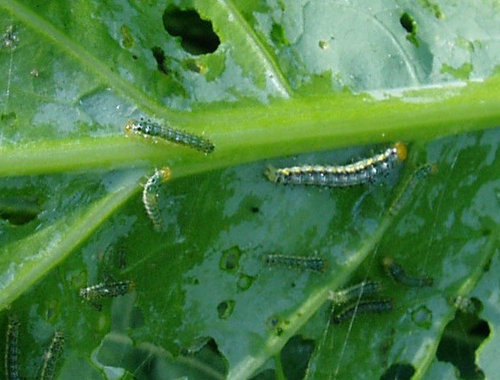
This was the first winter I grew collards. We had a bountiful crop, and with four plants in the ground, each getting to be more than four feet tall, we were eating them for almost every dinner. Great salad greens, and excellent stir fried and, steamed, as wraps. I'm going to grow them every year! But maybe I'll restrain myself to two plants in the future! Increasingly, in the spring, our collard leaves had lots of holes. I was frustrated never to find a single pest, but it turns out that they were hiding on the underside of the leaves. What are they? See picture below. The largest one is a bit more than half an inch long.


I think I even saw a larger one of these critters that was all green.

I had applied Sevin occasionally, but only to the tops of the leaves. (Collards are a bit weird in this respect, as the leaves repel liquid. You spray it on and the fluid sort of balls up and rolls off.) For future reference, what's the best management strategy for these guys? Does their life cycle involve eggs in the soil, such that I should plant collards in another bed next year?

Comments (14)

  • 10 years ago

    Bt dust (Dipel, Thiricide) applied to the underside of the leaves. Cabbage worms and cabbage loopers - the larvae of different moths are chronic pests for all the crops in the family. If keeping the all the plants dusted is difficult - row covers from the beginning to prevent the moths laying eggs works best. Any more I just routinely cover all my collards, broccoli, brussels sprouts, cabbage, etc. with insect barrier/floating row covers. But with just a few head the BT takes care of them.

    Dave

  • 10 years ago
    last modified: 10 years ago

    Thanks, Dave. So you're saying those are, in fact, cabbage worms? Or just that all worms on cabbage are just generic "cabbage worms" because they're worms that eat cabbage? I'm surprised that Sevin on the top surface of the leaves didn't take care of them, in that even if they're eating from the bottom, what they eat has Sevin on top. But as I said, the Sevin didn't really want to "wet" the leaves. Maybe dust would work better.

    Let me add, what is the procedure for applying that dust? A shaker doesn't seem to be a very good way to apply it to the underside of leaves. For DE, I blow it on with a vacuum cleaner, but DE is a lot less pricey then dipel, and I'd like to end up with most of it on the plant rather than in a cloud around the plant. I guess I could pick up each leaf and shake it onto the back side, but that would take some time.

  • 10 years ago

    Since you only have four plants, albeit big ones, I'd be tempted to use a combination of hand picking and hose blasting.

  • 10 years ago

    The label cabbage worms is in part a catch all label for 3 different moth larvae - the most common of the 3 are Pieris rapae (what you have in the pic) aka imported cabbage worms and are the larvae of the small white butterfly with dark spotscommon this time of year.

    Cabbage loopers are the larvae of a small brown night moth and are smaller,lime green and mistaken for inch-worms because they move that way.

    Then there is the larvae of the Diamondback moth but they are very small - 1/2 inch and no stripes.

    All are commonly referred to cabbage worms even though none of them are actually "worms". Go figure. ;-)

    Bacillus thuringiensis Kurstaki (BtK) is the standard control, a bacteria they consume that kills them, organic approved.

    Dave

  • 10 years ago

    Hmmm. Never seen any white butterflies around, but maybe I'll start seeing a lot. Yes, I probably should use Bt instead of Sevin, but I'd like to understand why Sevin didn't work.

  • 10 years ago

    Sevin is a short lived contact insecticide if you don't hit em you don't kill em. Bt is a stomach poison for butterfly/ moth larva and hangs around for a couple of days to be eaten. Sevin kills by contact but is only effective for day or so

  • 10 years ago
    last modified: 10 years ago

    Yes, that may be what's going on here. If I'm spraying the tops with Sevin, and I don't hit 'em because they're on the underside, it may not do the job. Also by the time they eat through the leaf, the topside Sevin may be gone. I thought Sevin was maybe good for a few days, but perhaps in full sun it might not be.

  • 10 years ago

    "what is the procedure for applying that dust? A shaker doesn't seem to
    be a very good way to apply it to the underside of leaves. For DE, I
    blow it on with a vacuum cleaner, but DE is a lot less pricey then
    dipel, and I'd like to end up with most of it on the plant rather than
    in a cloud around the plant. I guess I could pick up each leaf and shake
    it onto the back side, but that would take some time."

    Sorry I meant to add this before. Thuricide is a liquid spray if you don't want to use dust. Dust application is better with a dust applicator made for the purpose. Several models available. And some brands of Bt dust come in a puffer applicator.

    Just one example: http://www.amazon.com/Chapin-5000-16-Ounce-Plant-Duster/dp/B0009KM2LG?SubscriptionId=AKIAIKBZ7IH7LXTW3ARA&&linkCode=xm2&camp=2025&creative=165953&creativeASIN=B0009KM2LG&tag=wwwbookcompar-20&ascsubtag=5725137048308f1c48b4632e

  • 10 years ago
    last modified: 10 years ago

    Yes, thanks. I really should get one of those dust sprayers. Though I suppose I could make one of those do-it-yourself plastic pop bottle dusters with holes drilled in the cap. Yes, liquid Bt is, in fact, Thuricide. I forgot that.

    Just out of curiosity, what is the lifetime of Bt powder or Thuricide before application? I assume it will last a season at least in the bottle. I'm suspecting that since it is a bacterial compound, I can't leave it in my shed outside where the summer temps get well above 100F.

  • 10 years ago

    OK, there was a very old GW post on this question of Bt lifetime. Bt doesn't last as long as chemical insecticides, though if kept in a cool place it seems to be good for a few years. I'll keep mine indoors.

  • 10 years ago

    So are you dismissing the hose and hands approach completely? It does work and it costs nothing.

  • 10 years ago

    That's a fair point. I should probably try the hose blasting. Of course, the bugs aren't killed, but rather just washed to the ground where they'll go on to infest the plants again. As to hand picking, a lot of these caterpillars are quite small, and not easy to see. I guess those aren't the ones that do the most damage individually, but I suspect there are more of them.

  • 10 years ago

    Once the caterpillars are washed off they may be too weakened to climb back on or be picked off by birds. They will certainly be reduced. I hand pick on far more than four brassicas. But you need to watch out for the butterflies and inspect the leaves fairly regularly.

  • 10 years ago

    Use a wide tape (ie. duct tape) - wrap around your fingers so the sticky part faces out. Use the tape applied to the worms or eggs to remove from the backside of leaves.

    Time consuming but used daily it is very effective AND very organic.

    Can also be used on squash and other leaves where pests are found.