

NSF Protocol P 172 Sanitary
Electrolux Home Products, Inc. 10200 David Taylor DriveCharlotte, NC 28262 United States 706-651-1751Visit this company's website
Facility : Porcia, Italy
Kenmore Front Load Washer 417.4191*51*[2]
[2] * is used to denote color and graphics
Electrolux Front Load Washer EIFLS20QS*[1]
[1] * - Color code
Facility : Chihuahua, Mexico
Electrolux Washer EFLS517**** EFLS617**** EIFLS55**** EIFLS60**** EIFLW50**** EWFLS70****
**** Model graphics and color.
Frigidaire Washer FFFS5115P
Comments (44)
Jeannie Cochell
Original Author10 years agoGE Appliances, a Haier Company Appliance ParkLouisville, KY 40225 United States 502-452-3332
Facility : Louisville, KY
GE Front Load Washer[1] GFWR2700(1)(2) GFWR2705(1)(2) GFWS2500(1)(2) GFWS2505(1)(2) GFWS2600(1)(2) GFWS2605(1)(2) GHWS3600(1)(2) GHWS3605(1)(2) GFWR4800(1)(2) GFWR4805(1)(2)
[1] (1) Model year designation letter
(2) Two-letter color designation
(3) Color type designation.
GE High Efficiency Top Load Washer[1][1] GHWS8350HWS(1)(2) GTW680BS(3)(2)(1) GTW810S(3)(1)(2) GTW860S(3)(1)(2) GTWS8655(1)(2) GTWS8650(1)(2) GTWS8455(1)(2) GTW8355HMC(1)(2) GTWS8450(1)(2) GTWS8350HWS(1)(2) GHWS8355HMC(1)(2)
[1] (1) Model year designation letter
(2) Two-letter color designation
(3) Color type designation.
Facility : Jiangsu, China
GE Front Load Washer3.6 cu. ft. Capacity[1] GFWH1200(1)(2)(3)
[1] (1) Model year designation letter
(2) Engineering digit/revision
(3) Two-letter color designation
4.0 cu. ft. Capacity[1] GFWH1400(1)(2)(3) GFWS1500(1)(2)(3)
[1] (1) Model year designation letter
(2) Engineering digit/revision
(3) Two-letter color designation
4.1 cu. ft. Capacity[1] GFW400SC(1)(2)(3) GFW400SS(1)(2)(3)
[1] (1) Model year designation letter
(2) Engineering digit/revision
(3) Two-letter color designation
4.3 cu. ft. Capacity[1] GFWN1600(1)(2)(3) GFWN1600(1)(2)(3) GFWS1600(1)(2)(3) GFWS1700(1)(2)(3) GFWS1705(1)(2)(3)
[1] (1) Model year designation letter
(2) Engineering digit/revision
(3) Two-letter color designation
4.5 cu. ft. Capacity[1] GFW450SC(1)(2)(3) GFW450SS(1)(2)(3)
[1] (1) Model year designation letter
(2) Engineering digit/revision
(3) Two-letter color designation
Facility : Coahuila, Mexico
GE Top Load Washer GTW680BMKDG GTW680BMKWSJeannie Cochell
Original Author10 years agoLG Electronics, Inc. 1000 Sylvan AvenueEnglewood Cliffs, NJ 07632 United States 82 55 269 3245Visit this company's website
Facility : Nanjing, Jiangsu Province, China
LG Top Load Washer[1] WT5680H*A WT7600H*A
[1] * - color
Facility : Gyeongnam, Korea, Republic of
Kenmore Elite Top Loader Washer[1] 3141(1)##(5) 3146(1)41(6) 3162(1)##(5)
[1] (1) indicates color.
(2) blank or M depending on the communication function.
(3) denotes A-Z to identify additional function.
(4) operation washing cycle or function.
(5) service part version.
(6) serial number.
LG Top Loader Washer WT 5101H(1)[1] WT1701C(1)[1] WT1801H*A[2] WT5680HV(1)A[1] WT5680HW(1)A[1] WT7700H*A[1] WT7710H*A WT7710H*A WT9000H*A[1]
[1] (1) indicates color.
(2) blank or M depending on the communication function.
(3) denotes A-Z to identify additional function.
(4) operation washing cycle or function.
(5) service part version.
(6) serial number.
[2] * denotes A-Z according to the appearance color.
Front Loader Washer with Heater and Sanitary Cycle[1]Kenmore Elite Front Loader Washer 4128(1)##(5) 4137(1)21(2) 4147(1)21(2) F14E7CDYP*[2]
[2] * denotes A-Z according to the appearance color.
Kenmore Front Loader Washer 4107(1)21(5) 4157(1)21(5)LG Front Loader Washer WM2650H(1)(2) WM3070H(1)(2)(3) WM3250H(1)(2)(3) WM3470H(1)(2)(3) WM3570(1)(2)(3) WM3650H(1)(2)(3) WM3997H*A[2] WM4070H(1)(2)(3) WM4070H*A[2] WM4270H(1)(2)(3) WM5000H(1)(2)(3) WM8000H(1)(2)(3) WM8100H*A[2] WM8500H(1)(2)(3) WM9000H(1)(2)(3)
[2] * denotes A-Z according to the appearance color.
[1] (1) indicates color.
(2) blank or M depending on the communication function.
(3) denotes A-Z to identify additional function.
(4) operation washing cycle or function.
(5) service part version.
(6) serial number.
Front Loader Washer and Dryer Combination with Water Heater and Sanitary Cycle[1] [3]Front Load Washer/Dryer Combination WM3987H(1)
[1] (1) indicates color.
(2) blank or M depending on the communication function.
(3) denotes A-Z to identify additional function.
(4) operation washing cycle or function.
(5) service part version.
(6) serial number.
[3] Certification for wash cycle only.Related Professionals
Cape Girardeau Kitchen & Bathroom Designers · Waterloo Kitchen & Bathroom Designers · Rutland Kitchen & Bathroom Designers · Atlanta Bathroom Remodelers · Great Bend Bathroom Remodelers · San Antonio Bathroom Remodelers · Enfield Bathroom Remodelers · Saginaw Bathroom Remodelers · Altoona Bathroom Remodelers · Tucson Bathroom Remodelers · Logan Bathroom Remodelers · Cookeville Cabinets & Cabinetry · Auburn Cabinets & Cabinetry · Kenosha Cabinets & Cabinetry · Mesquite Cabinets & CabinetryJeannie Cochell
Original Author10 years agoSamsung Electronics Co., Ltd. System Appliances Div. Washing Machine416 Maetan-3dong, Yeongtong-gu Suwon City, Kyeongki-do 443-742 Republic of Korea 82 31 200 6772
Facility : Jiangsu Province, China
Top Load Washer WA50F9A8D**[1]
[1] First and second * indicates color.
[2] * indicates body color.
Front Load Washer WF42H51**A*[3]
[3] ** indicates grade, * indicates color.
[4] First * indicates feature.
Top Load Washer WA50F9A8DSW
[1] First and second * indicates color.
[2] * indicates body color.
Front Load Washer WF42H52**A*[3]
[3] ** indicates grade, * indicates color.
[4] First * indicates feature.
Top Load Washer WA56H9000A*[2]
[1] First and second * indicates color.
[2] * indicates body color.
Front Load Washer WF42H54**A*[3] WF42H55**A*[3] WF42H56**A*[3] WF42H57**A*[3] WF45H6100A*[4] WF45H6300A*[4] WF45H6500A*[4] WF56H9100A*[4] WF56H9110C*[4]
[3] ** indicates grade, * indicates color.
[4] First * indicates feature.
Front Load Washer with Heater, Hot Water Sanitary Cycle Selected, and SilverCare Option Deselected WF361B*BE**[4] [5] WF363B*BE**[4] [5] WF364B*BG**[4] [5] WF365B*BG**[4] [5] WF393B*PA**[4] [5] WF395B*PA**[4] [5] WF397U*PA**[4] [5] WF398A*PA**[4] [5] WF405A*PA**[4] [5] WF433B*GJ**[4] [5] WF435A*GJ**[4] [5]
[4] First * indicates feature.
[5] Second and third * indicates color.
Facility : Jiangsu, China
Top Load Washer WA50F9A8D**[1] WA50F9A8DSW
[1] First and second * indicates color
Facility : Queretaro, Mexico
Washer[1] WF220AN WF221AN WF231AN WF241AN WF331AN WF340AN WF350AN WF501AN
[1] Suffix indicates color designation.
Front Load Washer with Heater, Hot Water Sanitary Cycle Selected, and SilverCare Option Deselected WF361B*BE**[2] [3] WF363B*BE**[2] [3] WF365B*BG**[2] [3] WF393B*PA**[2] [3] WF395B*PA**[2] [3] WF398A*PA**[2] [3] WF405A*PA**[2] [3] WF433B*GJ**[2] [3] WF435A*GJ**[2] [3]
[2] First * indicates feature.
[3] Second and third * indicates color.Jeannie Cochell
Original Author10 years agoWhirlpool Corporation 2000 North M-63Benton Harbor, MI 49022 United States 888-539-2372 269-923-5000Visit this company's website
Facility : Clyde, OH
Maytag Bravos[1] MVWB950Y*
[1] * denotes color.
Whirlpool Front Load WFW94HEA WFW88HEAMaytag Front Load MHW7000A MHW6000AWhirlpool Cabrio[1] WTW8800Y*
[1] * denotes color.
Maytag Maxima with Steam[1] MHW7000A* MHW6000A*
[1] * denotes color.
Maytag Maxima[1] MHW9000X* MHW6000X*
[1] * denotes color.
Whirlpool Duet[1] WFW94HEX*
[1] * denotes color.
Whirlpool Duet Models with Steam[1] WFL98HEB* WFW88HEA* WFW94HEA* WFW95HEX*
[1] * denotes color.
Maytag Bravos[1] MVWB980B*
[1] * denotes color.
Whirlpool Cabrio[1] WTW8900B*
[1] * denotes color.
Maytag Maxima with Steam[1] MHW7000X*
[1] * denotes color.
Whirlpool Duet Models with Steam[1] WFW96HEA* WFW97HEX*
[1] * denotes color.
Maytag Maxima with Steam[1] MHW8000A*
[1] * denotes color. 10 years ago
They all may be "certified." Here is what the protocol says about that certification:
The protocol does not evaluate the water or steam temperature per se,
but it evaluates the ability of the sanitization cycle to perform
effectively. The sanitization cycle of a washer is dependent on the
combination of many variables (i.e. – drum size, drum shape, heater
wattage- if applicable, cycle time, cycle temperature, tumbling action,
etc.) These variables can change from model to model and manufacturer to manufacturer as long as they perform effectively.”So all those machines are certified to "perform effectively" on sanitize.
Practically speaking this protocol is a dead end. Just marketing.
Jeannie Cochell thanked rococogurlJeannie Cochell
Original Author10 years agoYour comment above is directly from your own article so I went back to the NSF website and copied their certification criteria.
"NSF Protocol P172 was developed by a panel of experts, including representatives from the U.S. Food and Drug Administration (FDA). Using established scientific methods, clothes washers are evaluated to determine if they can effectively sanitize clothes.
To earn certification, a clothes washer tested under this protocol must be able to reduce 99.9 percent of microorganisms when clothing is washed on the unit’s sanitization cycle. In addition, there must be no significant carryover of bacteria into future loads."
As a writer, I don't usually cite my own articles, and if I do, I cite the publication information.
 10 years agolast modified: 10 years ago
@moroseaz - at one time the P172 protocol actually stated a specific temperature. Apparently it has been modified over the last couple of years to a lessor standard. Do you actually think manufacturers would have been producing machines that heated in access of 152F if there wasn't a reason. And that reason was to obtain the certification to compete in the marketplace. Many manufacturers are still producing products by the old standard. Electrolux, Samsung, LG, Kenmore to name a few, and I am sure there are others. Whirlpool/Maytag are not, on any current product. The hottest temperature available on a new model "poolie" is Allergen, which in all practical purposes is just fine. I would assume in the future, others may very well follow. In all practicality the only data that is currently relevant, are which machines are certified to the P351 Allergen standard. I agree with @roc, the other modified standard as it is written, is useless and meaningless.
Jeannie Cochell
Original Author10 years agoI think you'll both find that most of the models listed above are no longer manufactured. Unfortunately, it costs $45.00 to purchase the documentation that discloses the testing and criteria needed to meet the P172 protocol. If someone has that, then maybe they will be kind enough to share it with us.
- 10 years ago
I bought a copy of P172-07 for $35. It's copyrighted so I'm not going to post it. I'm happy to answer any questions.
Some observations:
It's dated August 2006 so it isn't recent.
Regarding detergent, it says "If detergent is used for the sanitizing cycle, the amount and type of detergent used in the cycle shall be determined by the clothes washing machine manufacturer’s instructions. If detergent is used, it shall not be antibacterial and shall not contain bleach."
No reference to wash temperature, other than:
The hot water supply shall be available at a maximum of 120°F or 51°C.The cold water supply shall be available at a maximum of 65°F or 18°C.
It's very detailed. E.g.
Inoculum PreparationTest organisms obtained from ATCC shall be resuspended in 10 mL of Tryptic Soy broth and incubated for 48 hours at 35 - 37°C. One mL of the 24-hour suspension shall be transferred to 10 mL of fresh Tryptic Soy broth and incubated for 24 hours at 35 - 37°C. This passing shall be repeated for a minimum of 3 consecutive daily transfers (no greater than 30 transfers). On the day before testing, the entire 10 mL of the organism stock shall be transferred into a 2 L sterile Erlenmeyer flask containing...
Jeannie Cochell
Original Author10 years agolast modified: 10 years agoThank you, Sub. By effectively removing the most common uses of household sanitization, we can arrive at a definitive that involves high heat. Sadly, we may not know that magic number. Doesn't mean it's a scam, only that the NSF won't tell you even if you pay for it. THAT is the scam.
- 10 years ago
What is the difference if bleach was involved? Is it not to be used in a P172 protocol?
Jeannie Cochell thanked User - 10 years ago
Allen L, the excerpt I quoted above does prohibit the use of detergent with bleach. One would assume that added bleach is also prohibited.
We don't know if earlier versions of the protocol included the temperature for thermal sanitizing. But this version, which dictates the result, not how you get there, has been in effect for almost 10 years. Maybe this approach was chosen to allow for alternative sanitization methods like Samsung SilverCare.
Perhaps the allergen protocol does specify temperature because there's no practical procedure to test whether dust mites have been killed.Jeannie Cochell thanked suburbanmd Jeannie Cochell
Original Author10 years agoOK, so we're all in agreement? The NSF P172 protocol is disappearing because the addition of bleach and/or high water temp, plus common sense, should do the trick? It would really be nice to get off this topic of so many rants in other posts. As I've said before, I don't use it because I can get the same benefit from Allergen (steam), hot water (steam) and have the option to add bleach if there's vomit or some other bodily discharge. A cold-water presoak and enzyme-busting additive would need to be used for blood. Maybe another thread should be started on pre-soaks and pre-washes.
- 10 years ago
Only the NSF could say why the protocol is disappearing and they haven't.
We all know machines with Sanitary cycles and no specified temperature are "sanitizing" on trust.
Bleach works if someone wants a guarantee.
Otherwise, for me, it's a distinction without a difference.
Jeannie Cochell thanked rococogurl - 10 years agolast modified: 10 years ago
Actually we are not in agreement. The P172 protocol is not disappearing, however we have all made the erroneous assumption it is. They are two very different standards.. The P351 protocol should not be construed as a replacement for the latter. The P172 protocol insures "Sanitation" is met without chemical disinfection. While the P351 insures effective removal of common allergens, dust mites through a specific temperature and hold time.
"Washers certified to this protocol must remove at least 95 percent of house dust mite allergens and feline dander. The wash water must reach 55º C (131º F, the temperature required to kill dust mites) for at least three minutes and the washer must be easily cleanable, corrosion resistant and designed to avoid accumulation of dirt and debris.
Some washers are also certified to reduce other allergens, including canine dander and birch pollen (a common cause of hay fever) by at least 95 percent."
Consumers should be aware the Allergen protocol will not guarantee "sanitation" to the higher NSF standard without the addition of chemical disinfectant. It is an important distinction to make and understand.
Jeannie Cochell thanked rpsinfoman - 10 years ago
rococogurl, if you don't trust that a P172-certified sanitary cycle does indeed sanitize, then why do you trust that a P351-certified allergen cycle reaches 131F for three minutes?
Jeannie Cochell thanked suburbanmd Jeannie Cochell
Original Author10 years agoIf the Sanitize cycle has no NSF protocol associated with it, why are we arguing about it? My washer has a Sanitary cycle but has no written protocol promise. They aren't alluding to anything mandated by a government agency for that cycle. If I wasn't visiting the Laundry forum, I never would have associated it with the NSF 172. Because it continues to be an issue here I visited the NSF website and confirmed that my WP95 does indeed meet the standards for the NSF 172 protocol. If anyone else is wondering whether their model meets the standard, they just need to look at the NSF website. Personally, I wouldn't trust plain ol' hot water to sanitize. I worked for years in the restaurant and hotel industry. Even the little Mom & Pop places have to meet federal standards for sanitization using chemicals combined with high water temperatures.
- 10 years agolast modified: 10 years ago
@morosea - it's all good and all of the information has been an educational experience. I don't feel there is any argument, but help me understand what's been written in other threads. You and mama pink have identical machines and model numbers. You have indicated the machine is P172 certified. Mamapink on the other hand points out her machine is certified in the documentation to the P351 Allergen protocol, which I have confirmed myself. She has indicated Allergen is the hottest cycle on the machine, and inquired several times with Whirlpool. Matter of fact we all did, without resolution.
Thats very strange two identical machines certified to different protocols.
- 10 years agolast modified: 10 years ago
moroseaz, there are washers on the market certified to P172, and this thread is relevant to them.
P172 has its limitations:
1.2 Scope / Limitations
The methods described in this protocol simulate significant contamination of a small number of clothing items in an otherwise typical laundry load. This protocol will establish the ability of washers to sanitize under those conditions and will confirm that there is no significant carryover of contamination to subsequent washer loads.
The requirements of this protocol are limited to addressing the sanitization performance of residential and commercial, family-sized clothes washers. This protocol does not establish performance requirements for washing performance, energy efficiency, or effects on fabrics. This protocol does not establish requirements for commercial laundry operations associated with food service, hospital linens or other non-residential applications. The protocol does not address the needs of persons with specific health conditions requiring special sanitization and/or disinfection techniques.
- 10 years ago
@suburban - For a cycle labeled Allergen, if a machine heats to 131F for the allotted time then I accept that allergens should be eliminated per NSF protocol.
With the Sanitize cycle I don't accept that anything necessarily will happen unless the machine specifies a temperature of 150F or above for that cycle and that can be verified -- whatever the cycle may be called. Expect that varies by manufacturer. This has all been pretty clear to me from reading the NSF website.
I personally also have confidence in a wash in excess of 150F in my machine as it's temperature specific. I'm not looking to sterilize. But without a microscope and scientific training no one can verify whether any load of laundry has been sanitized.
The addition of chlorine bleach to a load of laundry would be -- as
rpsinfoman always points out -- most effective since it's chemical. That
essentially blunts the issue.As a practical matter, Sanitize is a marketing term IMO. My interest is that an average buyer understands this when they go to buy a front loader. That way they can decide if they want a machine with a heater and see what owners have experienced. I approach the purchase of any appliance this way.
So I haven't understood the point of this -- hence my post upthread. But better to overthink than not to be aware at all.
- 10 years ago
I personally don't see any argument going on here...I see people investigating, reading reading and reading trying to figure out what manufactures should be making readily available to consumers. If you have a washer with a designated sanitize cycle the manual should clearly state if its sanitizing with chemicals or thermal heat. But instead they play word games instead of just comming out and saying what the facts are. These manufactures know what the temps are, but its some big mysterious secret...sales stratagy.
- 10 years agolast modified: 10 years ago
@roc - you stated, "As a practical matter, Sanitize is a marketing term IMO"
One could also make the argument the temperatures HOT and WARM have become jargon also. Potential buyers should be aware with new energy complient machines, those words deliver far less than a typical consumer expects they're getting.
To be very simplistic, all of this is marketing and deception! You don't need a specific cycle to kill dust mites and allergens or a cycle to sanitize. You need hot water in access of 130F and disinfectant for other sanitary purposes.
Consumers should also be aware, simply because a machine has an onboard heater, it does not guarantee a specific operating temperature.
I do feel the NSF is an advocate for the consumer and has taken the guesswork out of selecting equipment simply by looking for a certification label. While none of us truly have the tools to validate biological results. The protocols, testing, and validation are very precise! One can be assured if the appliance bears the label, it delivers as promised in at least two cycles. Whether or not you or the consumer "trust" that, are purely personal issues.
Jeannie Cochell
Original Author10 years agoRP, my machine manual says nothing about P172. It is listed on the NSF website as shown above. I'm still trying to work with Pinky on whether she has run the Sanitize cycle on the defaults. Until she does that, nobody can determine if there is a problem with the cycle or user error. Whirlpool has already tested it and couldn't find a problem. It seems to me that some folks may have jumped to conclusions rather than reading the manual.
I am puzzled as to what difference the temperature makes if there's no protocol associated with it.
- 10 years agolast modified: 10 years ago
@mo - I don't' have an answer for that. We probably spend too much time analyzing this stuff anyway.
For decades there have been washing machines, and consumers washed clothes. There were no standards, protocols, anticipated temperatures, just clean clothes! Sound basic laundry practices was all there was. Hot Water, Detergent, and Bleach. It worked and worked very well!
It wasn't until the government began mandating energy savings, removed phosphates from detergents and some genius decided we can save "X" if we lower the water temperature. It is readily apparent their mission has failed.
Manufacturers had no choice but make machines compliant, while still cleaning to some level of acceptance. Frankly, it's been costly and a DISASTER!
The dirty little secret is you really can't clean, sanitize, remove allergens, fleas, lice, ticks, prevent cross contamination in Cold/Cool water without the use of some toxic chemical going right down the drain. Burn energy or generate toxic waste are the two choices, and we all know the correct answer. Being Energy Star and Eco Friendly is the real deception.
What is hypocritical is some of the very agencies responsible, make up the consortium that is the NSF, who are writing protocols to the contrary. There is a cause and effect and action and reaction to everything. Then there is just plain stupidity!
- 10 years ago
In case there's any misunderstanding: P172 doesn't dictate how a sanitary cycle should operate. It dictates lab procedures for inoculating textile samples with bacteria, and for testing them after the cycle. The makeup of the test load in the washing machine is also specified.
Jeannie Cochell
Original Author10 years agoThank you, everyone, for your input. Personally think we've hashed out everything we can on the Sanitize wash option. I apologize if I offended anyone. For some people, this is a hot issue. For others, it's cloaked in mystery.
- 10 years ago
Having spent $35 of my own money to find out and share the facts about NSF sanitary certification, I don't appreciate an attempt to suppress this discussion before it dies a natural death. Not to mention that this kind of orchestration is pretty much unheard-of in this forum, no matter who started the particular thread. So, yeah, you did offend someone :-)
Jeannie Cochell thanked suburbanmd - 10 years agolast modified: 10 years ago
I am very much interested in it. I was going to purchase the Allergen protocol, but there doesn,t appear to be a document.
What's your overhaul opinion of the P172 standard?
- 10 years agolast modified: 10 years ago
As someone with a new washer with a Allergen & Sanitize cycle, I find this subject fasinating.
- 10 years agolast modified: 10 years ago
Here's the page where the protocol can be purchased. I saw it when I was researching -- not easy to find. I didn't buy it because there were several summaries and the statement from NSF on the other thread and no temperature.
Here's a fairly good summary from 2007. It also gives the background including who was in on the development of the protocol. 2007 Summary from Appliance Design.
It also notes -- very interesting -- that Whirlpool Duets were among the first washers to be certified. Some tradition @mamapinky.
- 10 years agolast modified: 10 years ago
I was on that page previously. Only found the P172. Since one member purchased that already, I was going to buy the other. I had previously seen the Appliance Design Summary. TY.
- 10 years agolast modified: 10 years ago
I actually question the P351 standard. Dust mites for example require a temperature of 60C for complete elimination, yet the published standard is 131F. There are studies that support that fact. Must be a lot of lattitude with 99.9% statistic.
- Washing laundry in warm, 86 F to 104 F water killed only about 6% of dust mites.
- Hot water washing (at 140 F) killed 100% of dust mites.
- Washing in hot water also removed nearly 90% of dog dander compared with about 60% removed in warm water washing.
Jeannie Cochell
Original Author10 years agoSub, I'm leaving the discussion and I wanted to make sure I thanked everyone for their input. I only posted this information because there were so many comments about whether somebody's machine was P172 compliant. I didn't start the conversation, nor am I ending it. I've simply lost interest in continuing with this thread. I appreciate that you spent your own money. I don't think I've orchestrated anything but maybe I have... sigh. Again, I've lost interest in the P172 discussion and nothing I write is going to add to it.
 10 years ago
Like rpsinfo, I am also wondering about the 131°F temp. Over here, we are being told that 140°F is needed to eliminate dust mites. Some companies have very effective Allergen cycles: V-Zug's Anti-Mite cycle runs for an hour at 140°F or more (https://www.vzug.com/ch/en/news_pressrelease_milbenstopp_2016).
- 10 years ago
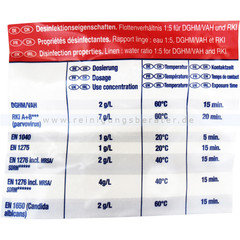
Also: what detergent would everyone recommend for non-NSF Sanitary cycles? I've been looking at ingredient lists of various powdered disinfection detergents like Persil Expert Line etc. and the one ingredient that is usually listed as the disinfectant is oxygen bleach.
This is the label found on Ariel Formula Pro+ that apparently uses sodium percarbonate as the key ingredient.
- 10 years agolast modified: 10 years ago
I am unable to locate this protocol in print. P351 anybody? It's difficult to question without knowing what specfically it was written for, and the intended result. Existing standards I am aware of require temperatures much higher.
I certainly hope this isn't shaping up to be another meaningless gimmick.
- 10 years ago
The Appliance Design article is a fair summary of P172-07.
I don't know enough about microbiology to have an opinion on the protocol, so I'll have to believe it's valid. Similarly, if P351 says 131F for 3 minutes kills dust mites, who am I to argue? Finding stuff on the internet doesn't make me an expert.
P172-07 does specify temperature for decontaminating the washing machine between tests:
"Decontamination
Subsequent “decontamination” cycles can be performed using an empty washer cycle at 40 - 45°C with 50 - 100 ppm bleach in the wash cycle until the test acceptance criteria of less than 10 cfu/mL is attained."
"Bleach" here must be something other than household bleach, since 50-100 ppm is a high level of dilution. - 10 years ago
That's roughly about a TSP per gallon of water, which is not very potent. I guess the concentration remains unknown as you indicated.
- 10 years ago
I figure that 100 ppm is .01%. .01% of 128 fluid ounces is .0128 fluid ounces, which is less than a tenth of a teaspoon. Would that little household bleach in a gallon of water do anything? Maybe they mean powdered bleach? It's a technical document so words may mean different things than we're used to.
- 10 years ago
That's a fairly weak concentration. In commercial laundry, our bleach bath was titrated to 250-400 ppm. One would think for the purposes of disinfection between test loads and ensure there is no cross contamination skewing results. I would think it should be higher. I don't know, I am not a wash chemist or a microbiologist.


rpsinfoman