Software
Houzz Logo Print
gthomson910

Three sisters planting

I'm a bit new to growing, and tried to do a 3 sisters planting of corn/squash/pole beans.

The roly poly bugs ate the pole bean plants, and I didn't re-plant them. Next year I'll start them earlier inside, and have a way to deal with the roly polies I think next time.

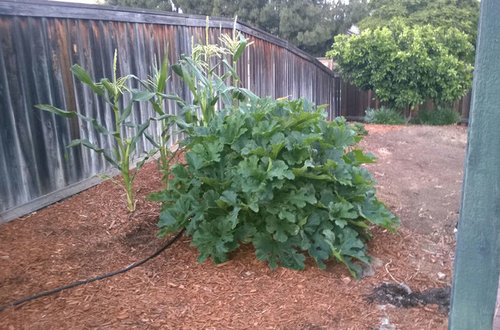
My question is mostly on the squash. I planted 5 corn stalks, and just 2 squash plants in front of them.

I didn't realize the squash would get that big.
I did prune off some of the bottom leaves this weekend before the picture below.
Should I be pruning more off the top to keep them shorter?
How would you prune these two squash plants at this point? The picture is taken facing East. And I think I need to do some more pruning around the two corn stalks in the front soon so that the corn pollination happens without the squash leaves in the way?

Was my mistake to not prune them early enough to keep them shorter? And if so, then it would make sense to also plant squash between the corn to help shade the ground better around the back corn stalks also?

Greg


Comments (22)

  • 10 years ago

    Yeah 3 Sisters always sounds good in theory to new gardeners but the truth is it doesn't work at all well. It has a lot of very specific requirements in both varieties used and planting methods and layout formats. Even then the end results aren't all that good.

    There are lots of past discussions here about its problems so take comfort in the fact that you aren't alone in getting sucked into trying it. The Search will pull them up for you if you want to read through them.

    As lacey said, your corn will not produce anything of value so you might as well pull it but you should get some summer squash from the plant.

    Don't get discouraged as you have learned some valuable lessons for next year but let go of the 3 Sisters idea.

    Dave


  • 10 years ago

    Well, Greg. I looked at this thread thinking Three Sisters was some kind of new veggie! That's how new I am! I would be so discouraged reading this, but I hope you aren't. Let this be a lesson, but now I really want to see if your corn is edible, even if it's not full ears. Your squash looks great! I guess you won't be planting everything at once next time.

    Thanks for posting this. Sharing is caring! :-)

  • 10 years ago

    the problems people had with three sister happened because people did not plant it or research how to do it properly. the three sisters in not something a newbie should try since it require proper planning and advanced knowledge of varieties and even experienced gardeners fail with three sisters since they don't follow the steps and rules properly.

    the three sister was not designed for fresh eating varieties it was designed for storage varieties of squash beans and corn. to use three sister concept for fresh eating varieties you need to use a different set of varieties and spacing for it.

    I have been successful with three sisters since I researched it thoroughly .

    to do the three sisters for fresh eating varieties of sweet corn you need to use bush varieties of squash and beans.

  • 10 years ago

    "to do the three sisters for fresh eating varieties of sweet corn you need to use bush varieties of squash and beans."

    The concept isn't intended for fresh eating as you said. Nor is it primarily just for growing corn, much less sweet corn. Anyone can plant any variety of sweet corn, bush beans and bush squash in the same garden and do well but it isn't a 3 Sisters Garden, it is just a garden. ;-)

    Dave

  • 10 years ago

    Thanks everyone - good info.

    Since the corn doesn't sound likely to pollinate well, I may experiment with hand pollination on those and see if that helps. It was a 'Top Hat' variety of sweet corn. Saw a youtube guy that did 64 stalks in a 4x4 raised bed, so I may try that route with the corn next year - probably not 64, but maybe 32.

    After more checking, I also did find that the squash I planted - Napoli squash - is known to get really big, yet not produce a lot of squash - so another lesson learned there on this attempt.

    The beans I tried to grow there were rattlesnake pole beans. And I have one other planted on the other side on a trellis that is doing okay - although a bit overwhelmed by the cukes on the same trellis. Will give the beans their own trellis next time.

    As some mentioned - best if I learn the individual growing traits better before trying to combine them all.

    Doing the 3 sisters with a sprawling squash like a pumpkin is sounding like the better option if trying again in a couple years.

  • 10 years ago
    last modified: 10 years ago

    Gth...don't give up. We've all been there. My first shot at a garden was watermelons. Epic. Fail. Lots of foliage...marble sized melons. My dad was humored. I'm still a novicecompare to the posters here and probably am compared to you...but I keep plugging along. Lol

    On the bright side, both squash and corn stalks can be used for fall decorations. All is not lost.

    On a side note; my first successful "garden" consisted of boston pickler cukes and some Kentucky pole beans. I was hooked ever since. Give the sisters another shot. I

    Even after careful research, a lot of this stuff is trial and error, not to mention the the fact that we are all really fighting a strategic war with the weather, bug and disease gods.

    In my humble opinion.

  • 10 years ago

    Corn, squash, and beans were staple crops for the native peoples from Peru to Canada, with the "three sisters" mostly, from what I can tell anyways, belonging to the eastern and woodland cultures. But I wonder, what is the benefit? The natives of the southwest had been growing these three crops for a good while longer than their counterparts in the east and they did not use this planting style. If there was a significant increase in yield as a result, I imagine the people living in the Four Corners region, with their harsher climate and growing conditions, would be eager to capitalize on it. After all, the flow of ideas between the American Indians was anything but restricted. Perhaps there are variables that made it practical for the societies east of the Mississippi but not west of Rocky Mountains. Perhaps this planting style was based off of the religiously held beliefs of the people who practiced it rather than actual results? Perhaps the whole thing is just a colorful piece of folklore.

  • 10 years ago

    The past vegetables likely don't represent today's vegetables and their growth patterns. Corn, squash, and beans were likely just the most common planting technique handed down.

    I think it would be better to just call it companion planting or inter-cropping, which is a natural progression to maximize production. Screwing up fall harvest could cost lives during winter/spring.

  • 10 years ago

    I'd agree on just calling it companion planting, with the three sisters just happening to be the most well-known combo handed down for centuries, and maybe romanticized a bit a long the way.

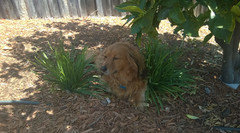
    I got my first taste of companion planting the past year from Chipper my pooch. Planted some chive plants under an orange tree, and the two of them, plus my pooch, have become good companions. They all seem to like the watering schedule, and the dappled shade from the tree is liked by the chives and the pooch. Not sure if the chives provide any benefit to the tree. But they don't seem to be causing it any problems, either. So that's when I started looking for more companion planting combos to try.

  • 10 years ago

    Yepperbepper, no chance of me giving up at this point, at least when it comes to growing food :-)

    I killed 99% of what I tried to grow up until 50 years old. Then at 50 I was starting to look at retirement at 55, and decided I wanted part of my retirement plan to be growing as much of my own food as I could. I'm about 2 1/2 years into learning that with many John Kohler and Back to Eden videos along the way.

    What I plant in the ground now does seem to love what I've done with the soil so far. Now I'm learning the plant side, and what does/doesn't go together. 2 1/2 more to go :-)

    Somebody mentioned getting frustrated - oh, no frustration here. I've worked in the tech field for almost 30 years. So I guess in some way frustration is what I thrive on. When it doesn't work the first time, and it usually won't, try another way, then another way, then another way.

    One thing I finally realized at that 50 year point, I was really good at keeping fish alive - some for almost 20 years. And my focus there was always on the water. and then light when it came to corals/anemones. I carried that same idea over to plants - it's the water stupid (me, not you), and the soil that are important to get right first. Then learn about the fish's needs, or in this case the plant needs for companions and light. Once I started looking at it more that way, my plants started to live and even thrive in some cases. Not all, but %age that died started to drop down nicely for the first time.

  • 10 years ago

    Chipper is a great looking pooch! Glad he found a nice place in the shade to spend the summer.

  • 10 years ago

    Suzi asked if the corn ended up being edible, so here's my follow up for that...

    It depends on your culinary taste buds, I think :-)

    I picked my first ear today, as it seems like they are moving more towards brown, so not going in good directions. Could be lack of water, or the 100 degree temps here probably.

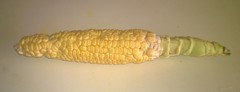
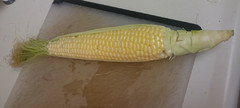
    This was the ear picked today -


    The kernel side of things is about 8".
    This was Top Hat sweet corn - I'm not sure if that's important.
    It actually pollinated a lot better than I thought it might based on what I was hearing/seeing/reading. I never did get around to manually pollinating.

    And please don't take this as any indication of the Top Hat sweet corn being good or bad. I've killed every plant but one from the time I was born until I was 50. I'm a bit over 52 now, and I'm actually now trying to keep plants alive.
    So that I can keep a plant alive, and actually have it result into something that might be edible - that's simply amazing, even if it doesn't taste all that great.

    Is it edible? That's where it probably depends...
    I ate a row across it that was probably about 3 kernels high.
    It wasn't bad, it wasn't good, but my taste buds are not very sensitive.
    It seemed very starchy and dehydrated.

    I'll probably pick the rest in the next week, cut off the kernels and freeze them, and then add them to crockpot chili.

    Next year, I'll try a 4'x4' corn patch, 9" between stalks, no squash or beans this time, and learn more about what they need for water. I think they would have done okay if the squash hadn't stole all their water/nutrients.


    Greg


  • 10 years ago

    If it's any comfort, a couple nights ago we dined at a prime rib restaurant that is famous for it's creamed corn. The night previously we had store bought corn on the cob microwaved for 3 min and finished on the grill. The store corn was crisp and sweet. The fancy restaurant's pricey creamed corn was tough and blah. Sure it was sweet cuz they loaded that cream with sugar! Your corn will probably be great in your chili!

  • 9 years ago

    @ZachS. wrote:

    "Perhaps there are variables that made it practical for the societies east of the Mississippi but not west of Rocky Mountains."

    The theory most often presented to explain the three sisters companion planting benefits is this:

    • The corn gives the pole beans a structure to grow on. Corn is a heavy feeder, needs nitrogen.
    • The beans fix nitrogen, providing additional nutrients for the corn and the squash. Beans should be started when the corn stalks are at least about 6 inches tall.
    • The squash has big leaves, and shades the soil of the mound. To some extent, this protects from weeds sprouting and robbing nutrients from the crops. Start the squash last, after the beans have sprouted and are trained to the corn stalks. Otherwise it will shade the other crops and stunt their growth.

    Varieties do matter, winter squash (for drying and preserving), "flour corn" for drying and preserving (popcorn might work as well), and beans for drying.

    Sorry to resurrect a zombie thread from last year. It came up in a search I was doing for a friend who is wanting to try this this year.

    I don't know how bad weeds are out in the southwest. That might be one of the benefits for eastern tribes.

  • 9 years ago

    Thank you - no worries on resurrecting - this is a multi-year learning experience for me. I actually just started germinating the corn last Friday inside, and 16 out of 24 have jumped up to almost 2" already, so 16 is good enough for me to start with, and I'll be putting out in the corn patch either Friday or Saturday most likely. Also changed the irrigation and setup a grid with drip line with built-in emitters to try to get the area some better irrigation this year.

    Decided to do the beans up a trellis this year to see their growth pattern this go around.

    And I'm thinking I might try cukes instead of squash this year. They also seem to provide good ground cover, or vining, and I juice a cuke daily, so a good use for the space if they work well together. Corn and cukes seem okay planted next to each other, so we'll see how that works. And rather than get the timing right - I'll just go get a couple big-box cuke plants this time so that they're a good size to plant once the corn is maybe 6" high.

    Weeds on the western side - a problem? Yes and no. Where I've not added a few inches mulch they're a major problem. But where the mulch is, they're fine, and easy to pull out when they do show up. The area where the corn patch is is mulched pretty good, so need weeds there. The mulch might even be all that's needed to keep the soil shaded and warm. But if cukes can grow there as well, well that's just a bonus each year then.

  • 9 years ago

    Common, I am familiar with the given reasons for this "mixed planting." However, I don't necessarily think they are entirely accurate.

    First of all, the beans feeding the corn: while the beans are actively growing, they are not contributing any extra nutrients to the soil that the corn could use. Not in any significant amount anyways. The "nitrogen boost" comes in following seasons after the prior years beans have decomposed. It is far better and more beneficial to follow a rotational planting structure rather than a companion planting one. Of course native people didn't know about bacterial colonies fixing atmospheric nitrogen a thousand years ago. I find it far fetched to say the least that they would have come up with the idea that growing beans on their corn stalks was feeding the corn (regardless of the fact that it is erroneous) without that knowledge. However they could have noticed that corn planted in last year's bean patch grew better, but that would lead to following the more practical rotational scheme.

    Abd what about using corn as a trellis? Bean vines can easily overtake a corn stalk, robbing it of airflow and light and likely diminishing yield. Not something a culture that is fairly dependant on corn for their very existence is likely to be beholden to.

    The notion of squash providing a mulch of sorts does work, but again, that is something we would expect to at least ALSO find in the agricultural societies of the South West where the water saving benefit of this "living mulch" would be a tremendous benefit. But we don't find this to be the case, at least not as far as I know. So why not? If the Three Sisters planting works as well as purported, why are the other native cultures that are growing the same crops not utilizing it? Where are the records of early Europeans coming in contact with Indians who use this system? I have never seen or heard of any, not that that means they don't exist of course.

    I believe that the Three Sisters is a historical fallacy. The much more likely reality is that this style of gardening is a much more modern development that was fancifully attributed to the American Indian. The reason that it doesn't often work well for people is because it never has really worked, it has only ever "looked good on paper" and given the fun story that "this is how the Indians did it." Of course that is purely my opinion, which I freely admit is only of marginal worth ;).

  • 9 years ago

    I will say Zach that you make some good points but there are many ways that people can easy do this 3 sister planting and fail. if the Indians did do this they probably had a fine tuned of way of doing it and only the basics of it reached today's society. now first off with the beans, you have to inoculate them with something along the lines of this http://www.johnnyseeds.com/tools-supplies/inoculants/garden-combination-inoculant-9321.html because the microorganisms that help add nitrogen to the soil are normally in to little amounts to be of any help. now, when you're growing plants you should add compost and such to the soil before you plant, that will feed the plants for the season. the corn needs a lot of nitrogen so you grow the beans up the stalk of corn and as soon as the harvest is done of the beans you cut the beans just below the soil line so the the nitrogen nodules on the beans roots can become available to the corn. something about the beans choking the corn, it only does that if you let it do that, you have to guide the bean up the corn in a way to keep it from choking the plant. Now, for the squash. you can grow any like vining cucurbit at the base but for what it does? it only helps suppress weeds up here in the south. where I live the summer temps always get up to at least 110F and thus the vining cucurbit hardly helps conserve water, it might work up north where it doesn't get anywhere near as hot but down in the south you have to mulch to conserve water.

    I hope all this information is of help to you :)

    Dawson

  • 8 years ago

    No more three sisters for me. Got terrible germination of the corn last year - I put the kernels directly in the ground last year. I don't think I had consistent watering, and no added compost. Got some stalks, but zero pollination.

    This year is looking better, though. And I now realize three sisters doesn't match what I want. I want fresh sweet corn right off the stalk to eat raw. That's my main priority with it. The beans and squash I have other places that make more sense for me to grow those.

    I'm just one guy, so I don't need massive amounts of corn all at once.
    And the SoCal growing season is pretty long for corn I believe.
    Would be kind of cool looking to have a 4' x 4' patch of healthy looking corn.
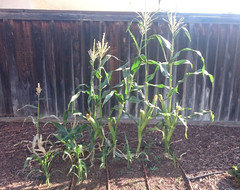
    My patch below doesn't look all that great.
    Picked an ear about 2 weeks ago - great pollination, not very sweet, but it was crisp not starchy.
    Picked another yesterday - deeper yellow, still crisp, and sweeter - very close to what I was hoping for.
    Was surprised pollination was so good with so few stalks, but it was.

    So my new plan... germinate inside - then I can pick the best ones to plant out.
    Plant out two rows of 5-6 stalks each every three weeks. And then circle back around for a second rotation mid-summer.
    I think that should get me some good eating sweet corn possibly from mid July until possibly into September.

    Oh, and I added compost about a month before planting the first row this time, and got more consistent on the watering this year also.

    Ugly corn patch this year


    But good tasting sweet corn from that ugly patch :-)

    In doing the rotation like I plan to, now three sisters just doesn't make sense for me, especially after realizing my main goal was the sweet corn.

  • 8 years ago

    Sorry you had to learn the 3 Sisters lessons the hard way. Just FYI, but corn needs much more nitrogen than just compost can supply so you might want to keep that in mind for next planting.

    Dave

  • 8 years ago

    Thanks Dave,

    Will look into that next.
    I put in worm castings also, but it doesn't sound like they are strong on the Nitrogen side, but do add some.
    Would it make sense to try to keep some borrage growing in that patch in the off-season, and chop it down when it comes time to re-start the corn?

    It sounds like borrage has deep tap roots that could help bring up some nitrogen from lower. And if I remember right, the corn seemed like it had very shallow roots.