Software
Houzz Logo Print
djsmith02

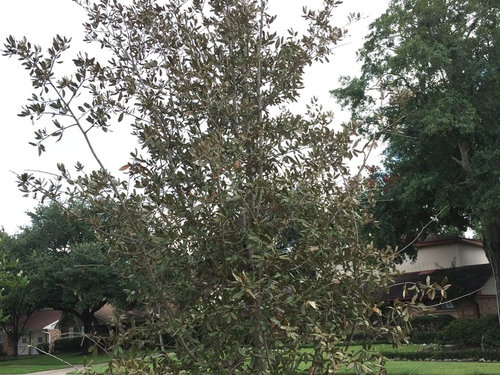
Help me save this young live oak!

10 years ago
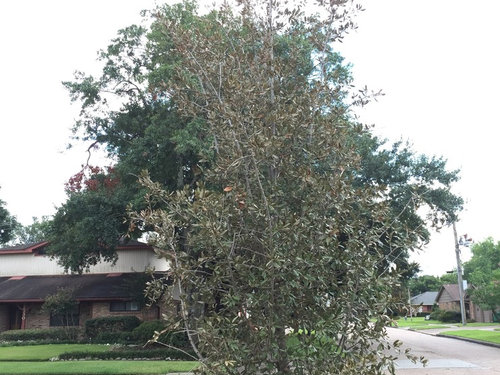
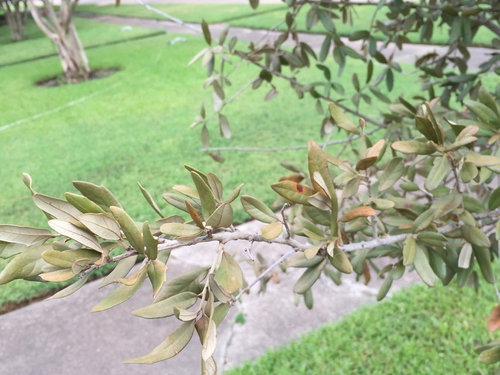
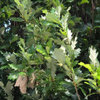
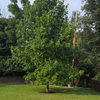
We purchased it about 2 months ago in Houston Tx. My yard guy suggested I don't water it much because that can kill these trees often. I watered about once a week and it rained a lot. About two weeks ago we had a small drought and I kept my watering the same. It has started raining daily since. Over the last two days it has noticeably turned brown. I've attached some photos. Suggestions.

Comments (24)

  • 10 years ago

    Any suggestions on this one?

  • 10 years ago

    You must remove the tape giving it a strangle hold to the useless stake.

  • 10 years ago

    Will do that for sure but I'm not sure that's what is causing it to turn brown like this. Am I watering to much? Am I watering to little? Is it dying?

  • 10 years ago
    last modified: 10 years ago

    Planting trees in Texas, in the summer, is risky. It's impossible to say for sure what exactly is causing this, it could be: overwatering if the soil isn't draining, underwatering if irrigation isn't reaching the roots, insects, transplant shock in our extreme heat and scalding sun, if the tree was not planted properly, etc. Live Oaks are pretty vulnerable to problems when newly planted. You need to try to check the roots to see if the soil below feels too soggy, or too dry. When I plant Live Oaks, and am not getting heavy rain, I water 2-3 times a week (sometimes more, in 100+ temps) ... a hose near the trunk and let it drip until the roots are getting enough water. But I'm in D/FW, different soil than yours. Houston is known for gumbo clay soil, which is super challenging in regards to watering correctly.

    If the leaves fall off, new ones should start growing. It's more dire if the leaves die and stay on the tree.

    I would take these pics to a trusted local nursery, ideally one that specializes in trees, and ask advice specific to your area.

  • 10 years ago

    it really doesnt matter what the secondary problem on the leaves are.. unless you perfect watering ...


    ken

  • 10 years ago

    Thanks all. I'll do that today and get back to you.

  • 10 years ago

    Ok. I was at home for lunch, dug a quick whole to about 4 inches into the root ball and it felt moist - not sure if id say soaked but certainly moist.

  • 10 years ago

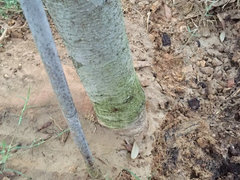
    Who planted it? I'd also wonder if it was planted too deep. Can you get a photo of the base?

  • 10 years ago

    Yes, please take a close up of the base. There are a lot of things that can go wrong during planting that can be seen at the base. It sounds like you did everything right.

  • 10 years ago

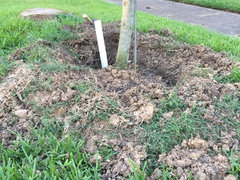
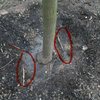
    Here is a picture of the base. You can see where the root ball is. I skimmed the top soil so you could see the root in the right.

  • 10 years ago

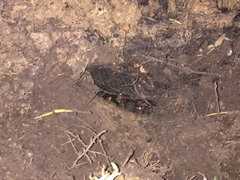
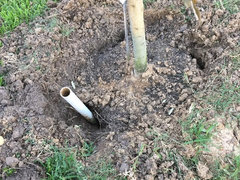
    I did some digging to the side of the root ball. I about 8 inches down I found the roots sitting in water. I'm guessing this is the problem.

  • 10 years ago

    You can see the water which is kind of shinny in the picture.

  • 10 years ago

    It's pretty common to see new builds with trees in a hole the size of the pot, dug out of clay- so water sits in there. I'm not suprised that's what you found!


  • 10 years ago

    That's exactly what I think has happened. What should I do? Can I save it?

  • 10 years ago
    last modified: 10 years ago

    I also think it might be planted a little deep...I don't see the root flare in the picture. And for a new planting during a drought I'd probably do a mulch ring.

    It's big enough to be hard to do much with. You could dig it up and plant it in a little hill of good soil but that makes it more vulnerable to drought.

    Is the area sloped at all? Doesn't look it in the pictures, but if there is there might be a way to put in a french drain or something to drain away excess water.

  • 10 years ago

    To add to Ed's comments, I too think that despite your efforts to scrape some soil off the top of the root ball-yea!-you stopped short, upon finding an adventitious root. These are roots that form above the root flare due to burial of the trunk in the nursery via cultivating practices that heap soil up on top of what should be the root ball. Extremely common. Still, this issue-while easily one of the most common and problematic in tree-planting-manifests slowly over time, not immediately as in this case. So, even though this tree is almost surely planted too deep, I don't think that's the reason for its present difficulties.

  • 10 years ago

    If you do lose the tree, consider a much smaller replacement. The root ball will be above the saturated layer, and the tree will adapt to the conditions. Live oaks are tough trees.

  • 10 years ago

    Too bad you don't know who planted it, you could make them fix it or plant another tree the right way. I'm far from an expert, but, I think if you can get it corrected, the tree should recover, but, of course the tree is likely pretty heavy, and has sent lots of roots out laterally making that difficult. Man, you';d think they'd train their tree planters right or hire people that know how to plant a tree! I would be PO'd for sure, especially if they consider any landscaping as a plus in the price of the house and land. You can replace cheaply I'm sure, local Big box stores or internet. I hope you can get the original raised somehow. Good luck to you.

  • 10 years ago

    It's hard to tell in this photo but highest root is about 1 inch from the dirt line if not right at it. There is a dirt ring around it in this photo which makes it look further below.

  • 10 years ago

    In this photo you can see 3 wholes I dug around the root ball. The one with the pvc pipe is the deepest. The other two are about 4 inches. I used a suck vac to pull the excess water out and it is much lower now.

    i was thinking of leaving it like this and seeing what happens. I called a nursery who told me it was probably root shock and it should be fine. Told them about getting the water out and they said that was a good idea. They said dig about foot down and I should hit sand. I dug down with that pipe but just for more clay with some sand. I could dig it out but I'm scared because it's certainly browner today.


    Thoughts?

  • 10 years ago

    I will just say that if it was my tree, I would make the rootball as close to the surface of the soil as possible. Oak trees usually put out deep roots when started from an acorn, you know taproots, and then some feeder roots etc. But, if you are planting trees that have been grown in nursery pots, and especially those last 2 pics of planted trees above. I would just say that planting those trees even with the soil, is the best idea. I hope that the (djsmith02) poster will maybe show a good result when maybe planting a Live oak in a planting hole. The previous post above, and the one above it isn't very exciting, but, i am hoping that if someone is going to replant (transplant) a small Live oak that they dig a hole that isn't deeper than the tree is deep from top of rootball to the last bit of roots in the bottom of the pot it came in. Even if the pot is deep, those top roots on the tree should remain in the top inch of soil.

  • 10 years ago

    "Root shock", huh? In my decades in this business, that is a new term for me! Transplant shock? Hells yeah. But root shock is an attempt I think to sound like you know what you're talking about....when you don't. Saying this of the nursery guy, not anyone in this thread.

    dj, the tree is clearly planted too deeply. And this is almost the norm in the landscaping business. Things we progressive arborists and horticulturists were looking into in the early 1980s are still completely a mystery to many, if not most of these folks. Sad situation.....tree installers are almost always ignorant.

    Still, that's not why your plant is struggling. I think it's just an extra heaping helping of transplant shock. Only one thing is going to make one bit of difference here, and that's moisture management.
    In other words, keeping the root zone moist, but not flooding it. Or to convey that differently, do flood it, about once a week, but then leave it be to somewhat dry down between these heavy waterings. And that of course assumes no rainfall. Watering is both art and science. One must get a feel for it, even though to the average person, watering is the easiest job in the world. T'ain't so.

  • last year

    I know this is an old thread but it really depends on the live oak you purchased. If its a `quercus virginiana or Southern Live oak it can survive in standing water for weeks. They get this type of water in florida all the time. If its a Texas Live Oak or Quercus Fusiformis it likes a somewhat dry to normal soil. Texas has both trees, Southern live oak trees along the gulf coast and the Texas live oak inland. My guess is its a fusiformis which loves water but needs well drained soil. seems like you have a clay layer thats not draining well.