Software
Houzz Logo Print
arbpdl

Need Kitchen Organizing Advice

10 years ago

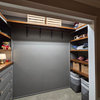
My kitchen is rather small. For one or two people it would probably be okay but for a large family it's lacking. Fortunately I do have a walk in pantry. It has two sets of double cabinets - that is, two uppers and two lowers, each a double door style. It is very narrow though, meaning when you are standing in front of the cabinets your back is close to the wall on the other side. Not much maneuvering room. I've never used it as a proper pantry before. I've wanted to, but there was other junk stored in there since moving in.

I've removed everything from my kitchen and painted the cabinets, inside and out so I have a clean slate. I've also removed the doors from the pantry cabinets so that I can use them as open shelving since there's not much room (before you'd smack yourself with a door if you weren't careful).

Is it better to store ALL food in the pantry and use the kitchen for non consumables or is it better to try to divide the food up between the two areas?

I was initially thinking a small supply in the kitchen and then my extras in the pantry, but that seems kind of redundant. Having the same thing in two places might get confusing and how would I decide what went where? When people help put groceries away I could see that being a disaster - no one sure which should go in which space.

On the other hand, having all consumables in the pantry would be extra steps since it's on the other end of the kitchen from the small counter area. Not that it's that far, it's a small kitchen. But isn't the idea to keep things in a nice work area so everytihng is within reach?

I'm ready to start putting things away and I'm not sure where anything should go.

Comments (6)

  • 10 years ago

    I don't really have a pantry, so most of our food is in the kitchen cabinets. I do have storage for extra things, though, like cereal and paper towels. I keep just the open boxes of cereal in a cabinet (next to the fridge, and above the cereal bowls), and the rest go above the fridge. New boxes from the store always go in overflow storage.

    I think it's OK to have a "working" supply of something, as well as extra. Perhaps you have canisters of sugar and flour near the stove, but 10-lb bags in the pantry. Before we remodeled our kitchen, our overflow storage was in the basement. Anything we bought in bulk automatically went downstairs. I think you'd quickly get a feel for what things would get put away in the pantry, and what goes in the kitchen.

    I also have a fairly small kitchen. One thing I did when we remodeled was to order extra shelves for every upper cabinet. That way, I can put items of similar height on the same shelf, and not have wasted space above (for example, coffee cups and mugs don't need as much height as water glasses). It increased my storage space a lot!

    I also got rid of a LOT of stuff! I'll bet when you emptied the cabinets to paint, you found things that you haven't used for a long time - I know I did! Once I got rid of things I didn't use, I had a lot more room for the rest.

    As you put stuff away, pay close attention to "point of use". Don't put things back where they were, just because it was there before. Potholders and cooking utensils go near the stove; containers for leftovers go in the cleanup area. My Mom has a small utensil drawer, and a box of things she uses rarely: potato ricer, melon baller, turkey baster, etc. I like to think in terms of Prime Real Estate - make sure you reserve the most convenient storage in the kitchen for those things that you use the most.

    Good luck with your project!

    arbpdl thanked AnnKH
  • 10 years ago

    In the kitchen I keep the food for quick breakfasts like cereal, drink mixes and coffee, and I also have refillable containers for the daily cooking items like oil, flour, sugar. Everything else goes in the pantry. My pantry is only 6 steps from the prep counter and I have a habit of looking at all that's available to decide what's for dinner so I prefer to keep it all together. All together in the pantry also makes putting together a grocery list easier.

  • 10 years ago

    Step one would be to get rid of needless redundant items - if you have three egg slicers it makes sense to get rid of two.

    Step two is to put cooking things close to where they will be used ... pots, pans, seasonings used at the stove.

    Consider moving the tableware to the dining area.

    Having items in two places can actually be convenient, and works well for us - when we move the last box of ___ to the kitchen, it's time to put it on the shopping list to restock the pantry.

  • 10 years ago

    I agree that the very first thing to do is to get rid of as much as possible. You would be amazed at how little you really need in the kitchen, even if you really do cook.

    A second tier storage area is nice, but another thing that becomes problematic are those sofa sized bundles of paper products that folks buy at Costco. You probably save no more that twenty cents or so on a roll of paper. Not enough to warrant having to store all of that. If the slight savings is important to you, you could always use just a little less and still come out ahead and have more room in your house.

  • 10 years ago

    I'm so glad you took the doors off the cabinets--that was going to be my first suggestion.


    I used to keep the canned goods in the dining-room buffet. It was annoying to have to step out into the dining room, but I also didn't need to suddenly grab the canned green beans--I'd decide on the menu and the gather things. So getting the vegetables or the kidney beans from a pantry-type area was OK.
    Keeping olive oil or flour there was not OK, because while I was cooking i might suddenly need them.


    I don't think you should think of that as "a pantry." Think of it as "away" storage. Or auxiliary storage. As non-"I'm cooking now" storage.

    So, stuff you use often in the kitchen (both ingredients and tools/equipment) stays in the kitchen cabinets. Stuff you won't use that often (including bulk storage) goes in the auxiliary storage.

    And stuff that you don't use in the kitchen (snacks, which you carry away to eat; cereal, which doesn't require prep; dog food, which also doesn't need to enter the kitchen) goes in the auxiliary storage.


    Mentally walk through making a meal (several of your most common meals). What do you touch, or measure, or use? Those things stay in the kitchen.
    What do you use less often? Or what do you buy a lot of? Those go in the pantry. Are there cooking/baking things you do infrequently? (Like, do you seldom bake, in which case having a baking section in the pantry might be sensible--get a plastic tub of some kind to put the most-used stuff in for bringing it to the counter.)

    I agree w/ AnnKH so much:

    "As you put stuff away, pay close attention to "point of use". "

    That's why I say you shouldn't think of your pantry space as food only, or tools only.


    In the pantry, store the lightweight bulky stuff overhead (extra paper towels, etc.), and the bulky heavy stuff on the bottom (dog food; cases of bottles water).