Software
Houzz Logo Print
c_nicole_carlisle

Need advice on new Jacaranda tree

10 years ago

I had a new Jacaranda tree planted about a year and a half ago. At the time, it was about 5 feet tall. Now it's probably 10 at least, probably a little more. Probably 3-4 inch-thick trunk. My issue is that my tree is now leaning to the side at about a 30 degree angle or so. It's fairly significant. I'm not entirely sure what happened, but I need to prop it up. I tried staking it without doing much digging, but the stakes popped out of the ground. Not the best plan as the stakes were basically just trying to pull it back the other way. My thought now is that I'm going to have to dig more significantly to re-straighten the plant and then stake it properly. My question is, does this seem like the best way to accomplish what I'm trying to do? I'm not sure there's another way at this point, but that is why I'm posting. My follow-up is, does anyone know how extensive the root system is after a year and a half? It's obviously still a fairly young tree and when I dig, I'll definitely give it some berth. I just want to minimize the risk to the tree. Thanks!

Comments (33)

  • 10 years ago

    Please show us a picture.

  • 10 years ago

    I sure will, but it'll have to wait until it's daytime. :)

  • 10 years ago

    One key determining factor here will be where it's leaning from. If the rootball has shifted and the trunk is coming out of the ground at an angle (this is my bet, based on your description), then the tree very very likely has a root system problem caused by improper planting technique. If the tree is leaning because of a bend in the trunk (and it's coming out of the ground straight), it's an entirely different situation.

    Sometimes people plant trees without eliminating potbound/circling roots. The existing roots are wrapped around the rootball and only a few escape the tight wad of roots as the tree grows. Also, as the tree grows and the roots get larger, the situation gets worse and worse as the root system starts strangling itself.

    Often, the potbound (or circling) roots are not evident without investigation of the rootball. I planted a tree, just the other day, whose rootball looked perfect on the outside. I cut just a few roots off of the surface of the rootball and was impressed at what I was seeing. Then I dug down into the rootball a little and found that the grower had repotted the plant without doing anything to the tight mat of roots from the initial smaller pot. After fixing the mess, I was irritated at the grower, but my tree had a much greater chance of long-term survival. This is a huge problem in the nursery industry, and, unless the planter is educated and aware of the potential problem, poor root systems (and leaning, strangled trees) are inevitable.

  • PRO
    10 years ago

    you could always prune it to make the crown straight

  • 10 years ago

    waiting on that pic or 3 ... ken

  • 10 years ago

  • 10 years ago

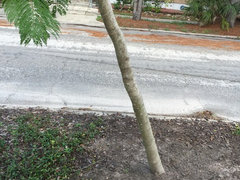
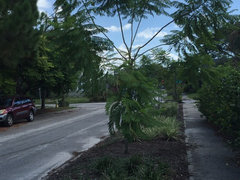
    First one to show the lean from the base and the second to attempt to show how tall it is. I appreciate the comments so far. I'm in zone 10a. Brandon, do you think what you described above could have happened with my tree? If that's the case, I definitely do not have the experience to remedy it as you did and would get some professional help. If it's safe enough to dig and then straighten, that's my plan a for the moment.

  • 10 years ago

    I don't know if this is true of Jacaranda but a lot of semi-tropical trees with wood that is really not hard enough to be considered hardwood (such as Chiranthodendron from Guatemala and Acacia) really need help establishing decent root systems. Left to their own devices, they do not establish systems that provide good support. It is really necessary to not only tease them out as far as you can when planting, but make sure to water gradually farther and farther away from the trunk to encourage root development. Also, better to water deeply and less frequently than lightly and often. With the others that I named, I have had them do what your Jacaranda has done, and due to the soft wood and lax roots, I have always been able to pull the tree up (generally after watering it) and stake it securely upright. I stake it as low as I possibly can to allow for maximum movement of the trunk. Again, I don't know if this is true of Jacaranda, but it is worth investigating. If you have to dig a semicircle on the side away from the staking, that probably won't hurt the tree.

  • 10 years ago

    Could be top heavy. Roots aren't established enough to hold up the crown. Pull it upright with a stake and tether. Run a piece of old garden hose or some such through the tether and line it up with the trunk so as not to damage it.

  • 10 years ago

    Concur that kentrees point could also be a factor. That happens to the trees I mentioned above as well.

  • 10 years ago

    Nicole, I think it would be a safe assumption to conclude that a lack of proper root preparation caused the tree's lean. It looks very similar to what I had guessed. Fixing the root system, at this point, would be a larger job than the average person would want to consider.

    The way I see it, you now have four options. The first is to do nothing and see what happens. It's impossible to know for sure. The tree might continue to lean more and more as it grew and eventually just fall over, or it might eventually gain a hold and become able to hold itself up, although with the distinctive lean. A second option, already mentioned, would be to try to dig the tree back up and replant, fixing the root system as best you could. That option would represent a considerable amount of work. The third option would be to soak the ground and attempt to straighten the tree. You'd have to stake it for quite some time and hope for, in my opinion, a small miracle. In the long run, the tree might become more stable, but you'd definitely be taking your chances as the tree grew larger. The final option, and the one I'd personally choose, would be to remove the tree and start over. You'd loose a year's growth and the price of the original tree, but, in the long term, you'd know you had a strong tree with a good root system.

  • PRO
    10 years ago

    also to add to brandon's ideas, you could cut it to the ground and train the new sprout to grow straight up. I am not familiar with this specific tree so I can't be so sure about this suggestion.

  • 10 years ago

    Again, I don't know if this is true of Jacaranda, but of the other tropicals that I mentioned, you could prep the roots all you want and they would still make a mess of it without help. These are not true hardwoods. I'd try staking it, probably helping it out with a 'root prune' on the opposite side. These trees are not like maples, oaks, elms, etc. Nicole - checking with someone local who is knowledgeable would be very helpful. Most of us don't live in zone 10 and are not familiar with Jacaranda. Good luck with it!

  • 10 years ago

    Thank you, Brandon and everyone else, for the input. I feel like I have to at least try to re-plant. I tried to stake it once before with minimal digging and it did indeed move back into a straighter position...it just didn't stay for long. This time I'll dig much more and if I end up having to replace the tree, then I will do so.


    As far as pruning it...I was kind of hesitant to do so since it's a new-ish tree. But maybe not anymore? Best time to do that, however, would be winter, correct? It has so much new growth on it right now that I'm really wary of cutting any of it.

  • 10 years ago

    I'm less apt than many here to suggest staking as the answer to slight leans, etc. But this isn't slight, and as the tree is still fairly new in the ground, I'd either go the staking route or re-dig and re-plant. It's too much of a lean-IMO-to just leave be. And again, that's coming from me, a guy who normally doesn't see the need for straightening of minor leans and squiggles, to use the scientific term.

  • 10 years ago

    it might be planted to deep also ... telephone polled ...


    go gently dig around the trunk.. and find the root flare ...


    then we can tell you how much digging is required ...


    i really think you will need to redig the whole thing... in the proper cool season .... and set it straight ... this need not necessarily mean digging it out completely.. unless it is too deep ... of course this might not apply to the trees sara talks about ... they are out of my personal scope ...


    who planted this ... if you hired it out.. i would be calling the dude back ...


    because of the huge canopy .. you will need some significant staking ...


    this is one reason ... i usually suggest a much smaller tree ... smaller problems ... and now.. for the two season you have wasted messing with it.. the smaller would have outgrown it ...


    out of curiosity.. big city name please ...


    ken

    https://www.google.com/search?q=root+flare&source=lnms&tbm=isch&sa=X&ved=0ahUKEwi82q6WrqDOAhVH4SYKHXiOAFMQ_AUICSgC&biw=951&bih=745&dpr=0.9


  • 10 years ago
    last modified: 10 years ago

    These kinds of trees don't always have a pronounced flare. Ken's suggestion to check in with whoever planted it is a good idea.

  • PRO
    10 years ago

    I don't know if anyone else here will agree, but my general rule for pruning is anytime the tree isn't in bloom. This rule does exclude crepe myrtles (they still should not be pruned when in bloom). If you are re-planting/staking or digging anywhere around the roots you may have some slight root loss, pruning would help it develop new roots. Just because something is new, doesn't mean it can't be pruned.

  • 10 years ago

    I disagree with the above statement. Auxins-plant growth hormones generated primarily in growing tips, send chemical signals to roots to "tell" them to expand. Thus, removing stem tips, ie, pruning, will only slow down the plant's ability to regenerate a root system, which, I think, we can all agree is job number one for a new transplant.

    There used to be a (bogus) rule of thumb that one should seek to "balance" the loss of roots at transplant by reducing the crown (upper portion, branches and so on) of a newly transplanted plant. This has been conclusively shown to be erroneous.

  • 10 years ago

    "I don't know if anyone else here will agree, but my general rule for pruning is anytime the tree isn't in bloom. This rule does exclude cr(a)pe myrtles..."

    I would strongly disagree with this suggestion! And, BTW, there's nothing special about crape myrtles (which, BTW, are not being discussed here by the original poster) in this regard. Different trees have different pruning requirements, but (for instance) significant late season pruning (before dormancy) is rarely a good idea. Ironically, many trees can be safely pruned when in bloom. Winter (especially late winter just before bud break) is most often an optimal time for pruning.

    "(Y)ou could always prune it to make the crown straight(.)"

    I don't think that's a good solution in this particular case.

    _____________________________________________

    "I feel like I have to at least try to re-plant."

    Here's a link that might be of some help: Planting a Tree or Shrub

    If you have questions about replanting, please ask. This might be a good time to cover that topic, if you are not certain what to do or how to do it.

  • 10 years ago

    Lots of great discussion here. So, if I'm absorbing what I'm reading correctly, is the consensus to not prune right now? I was not planning on it, in any case. Brandon, based on the link you gave me, I should try and wait a bit before trying to re-plant as we are still in the middle of summer? (I think I mentioned above I'm in 10a, St. Pete, FL.) Although, we really don't get much of a "fall" around here. It's mostly just hot and then a little less hot. I'm a little hesitant to wait to try this as it has really been bugging me and one of the branches is now hanging over the sidewalk. Kind of eager just to try it and see if I can do it or if I need professional help to get it done. Or if I just need to get a new tree, which I really hope isn't the case.


    So a few questions about re-planting, then. Ken above mentioned to check out the root flare. I'm guessing that's important to know so that I don't harm those roots anymore than I have to. So I would dig around and under the root flare? Your link also mentions not to stake unless necessary. That one I'm not sure of, based on the issue I'm currently having. It should be noted that I actually have a second one of these trees that is doing perfectly fine, all nice and straight and beautiful. I'll post additional ones if I think of anymore. Working overnight shifts, so my brain is a tad less than optimal at the moment!

  • 10 years ago

    This is gonna be brief, because I got to get to sleep...

    prune - Correct, I would NOT prune. It won't help a thing, and it would decrease the tree's ability to reestablish when you replant.

    timing - December/January would be much better. On average, the weather is 20 degrees F cooler then, compared to now, for your area. The tree would have a much easier time and experience less transplant shock then. You might want to stake the tree, to prevent it from getting worse, until then.

    root flare - It's where the top roots emerge from the trunk. It's important because it lets you know how deep to plant the tree. The root flare should ideally not be below grade.

    staking - In this case, it's almost certainly necessary. Do it! ...but do it right.

  • PRO
    10 years ago

    Nicole - you are in a tropical zone with tropical trees. While much of the advice here, such as Brandon's, is good, generic advice, it would really be best to check with a local expert who is familiar with your climate and your flora. This is not a hardwood and behaves differently. If this tree is important to you, check in with the folks who planted it or find a local expert. Good luck - they are beautiful trees.

  • 10 years ago

    The term "hardwood" is being maligned in this thread. This species is most certainly a hardwood. It's just that that term has relatively little meaning. So, here in the north, aspens are "hardwoods" but they have soft wood. Hardwoods are basically all trees that are not conifers. I didn't invent this convention, but there it is.

  • 10 years ago

    Thx Tom - I didn't know any other way to say it. And no intention of maligning hardwoods or the term. I just know that my Acacia, Chiranthodendron, etc don't behave like my beeches and elms. I live in a weird climate where plant worlds collide and I've had to learn (generally the hard way) (pun intended) that I have to adapt my methods. My x Chiranthofremontia lenzii fell down three times because I just didn't understand the root system, and finally went back to SFBG, where I got it, and talked to the Curator. I ended up staking it far more severely than I would have thought necessary, and adjusting the watering significantly while it established roots. Acacia are known for needing deep watering to get established, due to their less-than-optimal root formation and they lean all over the place at the slightest provocation. Jacaranda may not fit this category - I have never grown one but after this conversation I am now sorely tempted - but in many ways these trees act more like large shrubs than trees. Would love to hear from a Jacaranda expert. LA is gorgeous when these trees are in bloom, especially when you are flying in and can see them from the air.

  • 10 years ago

    Hi Sara. I'm no subtropics expert although I have spent considerable time in S. Florida and know a top-notch Extension Hort. agent down in Fort Myers well. So that said, I would urge you and all readers to run-don't walk-to U-FL site of Mr. Ed Gilman. If there's a tree topic, Ed's covered it and his research is being applied nation-wide.

    Also, if I may give a shout out to my buddy in Fort Myers, Mr. Stephen Brown. He has made numerous You-Tube videos covering a vast array of plant topics, and does a really nice job of it. Much, much can be learned by doing nothing more than viewing Stephen's videos....I promise.

    Finally, while I started out by saying I'm no subtropics expert, most tree-related issues do in fact run in common with those of further north. It's just that things are speeded up in FL and other very warm, wet places. As such, in a way, research can proceed rapidly in such climates, but again, is then made available for where things move more slowly.

    I thought of another so-called "hardwood" which happens to have wood so soft it was formerly used for carving-American linden, AKA basswood. Almost balsa-like, yet this tree species is a key component of the northern hardwoods forest type.

    In any case, I love a good Jac, and I hope it works out!

  • 10 years ago

    Oh what a good idea. I know of Gilman's work and my arborist has cited him often. And there he is in Florida, just where the OP needs him.

    What I find with the, ahem, 'softer' hardwoods is that they grow so fast that they produce a full crown before their roots are even close to being able to support them. I mean structurally, not vascularly. I planted a Quercus robur (a variegated one - lovely) at about the same time that I planted an Acacia covenyi. The Acacia shot up, branched out, was absolutely enormous within three years, while the Quercus just sort of sat there. The fourth year the Quercus woke up and went to town, but it was clear that its root system was developing the entire time. The Acacia didn't bother to develop roots first. That oak isn't going anywhere, is ramrod-straight (they were both #2 or #3 gallons when I planted them) and will be here for many years. With the Acacia I feel like I have a rebellious teenager and whether he makes it to adulthood is by no means certain. But it is sea-green, has fasciated tips and really is drop-dead gorgeous. This is why it is much easier for me to talk about the trees that I love than the trees that I hate.

  • 10 years ago

    Excellent. Thanks very much, Tom. I will check out the names you mentioned. I also plan on giving a few places locally a ring to ask about it. I like to hear from multiple people when learning about plants and trees. I love the heck out of jacarandas so I really hope this works out and again, I appreciate all the comments.

  • 10 years ago

    Nicole I am serious - after reading all about your problem I starting reading about Jacaranda and I think I'm going to try one!

  • 10 years ago

    You totally should. I can't wait until mine bloom- they're so pretty.

  • 10 years ago

    Sara, your observations on tree root system development are most interesting. To put it very simply, I have no idea if the basic premise is correct or not, but your experience counts for something! We do know that at least among the "hardwoods", hehe-there's that term again, it is the very fast-growers which put relatively little energy into defensive compounds, wound compartmentalization, and such. Therefor, these are the trees which grow quickly and die young in tree terms. And just to complete the picture, among conifers, this rule simply does not apply. Take just one well-known conifer-white pine; Known for very fast growth, these things are "only" good for about 600 years where conditions are suitable, and Mr. Husqvarna and Mr. Stihl don't show up! So that's not a short life by any standards. And if we look to such items as coast redwoods, et al, some even greater examples can be found. But I digress.

    c nicole....wishing you the best of luck with your jac. Very impressive trees at maturity, and Florida (I think that's where you are) needs all the good trees it can get, IMO.

  • 10 years ago

    Indeed it gets more interesting still when you add issues such as defensive compounds and wound compartmentalization. Makes me want to do both more reading and more watching. Thank you!