Software
Houzz Logo Print
idabean2

vermin proof compost bins

We have rats. Ugh. We're working very hard to clean up the weeds, debris and rocks that have accumulated around the property.

Now I'm planning what to do about the compost pile. I stopped using home made bins because shoveling compost from one to the other, or even turning it within the confines of the bin was backbreaking. A passive pile worked fine for my purposes: once a year or so I'd take off the top layer, put it on ground next to the existing pile and extract finished compost from the ground layer. I just didn't need anything faster or bigger than that. We've always been very careful not to add meat, grains, corn, eggs. However, 9 months outof the year our vegetable scraps and green yard waste are just put on top of the growing pile.

Obviously, we need a composter that the rat's can't use for a dining room. I would really appreciate recommendations. DH isn't interested in building one. I've composted for so long I can't imagine not having one....

Thanks for any suggestions you may have.

Marie


Comments (41)

  • 10 years ago
    last modified: 10 years ago

    The tumbling composter was invented just for you. These off-the-ground barrels are designed to keep vermin out while still letting air in.

    But, while the concept is simple, executing an efficient, workable design is challenging. Here are some of the things to be aware of when shopping (or designing your own, if you are so inclined):

    • Bigger is better - if you want it fast, you have to approach that 3 x 3 meter ideal volume recommended for piles on the ground. The tumbling action does make up a bit for a lack of volume, but not a whole lot.
    • Big bins can be difficult to turn - how much upper body strength can you muster to rotate a large volume of compost? Some designs are much better at dealing with this, but the trade off is that they also cost more for the gears and more sophisticated handles and turning mechanisms. On the other hand there are smaller tumblers that are easy to turn, but you are sacrificing that optimal volume.
    • Cheap plastic bins can wear out in a year or two - particularly their latching mechanisms. They can also wear out at the seams if you constantly load them to capacity (which you want to do - see the first bullet point). Either of these issues can make them unusable, and vulnerable to rats.
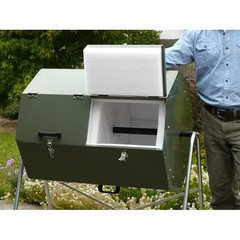
    • Well designed and built tumblers are complicated to assemble - yes you only have to deal with this issue once, but just note that a moderately sized tumbler with insulation and good turning mechanism (like the Jora pictured below) is definitely a two-person project that will take an entire afternoon. Simpler designs with just a few plastic panels, on the other hand, aren't terribly complicated.
    • Air holes are tricky - too many and you have a leaky mess that lets in rain which over saturates the mix. Too few or poorly designed air vents block easily and prevents good air circulation - the main purpose of a tumbler design.
    • Insulation pays dividends - an uninsulated bin suspended in the air is at the mercy of the ambient air temperature. The smaller the bin, the more this is true. Insulated bins keep your compost active through the colder months.
    • Dual bins make sense for the home - For maximum efficiency a bin should be filled all at once, and then left to process for a number of weeks. However, that is not how we usually come across our compostable materials. A dual bin system is a compromise that lets you gradually fill up one side, then close if off to process while you gradually fill up the other. So the size of the a bin should be equal to the amount of material you produce in the time it takes for that material to at least finish the bacterial (hot composting) stage of decomposition (or the point at which it is sufficiently broken down that the rats are no longer interested in it).

    Here are two examples.

    Jora JK270 $400

    The Jora ticks all the boxes. It is made of steel rather than plastic and the well placed handles and balance make it not difficult to turn. The insulation extends it's usefulness through the winter, when most other composters will grind to a halt. The JK270 is a bit on the small side when it comes to having the mass work quickly - the larger JK400 ($800) is the model for faster composting or for families that produce a lot of waste material.

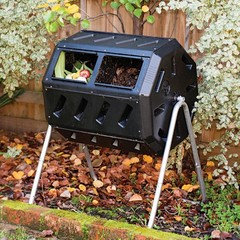
    Yimby Tumbler ($100)

    I got a Yimby for $5 on Craig's List. It's dual bin, but too small to get a lot of heat going. It's not difficult to turn, due to its size. I have had mine for two years now. The sliding bin doors are cracked, but usable, and the plastic panels are bulging at the seams from the weight of the compost. Eventually they will give way - this will probably have to be replaced next year. But, I am a single person with just a 10 x 20 community garden plot, so it does the job and it was practically free, so I'm not complaining. Bottom line, it makes compost and keeps the rats out.

    So, the good news is that yes, there are rat-proof composting solutions for home gardeners. The bad news is that they either

    • Expensive to buy off-the-shelf
    • Require a hefty investment of DIY time and skill
    • Are cheap, slow, and will break down after a couple of years
  • 10 years ago

    The only reason a bin is needed would be to help contain the material being composted. A bin is not needed to make compost. I have made compost many times without a bin or container of any kind simply piling up the material in the middle of the planting bed where it would be spread later.

    A bin does make for a neater yard, but is not necessary for composting.

    kimmq is kimmsr

  • 10 years ago

    Very true. But, then what about the OP's rat problem?

  • 10 years ago

    Yes, kimmq is not speaking to the OP's true issue.

    Instead of one dual-bin system, I use two bins. One is always the working bin, while the other rests. I add water and flip the resting bin whenever I do the same to the working bin. Both of mine are from Gardeners Supply and come pretty much pre-assembled.

    Gardener's Suppy - composting-supplies-sale

    Single bin system (what I'm using x2): single bin compost tumbler


  • 10 years ago

    Argh, rat control ... you only have to make your place less hospitable than the neighbors.

    1 - cleaning up brush piles, rock piles and other shelter will make your place less hospitable to them. Especially clean up along fences and foundations.

    2 - the tumblers on legs will keep them out of the food scraps.

    3 - Place the tumblers and any wood piles and yard waste bins with a clear space the rats have to cross to get to them, a space as wide as you can make it. They HATE doing that because it exposes them to aerial predators like owls.


  • 10 years ago

    "The only reason a bin is needed..."


    Ya, like there could never, ever be another reason.

  • 10 years ago

    How about switching to vermicomposting? I don't do it myself, due to a teeny kitchen, but if you have room, it might serve for composting inside. This looks like an objective explanation: http://www.sustainabletable.org/114/vermicomposting-101.

    It's hard to NOT have rats in a city; I wish you all the good luck in getting rid of them ASAP.

  • 10 years ago

    I let stuff rot in a well sealed trash can. added to the compost pile after it has rotten, it does not seem to attract rodents. There is also the 6 gallon bucket half full of water, with the surface covered with sunflower seeds. It is deadly to chipmunks (you can add them to the compost pile).

  • 10 years ago

    You could do vermicomposting inside for your kitchen scraps, and continue your present "cold" composting process outside with just the green yard waste, which the rats won't care about.

  • 10 years ago

    Once I got pest control out I moved my compost bins away from the house where the hawks, owls and barn cats could take care of business! No problems since! Nancy

  • 10 years ago

    Thanks for the interest and answers. I had thought of the rotating composter many times. I'll post on freecycle and look on craig's list just in case. I live in a densely populated suburban area and though the lot sizes may be large the generally affluent population often isn't in the composting frame of mind. In my own neighborhood 7 out of 10 neighbors have landscapers mow their lawns. We like to mow our small lawn ourselves (the other 9/10s is garden, trees, woods-like) this is by way of saying I don't have a lot of hope about finding a great quality composter at a small price!)

    Odd about habits of a lifetime. I pick recyclables out of our garbage can. I'll snatch the yogurt containers "someone" is too lazy to wash and rise them for the plastics. The idea of putting greens in the trash just kills me, even though I'll have to do it it until we get a secure composter.

    You all have given me a great start on composters as well as encouragement.

    yes, we are getting on top of the messy edges and accumulated debris. It's overwhelming when I look at it all at once, but actually manageable if when it's tackled an hour at a time. By November we might be done!

    Please keep posting....even your experiences with rats will be welcome reading.

    Marie

  • 10 years ago

    Tumblers, raised up off the ground, may help keep vermin out of the compost, but the best method of keeping vermin out of the compost pile is to build it properly and they will not go there.

    I have never had a problem with vermin getting into my compost piles in over 50 years of making compost.

    kimmq is kimmsr

  • 10 years ago
    last modified: 10 years ago

    I have never had lions, tigers or bears get into my compost. If people in Africa are getting lions in their compost they must be doing it wrong. :-P

    I do get mice though. Because there are mice in the fescue hay fields and lawns all around me. Hard to keep out mice, they can squeeze through anything.

    I have not dealt with rats but I do coordinate a composting area at my office building and we were concerned about raccoons and other varmints. We use black plastic bins with a locking lid like the Home Composter or the Earth Machine or other similar ones. We've used a number of them. We place bricks or blocks an inch or so apart as a base and set chicken wire or wire mesh (hardware cloth) on top, then the bin. Keeps anyone from tunneling underneath. Never had a single problem in almost 20 years with this system. I can't guarantee rats will not chew through the plastic but you could try it.

  • 10 years ago

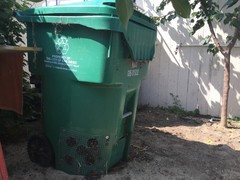
    Here is my compost tub. A modified green barrel from the city. I own a duplex so I have two. I pile it in the top and shovel it out the bottom. No turning nothing. The backs and side have air holes.

  • 10 years ago

    Sorry forgot water.

  • 10 years ago

    I haven't bothered to determine whether rats, raccoons, chipmunks or possums are chomping at the melon rinds. Before I never much cared which mammal opportunist it was. Have not seen rat holes in or near the compost. But it made sense to me to not leave fresh fruit offerings out in the open.

    I've been on "gardenweb" for over 12 years, I think, so I'm slow to take any comment personally. It does feel personal at times. But I've put my foot in my mouth often enough here so a low ignition is safer.

    I'm still interested in composter options and I'm keeping track of recommendations. I think it would take a few days for a rat to eat through that thick plastic and I'd have time to deter it- either by redirection or rodentcide- before it got through


  • 10 years ago

    Nothing better than a good rat-in-the-compost story....


    http://forums2.gardenweb.com/discussions/3000021/oh-rats

  • 10 years ago

    The Youtube video that never was, but should have been...

    Friends of mine have an aggressive little terrier that's very destructive toward dog toys. He'll shake them to break their necks, have their heads off and their stuffing out in no time. His talents are wasted in a city condo: he should be out there in Lloyd's fields, breaking rat necks.

    Worms LOVE melon rinds. You could be Lady Bountiful to a bin of grateful worms. Granted, their emotional states can be a little hard to read but some of their wiggles can definitely be read as "Thanks for the melon rinds, kind human!" Either that, or "Yum."

  • 10 years ago

    I have had mice (voles), raccoons, opossums, skunks, squirrels, and dogs and cats wander through the yard at various times over the years but have not seen any sign that they have visited my compost piles whether free standing or contained.

    I have been asked, numerous times over the years, by others why their compost piles have been invaded by those critters and have found that it always comes down to items put in, or on, those piles was in the wrong place, too exposed, not well buried.

    A properly constructed compost pile will not attract unwanted vermin.

    kimmq is kimmsr

  • 10 years ago

    I'd say ours met all three criteria for the wrong way.

    Today we hauled out all the bigstuff left in it. And ilm about to screen the rest. Then we start from scratch the right way.


  • 10 years ago

    "A properly constructed compost pile will not attract unwanted vermin."

    Not in the city. Ever see "Ratatouille"? Washington DC is Vermin Central. (And I'm not talking about the lawyers and lobbyists.)

  • 10 years ago

    I think anyone who says they have never had any rodents in their compost has never composted. It's that simple.

    But I will also say that once you get a compost pile HOT you can add almost anything to the middle w/o having the rodents get to it.

    This advice may not help the OP but may give other readers some ideas.

    Last year I reinforced a 3x3ft bin made from Trex material that had no top or bottom, only sides.

    The idea was to keep any rodents out but allow for good air flow which plastic with any amount of holes does not allow for.

    So I bought 23 ft of 1/2in. hardware cloth to line the above mentioned compost bin which sits right on the ground and at the edge of my garden bed.

    I first laid a piece on the ground to set the bin on. I extended it out the front 3ft so that piece was 3x6ft. This was so anything that dropped to the ground while working on the bin wouldn't attract something to just borrow down and up into the bin. I leveled the bin in place.

    Then the inside of the bin was lined with the hardware cloth.

    I used tyraps and safety wire to hold the hardware cloth to the bin frame and to the piece on the ground. If you know how to cut the hardware cloth to have tangs you can also use those to hold the pieces together.

    Then I made a frame that would slide on/off the top and screwed some hardware cloth to that. The extra 2ft allow room for the top piece to be custom overlapped.

    I use an old shower curtain on the top to keep rain out of the compost - this is important as if the compost gets too wet it just get slimy and stinky. Plus this way you can have airflow on all sides if you want or need it. I lay two 2x4's on top to hold the shower curtain in place.

    As of this writing I have not had any rodents break into this bin no matter what I put in it.


  • 10 years ago

    Richard, after 3 hours of pulling and cutting daylily "debris" in front of the stone wall, you made me laugh. So did the vodka and tonic.

    I agree about compost pile not attracting the rats. I saw no sign of them there. I'm appeasing my husband and comforting myself. After 45 years of marriage a little appeasement is acceptable to me.

    If you're interested here's where the rat condos are: between grades there's sa stone wall between my neighbor and me. "His " side (the top) is covered with mulch. Mine is the face of the wall. Huge rat holes, perfectly spaced about 18" to 24" apart on top. Clearly they like the rock wall and spaces and have elegant front doors mulch-side. Did I mention the dear man feeds the turkeys and birds cracked corn? (We don't have rats!)


    Partially rotted stumps: a perfect stump shaped circle of rat holes.

    Stone wall with the wood pile on top. I could smell the rodent smell in some holes. Pardon me, but puke.Nevertheless, all weeds gone. Raked under pallet as best I could.

    I didn't say how much garden we have so Some suggestions don't take into account the huge amount of yard waste a half acre garden generates. At this point, the idea of a closed turning composter on legs does make sense for kitchen waste with a cold pile for yard waste. As you suggested, not against a wall, but in a more open area. I like the idea of a closed composter close to the kitchen door in winter. As it is, we make a short trek along the porch and toss the kitchen waste over the wall onto the compost pile. DH and my night vision isn't so great anymore. I keep thinking one of us will walk off the wall at night while tossing the veggies and end up in the compost pile. It would be a soft landing, but embarrassing.


    I'm sure this is more detail than most of you are interested in; I'm just processing ..... thanks for continued ideas and support.

    Marie


  • 10 years ago

    Marie - we had a problem with "roof rats" (Rattus rattus, AKA black rats, not sewer rats) until this critter moved in. They climb trees, so all the pigeons nesting in crevices and rats in the orange trees either moved or were eaten.

    https://www.youtube.com/watch?v=OxNtYOcaT-I 

  • 10 years ago

    I had Gambel's quail in my compost heaps several times. They enlarged the burrows the curve-billed thrashers made (hunting grubs) and nested in them.

  • 10 years ago

    We have fox nearby! Only see them at night! Nancy

  • 10 years ago
    last modified: 10 years ago

    On the topic of varmints: last week I 'harvested' discarded materials from a local farm supply store's discards. Among the haul was a torn bag of special calf feed kibbles that had gotten wet. I only picked it up for composting so it wouldn't go into the landfill. It sat out in the sun for a couple days and really started to smell like rotting garbage. So I dumped it into a wheelbarrow and added a bunch of dry pine sawdust livestock bedding, the kind they sell in a compressed cube. I was going to lay it down as a degradable mulch. I got busy and left the wheelbarrow sitting out for a couple days. This was at my shop in the woods, not at home, and there are a lot of critters up there. Next time I got up there, like 3 days later, there was a circle of sawdust kicked out all around that wheelbarrow, and there was not one rotten stinky calf feed kibble left. Something (probably a coon) got up in there, dug around and ate every one. Yuck. They seem to have an iron stomach (and nose). I hope he got constipation for days from all the sawdust.

  • 10 years ago

    another post linked back to this one, mine originally

    i hope to find s tumbling composter on sale this fall

    my garbage had doubled since we stopped composting

    thank you everyone for the ideas, answers and humor

    marie

  • 10 years ago

    Here is the thing with composting in the city. You are going to get wandering scavengers. The trick is to not give them a place to live or a steady supply of food. I liberated one of those large plastic containers that hold like 10,000 cheese puffs from my nephew years ago. The lid is tight and doesn't allow odor out. I used some industrial strength duct tape to reinforce both the lid and the container and I fill that with my egg shells, coffee grounds, and veg scraps. Once it is filled (and fairly moldy) I dump it in my compost pile which is pretty much just chicken wire. I can't stop the raccoons and skunks from visiting but truth be told my garden is what is probably attracting them and they are rarely a problem (My dog tried to make friends with a rather large skunk 3 weeks ago and we both paid the price).


  • 10 years ago
    last modified: 10 years ago

    Even in the country you can attract rodents. They travel for many miles in search of food, every day/nite. That is what they do and they are good at it.

    I don't care for the tumblers. Have you considered worm composting? Inside, outside, or both? Just don't bring the stuff from outside inside or you can have hitchhikers.

    Compost your food scraps with worms inside and grass, leaves, yard waste, etc. outside. Raccoons are attracted to worms btw.

  • 10 years ago

    I was talking to a friend about that this weekend, so I'm thinking about it. I also miss composting the yard waste

    I]m nearly certain I found a new rat hole today, so they are not gone yet despite nearly 2 months treatment and the most fastidiously tidy property we've every had. Without a compost pile, I feel like a half-a-d gardener.

    We can get compost from the town, but it just isn't the same.

  • 10 years ago

    My compost heaps are now on the regular route of the neighborhood skunk! They are well-aerated. It's attracted by the enormous beetle larvae ("Fig-eater" beetles love compost heaps for their younglings) in the heaps.

  • 10 years ago
    last modified: 10 years ago

    I realized the solution is two composters. We need one at the first floor level for kitchen waste. That would be a relatively small, inexpensive one like yimby. It is very reasonable on Amazon.

    Then I'd get a larger tumbler for yard waste. I'm reading reviews. I think it was 'life solutions' that got very good reviews and a decent price. Safety is a factor. Being less sure-footed now, Having to walk out to garden to the composter in winter is an invitation to slip and fall.

    ( it is no longer an option to just drop the kitchen garbage over the wall onto the compost heap. That was so easy!)

  • 10 years ago

    What I do (and many others I'm sure) is to freeze the kitchen scraps for later use. You can either put into a freezer or if your weather permits as mine does place into an outside trash bin or barrel placed near a door.

    When spring appears I put all of this into the first compost pile of the spring. I also have an indoor worm bin.

  • 10 years ago

    JOIN THE WORM-HERDERS!

  • 10 years ago

    I have to think about worm herding.

  • 10 years ago

    I found it would not replace my tumblers, which was the thought when I started the worm farm. Too much effort to get the stuff to the worms. Tumbler : dump and be done. No chopping it up. No freezing first......tumblers - easy peasy.

  • 10 years ago

    Well, chopping up and freezing are both optional steps. You don't have to do either. (I've always frozen my kitchen scraps, even during times when I didn't have a worm bin going where I was living, just to keep my garbage from getting whiffy in my typically small living spaces before trash day. ) I was thinking more about the need not to hike across the yard to a compost location in the wintertime, which Marie mentioned as a concern. Worm bins can also be a little easier to cope with if you have physical limitations.

  • 10 years ago

    Freezing kitchen scraps can actually speed up the decomposition process. The cell walls of some scraps can burst allowing bacteria easier access.

  • 10 years ago

    Sure, but I don't find it makes a noticeable enough difference to be the only reason to do it, just a possible added benefit if you're doing it already for other reasons. If you're really in a hurry to get the scraps processed, blending them is a lot more effective.