Software
Houzz Logo Print
hzdeleted_34652704

Rain Garden Downtown

10 years ago
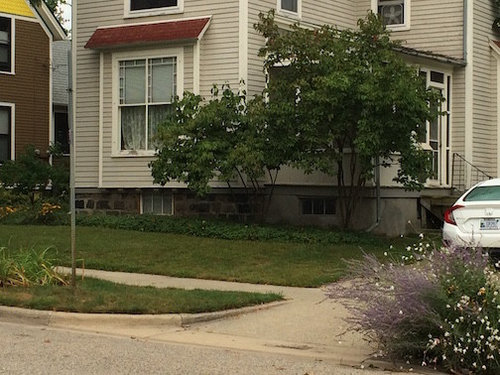
Hi. I'm Pat. I live in downtown Ann Arbor within the Allen Creek floodplain. I have 2 rain garden spots I am considering.

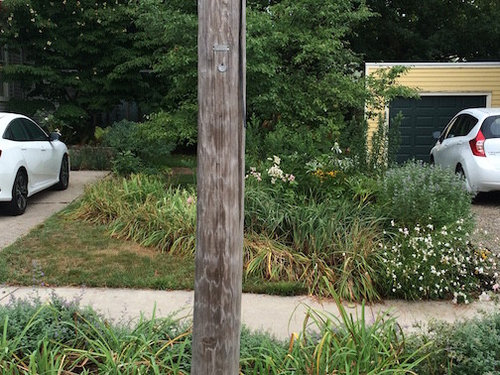
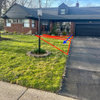
One would be fairly long and narrow, and would need to take in the front third of the house's roof runoff:

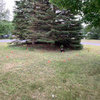
It's got quite a slope, and this would be a fabulous way to get rid of a very scruffy lawn the has been infiltrated with an unmowable sedge.

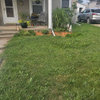
The other spot would take up part of an existing flower bed and a small patch of lawn--basically I would like it to go driveway to driveway. My neighbors to the north are already interested in this process. They have drainage issues.

What you cannot really see in this picture is the enormous silver maple in the yard behind this one that shades a third each of their yard, my yard, and my neighbor's house to the north.

One question that came to mind yesterday while listening to the discussion of distance from house, is how this would apply to dry wells. I had one put in several years ago, and I now suspect it may be contributing to the damp corner in the basement.

Comments (14)

  • 10 years ago
    last modified: 10 years ago

    In answer to Jan:

    The downspouts run down the outer corners of the front of the house. The one on the left is just peeking out from behind the parking sign, and the other is behind the nannyberries. Water does not tend to end up in the driveway, and never at the neighbors, but it does sometimes pool on the sidewalk in front.

    Unfortunately the drywell is towards the back of the house on the side opposite the driveway, way out of the reach of this project.

    In rain garden 1, I am imagining removing the lawn from the driveway to the S edge of the house, and putting in the rain garden parallel to the sidewalk. I'd like to remove the nannyberries, which sucker too much for my taste, and put in a smallish tree instead, but closer to the street. How would an alternate-leaved dogwood do?

  • 10 years ago
    last modified: 10 years ago

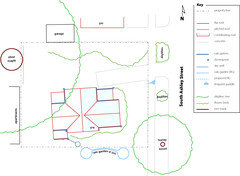
    I've made the base plan and played with the space a little--"little" being the operative word. I can wedge in a long skinny trapezoid and end up with something close to the size I calculated.

    I'd like to put an alternate-leaved dogwood in towards the northern end. I would love blue flag. I am considering ferns and some sort of peaceful green low grower--a sedge, perhaps. I suspect that some black-eyed Susans will end up in there, too. Once there's more shade, I would probably put wild ginger in. I have it in my backyard under trees (that are under the silver maple!); it likes shade and water.

    I did my drawing in Illustrator, using a screenshot of from Google maps as the template.

  • 10 years ago
    last modified: 10 years ago

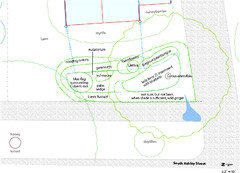
    Here's the current plan. This is a closeup of just the front yard, so the previous image is rotated 90 degrees clockwise (north is now to the right.)

    I have some, but not all of these plants. Neither the scarlet bee balm nor the black-eyed susans that currently live near the downspout on the left made it in, but I don't think a little thing like a plan will stop them.

    The myrtle will remain for now, as will a lawn pathway around it. The dogwood will start small, so the plants near it will have to take at least partial sun.

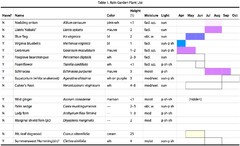
    This is the list of plants I am looking at:


    I have a swath of bluebells in the back by the fence. They pop out of the ground in April, look spectacular in May, and then keel over and go dormant just as the hostas erupt and the grape hyacinths vie for attention. My hope is that the ferns will erupt just as the bluebells are keeling over.

  • 10 years ago

    Your plant selections look gorgeous. :) This will be a beautiful garden. It is shade / part-shade, right?

    User thanked Susan Bryan
  • 10 years ago
    last modified: 10 years ago

    Yes; right now it gets some morning sun, but the honey locust is big and old and actually casts dappled shade. The house shades it completely in the afternoon, although some sun reaches the corner between the house and the honey locust.

  • 10 years ago

    Hi Pat. We want to feature your garden in class tomorrow. Would you like to be un-muted? We can do a quick tech check this afternoon if you like. I have the classroom open, just go in with the link you normally do. Anytime before 3:00

  • 10 years ago

    Yes, you can feature it. Let's try the sound in a couple of minutes; if it works well, I can be unmuted.

  • 10 years ago
    last modified: 10 years ago

    I have some photos.

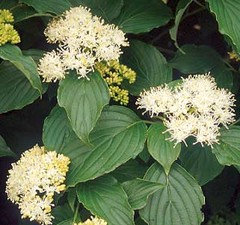
    At the north end, I am planting a small tree with ground cover. Alternate-leaf dogwood has a beautiful form, but while it's young, I love the leaves:

    [University of Kentucky]

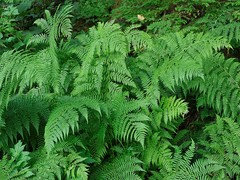
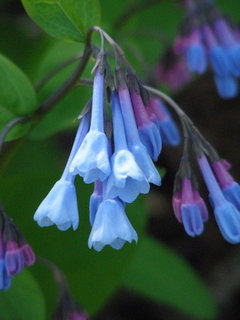
    I'm planning to put lady fern and blue bells directly under this little tree:

    [Mike LaBarbera, Creative Commons]

    [My photo]

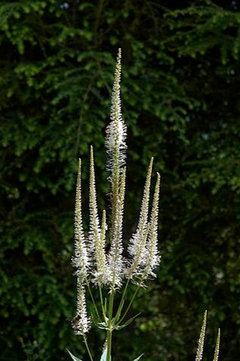
    The focus at the south end is herbaceous:

    Culver's root,

    [W. Hagens, public domain]

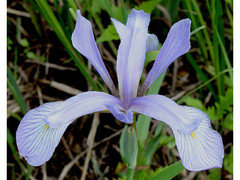
    Blue flag,

    [R. W. Smith, Creative Commons]

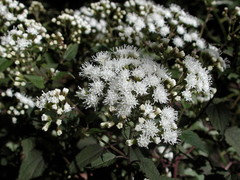
    White snake root,

    [My photo]

    The supporting cast at the south end is echinacea and liatris. Just about everything else tying the two ends together is short and green, with some flower accents: geraniums, nodding onion, and foamflower.

  • 10 years ago
    last modified: 10 years ago

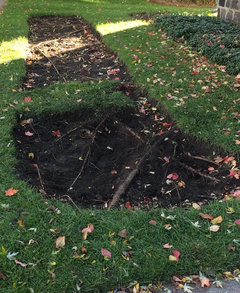
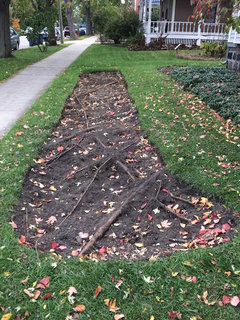
    I have been digging, when I have the time, over the last 2 or 3 weeks. It seems like forever. Why?

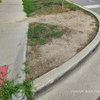
    !!! [My photo]

    The whole area is crisscrossed with roots, including those of an old silver maple that look and feel like balsa wood but crumble to dust if you squeeze them–that tree came out over a decade ago.

    The strangest thing about these roots is that many appear to be emanating from the SE corner of the house where there is no tree, and has been no tree since I removed an arborvitae over 25 years ago. Only some of the smaller roots appear to be running back to the nannyberries or honey locust. The roots are really entertaining the neighbors.

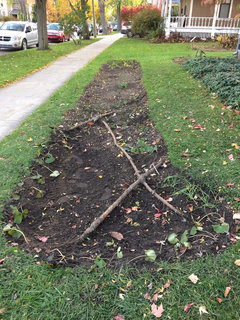
    I know that I will cut the smaller ones, but I am considering leaving the larger ones in place: they are essentially botanical pipes going from who knows what to who knows where, and I do worry that they may be honey locust, which responds to cuts by sending up sprouts with savage thorns. I stood up under such a sprout once while mowing....

    I have 6 or 8 square feet of sod left to remove, and then I can tackle cutting the roots and contouring the soil, however, I am declaring the really big roots "decorative elements."

    [My photo]

    There is a small collection of plants waiting patiently by my bench to be planted, and many others that can be transplanted. Lets hope for at least a few nice days this week. Cross your fingers. I would like to have something plausible-looking in place by Halloween, although there are things that must wait for spring; the bluebells and foamflower seedlings are dormant.

  • 10 years ago

    This looks awesome Pat!!!

    User thanked Susan Bryan
  • 10 years ago
    last modified: 10 years ago

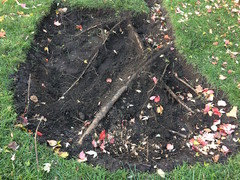
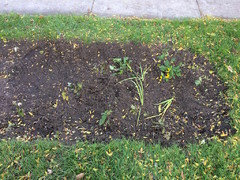
    I took out that last little bit of sod. The nest of roots under it made it seem like quite an operation. I let it sit and get rained on and allowed the inspectors general---a bunch of very nosy fox squirrels---check it out thoroughly.

    [my photo]

    You can see all the spots where the squirrels inspected. I let this sit another day or two and trimmed out most of the roots. The planting, at least the planting I can do this fall, is done. The layout was completely dictated by the remaining roots. So much for my map.

    [my photo]

    The near end is the north end; the sidewalk is east. I put wild ginger at sod level on the north end and around the east side up to the root that crosses the bed midway. That midway root now has blue-eyed grass running along it on the south side. It may be temporary, as blue-eyed grass has a mind of its own about where to stay and how to behave, but I though it would be better than bare soil.

    The big x, which is fused in the middle, is mostly planted:

    • The bottom of the x has 4 lady ferns hidden within.
    • The top of the x has mostly Penstemon digitalis, which I moved from another spot in the yard. It was getting too crowded the it was. The other plant, closest to the cross, is a Clethra sprout.
    • The left side of the x will get the alternate-leaved dogwood (that I have not yet found) somewhere near the cross in the spring, and I hope, at least 2 of the lady ferns that I stashed in the bottom of the x. Foam flowers and bluebells will go in here as well in the spring.
    • The right side of the x has nodding onions.

    The middle of the bed has a prairie rose, Rosa setigera, which is a mesic to dry mesic plant. It's sitting on a high spot in this rain garden. The soil is quite gravelly; this is the only spot I amended with compost. I'll keep an eye on it, and move it if I have to. I'll revisit the area around the rose in the spring.

    Finally, the southern end is fully planted for now:

    • There are two brown-eyed susans by the sidewalk.
    • Wrapping around the southern edge and up the near side are Eupatorium.
    • In the middle are blue flag.

    One last mowing, and I will be able to declare this yard ready for winter! I've never mowed in November before.

  • 10 years ago

    I agree. Big roots are simply "decorative elements". :)

  • 10 years ago

    I agree. Big roots are simply "decorative elements". :)