Software
Houzz Logo Print
nsboczulak

Black Tomato ID

10 years ago
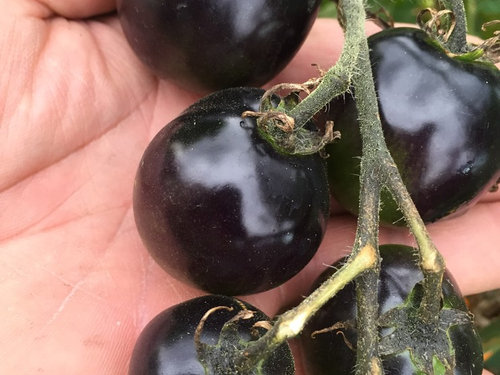
I purchased a tomatoe with a brownish hue . I decided to save seed and this spring planted it. Now it has bore fruit and they start out green with black tops, as they grow bigger , eventually turn black in color. I would like to know what variety this could be? I know there are are few possibilities. I have yet to taste one . Can you tomatoe growers tell me? How do I know they are ripe? Help?

Comments (17)

  • 10 years ago

    When you save seed from store bought hybrid tomato (yours was almost certainly a hybrid), you're not going to get a neat, clean reversion to an original parent variety. You're going to get a mishmash of traits from the parent strains. If you plant seed from the tomatoes you got this year, you could still get a ton of variation in the next generation. All we can say for sure is that your original store bought tomato obviously contained genetics for high anthocyanin expression.

  • 10 years ago

    It looks like Black Beauty. Google it for more info.

    You know it's ripe when it's mostly black and yields slightly to gentle pressure. You could cut one in half and compare to pictures of Black Beauty. Of course you cannot call it BB because you know that it's not pure, but it's interesting.

    Linda

  • 10 years ago

    Some of My Indigo rose that get more sun look like yours.

    As it ripens, the color should turn to nice peach red . I will post a picture tomorrow.

    As Linda said, it might also be Black Beauty.

    Sey

  • 10 years ago

    Ok I will await your picture,are the indigo rose and Black Beauty tomatoes very good eating or is it the black color that dominates all the best traits?

  • 10 years ago
    last modified: 10 years ago

    It's not Black Beauty. Wrong shape, size, and truss configuration. Unless it was a seed mixup with a blue variety that the OP has, it's not going to be a named variety. It could have genes from Black Beauty or Indigo Rose or Indigo Apple or any number of "blue" tomatoes. Final ripe color for non-black areas could be anything from yellow to deep brick red. No way to know until they ripen.

  • 10 years ago

    Looks like it could be OSU Blue. Developed by Oregon State University. Supposed to be high in antioxidants. See the link.

    John AOSU Blue

  • 10 years ago

    John you may be right as I look at the plant it does have a purple tinge right from small and yes the fruit hidden from sun stays green and anything exposed to sun turns purple. I moved two vines and soon the unexposed green areas soon turned purple. We may have found the variety here. Thanks . I hope it is a tasty tomatoe, if not it is cool never the less to look at

  • 10 years ago

    It's basically impossible for a hybrid to revert back to the exact type of any of it's parents. I mean, I suppose it's technically possible, but the chances are so astronomically tiny that it's essentially impossible. This new tomato may have genes from OSU blue if OSU blue was a parent of it or of the varieties in its ancestry, and it may appear to behave very similarly to OSU blue, but it will not be OSU blue. And it certainly has differences from OSU blue, whether the OP is able to perceive them or not.

    The behavior of turning blue in response to the sun is common to many tomatoes with genes for high anthocyanin expression, and clearly this mystery tomato, which is not any variety but is an unnamed F2, has those genes. But it is simply impossible for it to be an existing variety, and it's honestly irresponsible to treat it as though it is.

    The OP can call the tomato what he wants, obviously, but I would strongly advise against claiming the tomato to be any named variety if seeds are ever traded or fruit is ever given to someone else who may be interested in saving and sharing seeds. This sort of misunderstanding of genetics is probably responsible for a lot of unwanted genetic drift and off-type seed problems that we all encounter.

    Also, saving seed from this plant and growing it next year will be extremely likely to produce plants with a variety of different traits. If the OP had grown enough plants this year from last year's saved seed, there would almost certainly have been all kinds of different traits in the different plants.

    If the OP wants this to be a variety, he should select the plants he likes best, and continue to grow those out for many generations, selecting plants with the desired traits each time, until he produces a genetically stable new variety, which he can then name what he wants.

    But this plant is an unstable F2 and is not OSU blue, black beauty, indigo anything, or any other currently existing stable OP variety.

  • 10 years ago

    Ok gorbelly you have given me a lot of information to digest. The varieties of tomatoes is endless and I have to ask OP varieties and or heirloom that seed company's sell seed and claim origin from late 1800's and early 1900's. We know all varieties cross pollinate . Example is cereal grain wheat can cross pollinate with grass and you get ergot. ( extreme example) so purity is in question? As a garden I strive to grow a variety I love to eat, a good tasting tomatoe. Ultimately looks are not as important, this is why we grow gardens. Not for looks, flowers are what one plants for beauty. Ok , so with that recommend me a variety of tomatoe I would enjoy, just for a good old tomatoe sandwich. My mother always enjoyed the Cascade variety, early and easy to grow.

  • 10 years ago
    last modified: 10 years ago

    Melon Boy: Example is cereal grain wheat can cross pollinate with grass and you get ergot. ( extreme example) so purity is in question?

    Ergot is a fungus that grows on stored grain. It has nothing to do with genetic crossing.

    There is no danger in cross-pollination for anyone eating the tomatoes. It's just that cross-pollination will produce unpredictable plants that don't have stable traits.

    Obviously, tomato enthusiasts don't like the idea of unverified seed getting out into circulation because someone could pour their love and care into a plant expecting a large, purple, good-tasting beefsteak and end up with small, bland, red globe tomatoes with no better taste than anything one could buy in a supermarket in February.

    In the case of commercial hybrid tomatoes, which is what the one you saved seeds from probably is, the results could be extremely poor, since many of the tomato strains used in creating commercial hybrid seed are poor-tasting but used to contribute genes for disease resistance, heat-resistance, etc. Some of those genes from the original parents could resurface in subsequent generations, and you could get a very disappointing surprise, with small, unpleasant-tasting tomatoes.

    Melon Boy: As a garden I strive to grow a variety I love to eat, a good tasting tomatoe. Ultimately looks are not as important, this is why we grow gardens. Not for looks, flowers are what one plants for beauty. Ok , so with that recommend me a variety of tomatoe I would enjoy, just for a good old tomatoe sandwich. My mother always enjoyed the Cascade variety, early and easy to grow.

    What you want to grow in your own garden is your own business. If you want to grow crossed tomatoes or seeds from hybrids knowing that you'll get unpredictable results, that's absolutely fine. A lot of people do this on purpose for fun because they like being surprised and are OK with risking a disappointing surprise or because they are looking for new traits to stabilize into new varieties.

    But out of respect for the many people who work diligently to breed tomatoes and save seed correctly from varieties to preserve them for posterity, I would suggest not calling a tomato that cannot possibly be any already existing named breed by the name of a breed that others have worked hard to create, stabilize, and/or preserve.

    If looks don't matter, then the fact that your tomato doesn't have a name and is not any existing variety shouldn't matter, either.

  • 10 years ago

    Yes viewer, I think you are making your point, As a grain producer I beg to differ with you somewhat on the ergot issue. Yes it is a fungus but does not grow on stored grain in the bin. This forms on the kernel on the head while the plant grows on the field. Regards to the tomato, I put this question forward to viewers whom might give me some insight of possible genetics of this fruit. Never did I call it a specific variety and never will. Other comments have stated possibilities. Yes it does not matter to me if it has a name or not. I will grow it and and eat it with anticipation of it being a delicious tomato. Your sarcasm is not appreciated.

  • 10 years ago
    last modified: 10 years ago

    There was no sarcasm intended. If you detected it, then you're the one who injected it there.

    A lot of people don't understand basic plant genetics. When I saw you asking "I would like to know what variety this could be?" when discussing an F2 plant and then confuse issues of breed standards with ergot, my natural conclusion was to assume you didn't understand the concept of hybridization and its effects down the line, not to think that you just wanted to know possible ancestry of your market-bought hybrid tomato.

    My concern was not just for you to make sure your expectations were going to be in line with what you will get if you continue saving seed from this tomato but also for any future growers who may end up with seed from you.

    And a lot of beginners are too hung up on naming everything. I was merely pointing out that a tomato doesn't need to have a name if you're otherwise happy with it.

    As for your current tomato, there is no guarantee that just because it looks like it might have genes from OSU blue or black beauty or whatever that it actually does or will taste or behave that way or ripen to the same color. I was also trying to make that clear, as you did not seem to understand that.

    I in no way intended any offense.

  • 10 years ago

    In conclusion viewer, you are the one making all these assumptions. First of all I am not a beginner and I am fully aware of genetics ? I am a large grain producer. I purchase all my seed , it being certified or registered. I pay royalties and TUA fees. Your assumption of me passing tomato seeds on to the public is misconstrued. I fully support research and development. You have blown this topic out of proportion and I believe an apology should be in order . In closing I am not interested in hearing your opinions now or in the future. You have made a mockery out of this ordeal. Grow up

  • 10 years ago
    last modified: 10 years ago

    Melon Boy, thank you for a big belly laugh. It's always good to get a humorous reminder of how seriously some people can take themselves online and how fragile people's egos can be.

  • 10 years ago

    Here are couple of pictures of my Indigo Rose that I took today.

    The top one is ripening ..


    The color is close to Melon Boy's tomatoes. Maybe more blue than black. But basically these tomatoes are called " Blue ". Just a convention.

    Sey

  • 9 years ago

    I just came to this thread to see if there was anything new. Nothing. But as I look at my own pictures, I cannot wait to grow them again. What a beauty, INDIGO ROSE.

    SEY

  • 9 years ago

    Yea, Gorbelly! We desperately need more posts trying to remind people that they have to start to be more responsible about saving seed carelessly AND THEN naming the miscellaneous seed after a known cultivar. OP tomato seed in the US is an utter mess today.

    I cannot find the same seed for two great cultivars that I used to grow. The seed that I find for them is not the same cultivars I used to grow.

    And I bought seed for four cultivars which did not match their common descriptions. When I asked the source how she saves seed, I learned that she did not bother to bag and isolate. Some of the other seed that I bought from her was good, and some was apparantly contaminated by cross-pollination by her carelessness and lack of knowledge of genetics.

    We are not going to have any true OP cultivars if this continues.

    Asking for a name for a miscellaneous collection of genes is a way of contributing to this problem. Let's try to keep our cultivars pure.

    Because of this rampant carelessness, I believe that most OP's will vanish and be replaced by their hybrids that are grown by responsible large companies. We will be forced to pay Burpee prices to grow tomatoes.

    Please try to be responsible in saving seed!