Software
Houzz Logo Print
bbbbirdman

Help for my sorry front yard (8a)

10 years ago

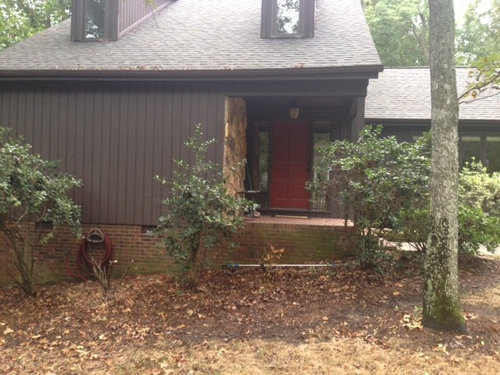
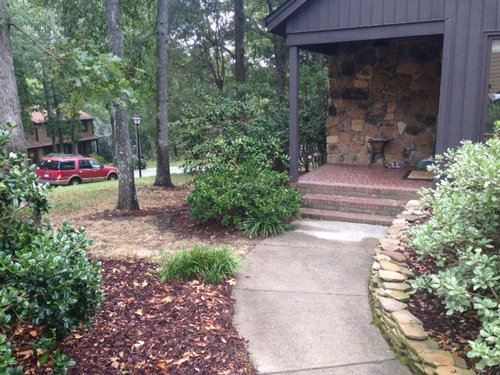
Hi, I'm a first-time homeowner who needs some serious help. 1.5 years ago we moved into a 1970's house on a sloping and wooded lot. During our first summer, we didn't water enough and a lot of our landscaping died. This includes some of the overgrown foundation plantings (hollies). We recently started ripping those out, but have no clue what to replace them with. Any advice, or answers to these questions are appreciated.


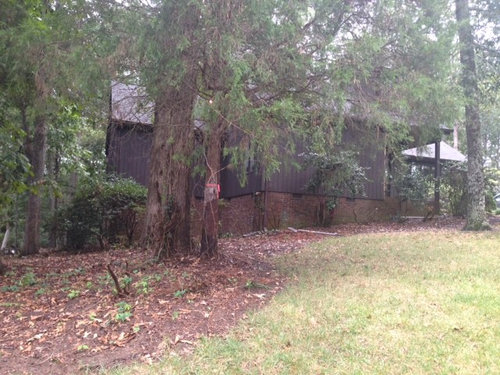
1. Should we continue ripping out the rest of those scraggly hollies (photo 2)?

2. What should we replace them with for foundation plantings?

3. What would look good to border the wooded area in photo 4? There used to be 5-6 azaleas here, but they died. Worth replanting azaleas, or do those need more sun?

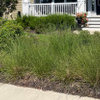
4. Many folks in our neighborhood edge their beds with monkey grass, and let the fall leaves pile up behind them. Is this a good idea, or should we just mulch the beds?

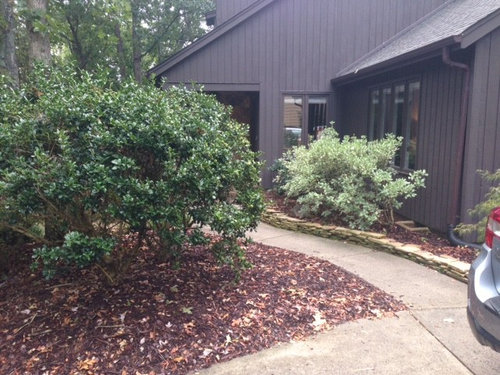
5. What would be good in front of the entrance sidewalk (currently just mulch - photos 6 & 7)? This area used to have pachysandra, but that died when we removed some trees. This area now gets full sun.


- Charlotte, NC - Zone 8a

- Front of the house faces north

- Foundation plantings are shaded by the house

- Area around entrance path gets full afternoon sun


Photo 1:

Photo 2:

Photo 3:

Photo 4:


Photo 5:

Photo 6:

Photo 7:

Comments (6)

  • PRO
    10 years ago

    Can we presume you have the standard objectives of increasing street appeal and improving appearance? It would make a difference than if your objective was something else such as low maintenance or privacy.

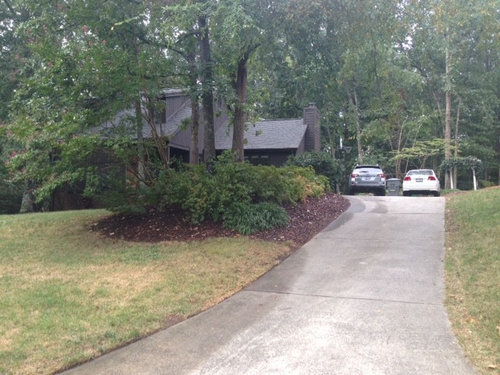
    If that's the case, you need to supply pictures that show complete, connected scenes, as if we were standing there. For example, at the first picture, I want to see what is right and what is left of what you show. I want to see the SETTING .... how the driveway fits in, and how the house fits in the woods. To do this you would pivot the camera (without changing locations) left and right and snap slightly overlapping shots. Even though they are separate pictures, we can see how everything fits together. Actually, you might move up into the yard and take a full 360* of connected shots. Also, you might back up (into the neighbor-across-the-street's yard and take an overall shot of the property. (It won't show detail, but it will show how the house fits into its surroundings.)

    The view of your entrance is important from two key directions. You might include a 180* photo-span of it taken from the driveway (with the cars not blocking anything important.)

    If you want the yard/house to end up looking nice, I think it's safe to say you need to start over with all shrubbery in picture #4.

    No not border the wooded area with shrubbery or Liriope. Hopefully, new photos will allow for suggestions of what to do with the wooded area.

    bbbbirdman thanked Yardvaark
  • 10 years ago

    Thanks Yardvaark! Yes, my objective is general curb appeal. I went out and tried to get some panoramas. They're still not the greatest, but hopefully tie things together a bit more.

    I'll definitely finish pulling out those shrubs, and will avoid the Liriope border. That stuff spreads like crazy and pretty soon you don't have a nice clean border anymore. I'd also like to lay down some pine straw mulch in that area, though i'm worried that i'll constantly be blowing leaves off of it.

    Your help is greatly appreciated!


  • 10 years ago
    last modified: 10 years ago

    Just a brief word on Liriope. Only one species of Lirope spreads--L. spicata. The more commonly available and generally handsomer species is L. muscari. It's a clumper and there are a number of cultivars, including variegated ones.

    bbbbirdman thanked laceyvail 6A, WV
  • 10 years ago

    Thanks Yardvaark! I really appreciate your fantastic markups. It really helps to see what the finished product could look like

    I will combine the two beds, as you've shown. Getting grass to grow between the two has been struggle anyway. Do you have any suggestions for ground cover? As long as it's not my nemesis, English Ivy. The bed next to the driveway gets full sun, and the other bed is shaded.


    Also, I like what you've put in front of the house (even if they're just cartoons). Any ideas for what to plant here? Maybe hydrangeas since it's pretty shaded. I'll also need something fairly tall for in front of the blank windowless wall facing the street.

    Laceyvall, good to know that all liriope doesn't spread. Though looking at Yardvaark's suggestion, I may need something that spreads to cover the large area I have!

  • PRO
    10 years ago

    Honestly, I feel a bit sorry for people who have a hatred for English ivy (Hedera helix) because it is so darn useful. As I have said many times before on this forum, I have managed large amounts of it over many years and could not be happier that it existed. It is work-horse plant capable of transforming and beautifying large shaded areas. (it would not be the plant I recommend for a small area, though. Nevertheless, I've seen needlepoint holly used successfully in some quite small areas.) On top of that, where it grows it is easily available so basically free for the taking. I understand that for those who don't know how to manage it, it can become a total PITA, but as I look at it that's just a small learning curve.

    Pachysandra might be a good plant for you then, Birdman. While liriope spicata is very good looking in the right spot, I wouldn't recommend it here. How would you keep it out of the lawn? I don't know its shade tolerance.

    I can't see that Liriope muscari has any use for you in the way of a groundcover for the yard. It's better in a smaller bed where you can plant it solid .... say like in that retained area next to the walk that goes to front door.

    Just a note about my sketch .... I'm not trying to show you THE correct scheme. As you can imagine, landscaping can have some complexities and I can't show or explain them all in one simple sketch. I'm just trying to show you a general idea about how to arrange the major and secondary elements. All these things need to be worked in a plan (plan view --- bird's eye view) before work commences, in order to know that things work, calculate quantities and for a guideline to follow when actually doing the work.

Sponsored
Peabody Landscape Group
Average rating: 3.5 out of 5 stars8 Reviews
Columbus' Reliable Landscape Design & Contracting