Software
Houzz Logo Print
omiwen

Cupressus nootkatensis

10 years ago
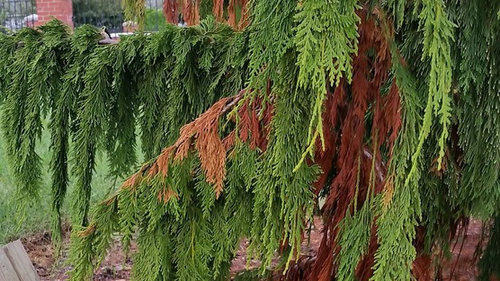
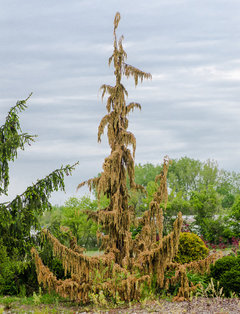
Help me identify what is happening to my Cupressus nootkatensis. My guess is Bot canker(Botryosphaeria dothidea), but not sure.

Comments (19)

  • 10 years ago

    why you jumping way out there??


    how old is it.. when planted... ??? any info there??? .. is the tag still hanging on it??? ... if planted within last 2 years.. i might suspect digging.. transporting or transplant damage .. of a large plant ...


    is it all one branch .. dig in there and find out.. is it cracked ... or damaged ...


    interior browning is seasonal.. and usual.. increased by transplant .. drought.. etc ... i think there may be a bit of that ...


    where are you.. whats the weather for the last year.. etc ... how do you water it ...


    we need some more info ... please.. ken


  • 10 years ago
    last modified: 10 years ago

    It looks like Interior browning which is normal this time of the year on the Weeping Alaskan Cedars.

  • 10 years ago

    Tree has been in the ground for 8 years. Two months of drought conditions in Gloucester, va. Browning started before drought. Tree did not receive regular watering. I am in the process of installing irrigation. The branches appear to be dead.


    i

  • 10 years ago
    last modified: 10 years ago

    Yes, it's not interior browning - it extends to the exterior. People have asked here before about this tree browning out after planting, I see it happen in my area also. Your suggesting of bot canker may indicate you have looked into the subject more than most of us here, your best bet might at this point be to see if Virginia Cooperative Extension has anything for you.

  • 10 years ago

    history rules out many of my thoughts ..


    what about the injury idea.. can you go look ...


    i would not irrigate a tree that has been in the ground for 8 years ... the rest of it look rather fat and happy ...


    the stake seems to indicate a large transplant .... why is it coincidental.. that if there was a rope or wire there.. it looks to reach in.. right where you problem is ???


    ken

  • 10 years ago

    No broken branch. High winds tilted the tree. I braced it with a 2x6. Browning occurred before bracing.

  • 10 years ago
    last modified: 10 years ago

    Maybe stress from drought. Parts of the east coast has been struggling with drought conditions since the spring.

  • 10 years ago

    how long ago did it tilt??? .... i presume it was pushed back away from the stake ...


    was it ball and burlap .. or potted ... how planted.. that it blew over??? ...


    stabbing in the dark here .. bear with me ... ken


    ps: we can rule out large children who may have run into it .. i have ruled out really freakin big dog .. lol ...

  • 10 years ago

    It is my understanding that on cyprus trees top growth outpaces root growth and therefore makes it vulnerable to being up rooted during high winds.

  • 10 years ago
    last modified: 10 years ago

    Nootka cypress is native to windy outer coastal and high mountain habitats. And the top overwhelming the roots thing you have heard about I've suspected before to be due to root deformities produced under nursery conditions rather than an inherent flaw in the kind of tree - they fall over because the top is fast growing and the root-stocks used were deformed before even being used. Or the finished grafts/rooted cuttings weren't kept up with when being grown on afterward. The faster growing a kind is the more likely it is to get pot-bound before being dealt with.

    Also if a vigorous tree is not dwarfed (or dwarfed enough) by being grafted onto a slower growing stock then a disproportion can result, wherein a big top ends up perched on a small trunk and root system.

  • 10 years ago
    last modified: 10 years ago

    I planted one two Novembers ago. Within 7 months it was completely dead. Mine died because of too much water. I didnt water it a single time. The problem was I did not build up a big enough mound to plant it on. Leeches (and mole salamanders with a vertical fin tail for swimming) live in my soil (Ive got a vernal pool that doesnt dry up until mid/late august(sometimes later) most years).

  • 10 years ago
    last modified: 10 years ago

    I've found that Weeping Alaskan Cedars prefer to be on the dryer side. When I planted 4 large Weeping Alaskan Cedars 2-3 years ago I was advised not to water them and that they would die if I did (I know this may go against some people's advise here). I only watered the Weeping Alaskan Cedars directly after transplant and not a drop afterwards and they are all doing well. The interior browning on them was definitely much more pronounced during the first fall but obviously the trees were getting adjusted to its new location and were probably stressed from being transplanted.

  • 10 years ago
    last modified: 10 years ago

    Alaska-cedar is notable within the cypress family for its tolerance of
    cool and wet conditions. The climate of its natural range is cool and
    humid....


    Alaska-cedar grows most commonly on Histosols and Spodosols. Best growth
    and development are on slopes with deep, well-drained soils. It is seldom
    found on the better sites, however, because of competition from faster
    growing associates. More frequently, it is found on thin organic soils
    over bedrock and is able to survive and grow on soils that are deficient
    in nutrients. It grows well on soils rich in calcium and magnesium and
    frequently on Lithosols developed from andesite, diorite, gabbro, or
    basaltic rocks (18). It is a common component of "scrub" stands
    on organic soils at low elevations in Alaska, and on organic subalpine
    soils. At high elevations and on half-bog sites, it often develops a
    shrublike or prostrate form.

    http://www.na.fs.fed.us/spfo/pubs/silvics_manual/Volume_1/chamaecyparis/nootkatensis.htm

  • 10 years ago

    I would add that they don't like their root zone freezing, I have logged them and would love to grow some but not going to happen.

  • 10 years ago

    "...they don't like their root zone freezing..."

    Every year for the past 10-12 years or so, mine has had its roots frozen.


    And it is pretty gooey clay outside the bed it is in, so I doubt moisture is the issue with the OP's tree. And my clay hasn't stopped the roots from anchoring my tree where it has withstood 70+ mph winds in a quite exposed area. I tend to agree with the idea of compromised roots (J-roots) may explain both the toppling and the branches dying.
    tj


  • 10 years ago

    Is it on it's own roots? I wonder.

  • 10 years ago

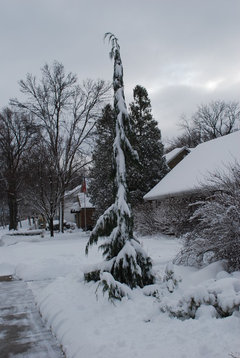
    This is what one of mine looked like this spring.

    Frank

  • 10 years ago
    last modified: 10 years ago

    Nootkatensis roots easily from cuttings, so most are propagated that way. Never noticed a graft when mine was a two footer and it is listed as hardy from zones 4-7.

    tj