Software
Houzz Logo Print
rebekah_fisher1

Do we need a pump or filter for largish pond?

9 years ago
last modified: 9 years ago

We are putting in a new pond and want in to be as low maintenance as possible. Does it have to have a pump or filter? I keep reading how plants keep ponds clean, how many plants? and what kind? We want to swim in the pond but it doesn't have to look like a swimming pool, since it is still empty I thought it would be a good time to ask. size approx 80x200

Comments (20)

  • 9 years ago

    There's a lot of information needed for a question like that. Is it going to have a natural bottom, or lined/concreted? What's the source of the water going to be? Is there any run off from the surrounding area going into it? Are there going to be trees around with leaves blowing into it? How deep will it be? What's the local climate?

  • 9 years ago
    last modified: 9 years ago

    Natural bottom, fed by several small springs, no water runoff into pond, no trees nearby, deepest part 10 ft, located in central pa. Thanks for any help.

  • 9 years ago

    Sounds like a good set up, although I don't know which climate zone your location is in. There have been a few arguments on this forum previously about natural ponds as swimming pools. Some people consider them a health risk and insist water needs to be filtered and chlorinated to be safe. Others (including myself) have argued that a larger pool with vegetation is safe enough, depending on source of water and type of run off entering the pool. It's a personal decision on the safety aspects.

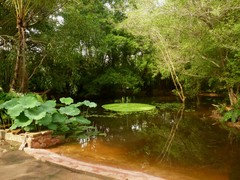
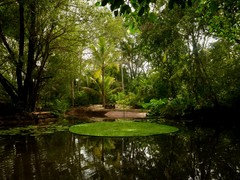
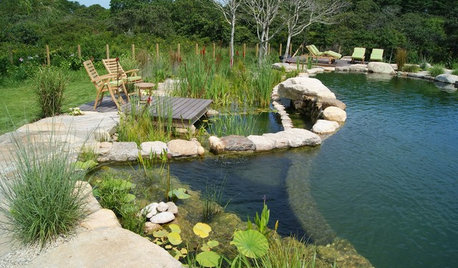
    My natural pool has a partial tree cover and is fed by a high water table and surface run off from a non-contaminated area. But it's only full during our wet season. There's a concreted area for getting in and out. The deepest point is about one and a half times as deep as yours. Waterlilies are growing in it but my main biofilter is a large floating ring of Pistia stratiotes. As a floating plant it's roots hang down in the water and are a good nutrient filter. There's fish, and a lot of wildlife also visit the pond. There's an inlet channel which 'snakes' its way through gardens, the outlet does a bit less 'snakeing'. When the water level is right up it gives me a nice (little) distance for canoeing through a garden setting.

    So basically, you work with what your situation/landscape allows only limited by your imagination. Mine's still a 'work in progress' as I still haven't reached the limits of my imagination.


  • 9 years ago

    Oh my word, thus is too beautiful ! what is the beach area? sand?

  • 9 years ago

    I do not see where swimming in pond is different that swimming in a lake.

  • 9 years ago

    We are not worried about potential health risks, we just don't want it to be too mucky and full of algae .

  • 9 years ago

    As with any new lake,or pond of any size, it has to do a natural life cycle. It may be mucky as the micro settles. Nature will handle it if you let it alone to do its own.

  • 9 years ago

    There's many variables involved. If you have springs flowing into the pond with water flowing out then there should be sufficient circulation to keep the water reasonably clear of algae, tannins and colloids. If the water is deep then any matter can settle and be deep enough down to not be stirred up by people swimming. Colder water allows insoluble particles to settle more quickly. Water plants with roots that spread out through the water act as efficient biofilters (plants with roots down in the bottom soil only remove nutrients from the soil). Wastes from fish and other aquatic life add to the nutrients in the water. It's a very complex situation and you need to maintain a balance.

  • 9 years ago

    Sounds like a typical farm pond. It is probably never going to be crystal clear with a mud bottom, but that's ok. Plan on aerating it though. That will move more water around cheaply than any pump ever will.

  • 9 years ago
    last modified: 9 years ago

    Don't you have that Houzz article at the bottom of this page - "Natural Swimming Pools : More beauty, no chemicals" Just scroll down - I read it and its actually quite good! Lots of pictures. I spoze you could do it with no pump/filters - some people do, but theres still a science to it, and my experience is that the pump/filtration actually makes it easier - the cleaning of the filters isn't that big a deal . With any pond youd still have to devote some maintenance time to it, unless you were fortunate to have some natural pond with a spring feeding fresh water in while old water drains out. Water needs to circulate/aerate SOMEHOW.

  • 9 years ago

    thanks for all the input

  • PRO
    9 years ago

    Hi Rebekah, I came across your question and felt that I could add some further information. In
    my opinion, water circulation and filtration is an essential aspect of any
    sustainable ecosystem. In over 40 years of designing and building the above, it
    has been my experience that much of the information circulating is somewhat
    helpful, but seems to need a little 'back to basics' thinking. If we look to
    what we observe in the creation all around us, we can recognize the perpetual
    systems that have been functioning effectively since the beginning of time,
    despite mankind's meddling, which somehow often seems to come up short, causing
    no end of complications, high maintenance and underwhelming results. There are
    numerous ways of keeping a pond clean and healthy, but circulation and filtration
    are an integral part. I
    have come to learn that if you circulate water over and through natural stone, which
    is one of nature's most efficient biological filters along with appropriate native
    fish, aquatic plant life, and desirable bacteria, you will have the basis for a
    sustainable ecosystem. The sun's UV rays will typically penetrate approximately
    3 meters (or 10 feet) deep, depending on tannin levels of water, which means
    that your actual water vessel itself should be at least slightly deeper than
    that for the photosynthesis process to be subdued enough for certain varieties
    of aquatic plants to thrive in shallower water, but not at the deeper levels,
    leaving much needed oxygen available for fish & the water itself. Aeration
    is an excellent method of dealing with some issues in a pond, which of course
    requires some measure of power to drive it. I have had substantial success
    by studying and applying the rules of nature as briefly outlined above, but
    much, much more is involved in order to establish these aspects of a long term,
    very low maintenance, and if desired, completely frost free ecosystem (able to
    operate the entire system year round) that you would be pleased to look at,
    swim in, fish in, or even drink in. An amazing additional aspect that we have
    included in our 'toolbox' of elements are 'floating wetlands'. The root
    structure grows through the strata allowing the roots to require more food and
    micronutrients than can be provided, which forces them to seek it elsewhere
    (i.e: the water beneath). In doing so, the root structure becomes somewhat of a
    natural vacuum cleaner for your pond, as they begin extracting the excess
    nutrients, nitrates, and heavy metals from the water, essentially filtering it
    and stealing it from the algae. If you are going to be aerating your pond, you
    may want to consider employing a stream and waterfalls, with a 'bottom draw',
    which will accomplish the aeration aspect, by simply circulating the water
    through the biological filtration as well as de-stratifying the water column. If you have any further questions please feel free to ask! Thanks, Randy Tumber.

  • 9 years ago

    Aeration and circulation is best accomplished with an air pump with an output at the bottom of the pond. You will be able to circulate more water for far less energy with an air pump than you ever will with a water pump for a waterfall. Circulation and high head applications should not be combined if you care about your electricity bill.

  • 9 years ago

    Except if you want to keep your pond from getting mucked up with leaves and organic debris - then a skimmer + filtration is a good thing to have, does not require waterfall/high head height.

  • 9 years ago

    I am the first person to tell people that their water feature needs a bottom drain and filtration, but this is a 1/3 acre pond. The filter would have to be huge. I haven't seen filtration on a pond of this size unless it is a public aquarium or a super high end, heavily stocked koi pond. I never needed filtration when I was managing a couple big farm ponds, just aeration to mix water strata to hold off eutrophication.

  • 9 years ago
    last modified: 9 years ago

    Also, my experience is that floating fountains don't do the trick nearly as well or cost effectively as diffused air aeration. People tend to go with fountains because they are decorative but really you should start with diffused air and treat the fountain as a decorative auxilary aerator.

  • 9 years ago

    Aha - you did the math. 1/3 acre sure sounds a lot bigger than 80 x 200 - I had no idea!


  • 9 years ago
    last modified: 9 years ago

    Yeah, 80x200 is 16,000 sqft. An acre is a little under 44,000 sqft. The pond should have at least an acre-foot of water in it (depends on average depth) which is about 325,000 gallons. If you wanted to turn that over once a day, you would need to move about 14,000 gallons an hour. That would require, iirc, 4 airlifts out of 4" pipe pushing about 3500 gph each. Of course at that point you would want to move up to 6" pipe. But what's crazy is that you can power those 4" airlifts with a 40w airpump for each one. So you would theoretically be able to move all that water with 160w.