Software
Houzz Logo Print
uscroy

Thickness of door casing & baseboard

9 years ago
last modified: 9 years ago
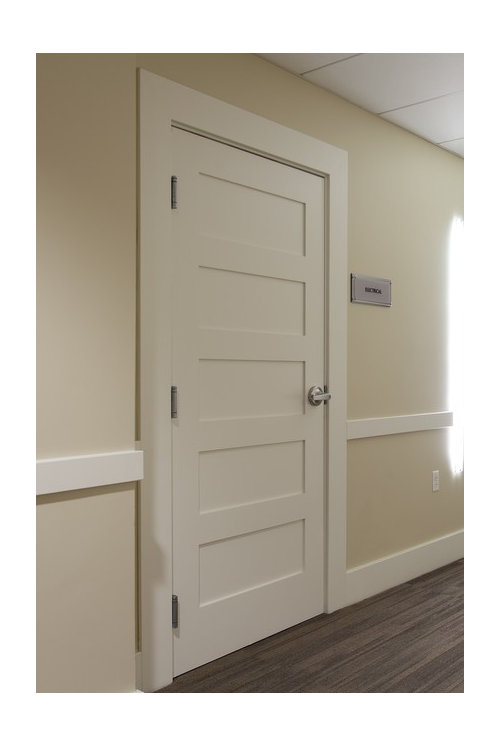
I know door casings are usually slightly thicker than baseboards. I've asked a few people and nobody has been able to really explain why. Is there a practical reason?

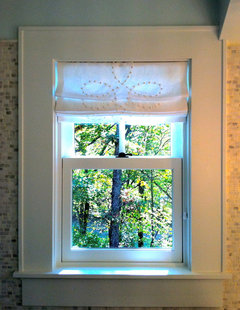
I would like my baseboard and casing to be the same thickness so that the transition from one to the other is flush. To me it is a much cleaner look. Is there any reason not to do it? Here is an example.

Comments (21)

  • 9 years ago
    last modified: 9 years ago

    Most base is 3/4" thick and many casing profiles are also that thick at the outer edge. But your example is flat square edged casing which is unusual for interior residential doors but if that is what you want just buy 3/4" casing and base but be sure the edges are square instead of eased. Actually, you can use the same profile for both and add a cap to the base. I'm not sure there is a cap on the example which is a bit of a dust catcher.

    uscpsycho thanked User
  • 9 years ago
    last modified: 9 years ago

    Actually, the square profile of the base and case in the example above are exactly the same as what I want to use but they are only 9/16" thick.

    Are you saying the base in the example is a dust catcher or a cap is a dust catcher? The way you worded it is ambiguous.

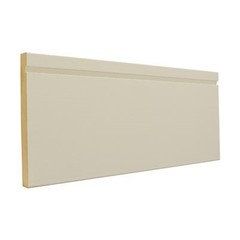
    The base I want isn't exactly like the one in the photo above, this is what it looks like.

  • 9 years ago

    USC...I wanted a very simple trim for my house as well. . This is what we decided on. It is a flat board with a "backband". The base will be the same board but taller with some kind of cap. We haven't decided which yet. Definitely want something that won't be a "dust catcher".


    Lake House · More Info

    uscpsycho thanked ILoveRed
  • 9 years ago

    A practical reason is so the base can die into the casing and the thicker edge on the casing allows for slight discrepancies at this joint

    uscpsycho thanked palimpsest
  • 9 years ago

    So what your saying is that selecting a thicker casing keeps my contractor from wanting to kill me.

    I can see how the casing and baseboard being the same thickness means that everything has to be perfectly square and plumb. I'm thinking I should probably go with a thicker case ;-/

  • 9 years ago

    I used identical profiles and widths for base and casing but the casing was slightly thicker .

    uscpsycho thanked palimpsest
  • PRO
    9 years ago

    "...I know door casings are usually slightly thicker than baseboards. I've asked a few people and nobody has been able to really explain why. Is there a practical reason?..."

    I'm guessing, but it may be a traditional trim feature where the baseboard had something to terminate against and to be able to adjust for any wall irregularities which would make a flush fit difficult, should the wall be bowed somewhat at that intersection point.

    As far as what to use, it all depends on the architectural character and style and what are the appropriate options for each given style/character. As long as it looks in character (and there's no gross historical conflict)--it's good!

    uscpsycho thanked Virgil Carter Fine Art
  • 9 years ago

    The 9/16" trim is MDF that will get beat up.

  • 9 years ago
    last modified: 9 years ago

    Many people are happy with MDF and consider it yo be even better http://ths.gardenweb.com/discussions/2584211/mdf-or-pine-baseboards-painted-white

    I'm open to more opinions.

    (I had to edit this, it did not display properly when posting it from the app.)

  • 9 years ago

    Back in the days when walls were plastered, surface irregularity was the norm. Trim needed adaptability. Using more narrow wall trim allowed the door trim/wall trim joint to have the door trim stand proud of the wall trim, which was more pleasing to the eye and design sensibilities. Vertical joint differences are much more pleasing than horizontal.

    Using sheet rock minimized that situation. As long as the framing on which the sheet rock is installed is even, the wall will be even. The requirement for trim to be adaptable is lessened.

    However, the industry has been set up for the former requirements and there is really no good reason to change.

    uscpsycho thanked User
  • 9 years ago

    For your design with so many sharp edges MDF is not a good choice.

  • 9 years ago

    JDS - Why is MDF not a good choice with the sharp edges? This stuff feels pretty solid to me. I know that MDF and water don't mix well but I'm not putting it anywhere that it will be exposed to water.

    Wood mouldings are about triple the price and I can't find the same style in wood. Copying this design would have to be custom made and that will cost even more.

    Sombreuil - I don't know what you mean by exposing end grain. I assume that doesn't apply to MDF since there is no grain? But what about wood baseboards and casings? At the dawn of carpentry they probably couldn't manufacture or cut baseboards and casings as precisely as is possible today. If I were to use wood, is there any reason not to make the baseboard and casing the same thickness?

  • 9 years ago

    Our door casings and baseboards are flush like your photo in the OP. They used wood. Our finish carpenter didn't indicate any kind of issue with doing things this way, and I thought his team did a really nice job. Good luck!

  • 9 years ago

    I have mdf. Sharp edges. Seems fine. I do notice dust on the top of the base, and mentioned it on this forum before but people here insist it's because I am a crappy housekeeper and it's not the 90 degree angles fault.


    ¯\_(ツ)_/¯

  • 9 years ago

    jn3344 not exactly sure what I am going to do when there are no longer kids living here whose chore it is to dust baseboards, windowsills and shelves. Maybe by then I will have a lot more time on my hands though ;-)

  • 9 years ago
    last modified: 9 years ago

    jn3344 and Oaktown - You both have flat-topped baseboards and find it to be a dust collector? Is it a pain in the butt?

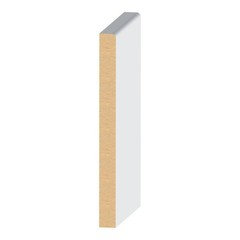
    I am getting more and more nervous about this and I'm starting to consider other profiles. In fact, I was about to start a thread about this (unless I can find an existing one on the subject). But since it's come up here, I would like to know if you think a flat baseboard with rounded corners would collect much dust, something like this:

    EDIT: After a quick search I found this thread where several people with flat 1" thick bases said they do not have a problem with dust. The one I that I really like is only 9/16".

  • 9 years ago

    uscpsycho, I will say that we probably have an unusually low threshold for what constitutes "dusty" because of family members with asthma/allergy issues.

    A friend once asked me, how can you have those baseboards they will show every speck of dust? I said, exactly! Whatever dust you have will be there either on the baseboards or the floor, take your pick. :-) We have a beveled sticking on our doors and dust/vacuum those too.

    uscpsycho thanked Oaktown
  • 9 years ago

    The difference is if that dust lands on the floor it will get mopped/vacuumed up when you clean the floors. If the dust is on the baseboard it is an extra step of cleaning and in a big house that's a lot of baseboard to clean.

  • 9 years ago

    I just put the brush attachment on the vacuum every other time or so.

    We're in a wooded setting. Dog, cat, pine trees, gravel drive, etc. I've had a number of homes and this is the only one where I have to frequently vacuum the top of the baseboards.

    (Insert shrug emoji here)

  • 9 years ago

    That's interesting jn3344. Our flat baseboards have much less dust than the traditional base at our prior house -- I suspect because no carpet at this new house.