Software
Houzz Logo Print
xerophytenyc

Let's talk Root Zone

9 years ago

A common occurrence on this forum is problems or questions pertaining to containers and roots. The actual ingredients of a potting mix is a whole other world of information, so let's try and avoid diving in too deep into that subject matter. There is lots of good reading on substrates, such as "Al's Gritty Mix" etc.

I think we can get a healthy discussion on some other aspects of culture related to growing succulents in containers. There are always exceptions of course, but for the sake of discussion let's not get into that. Here are some important concepts and considerations, in no particular order:

  • It's critical to remember that the Earth is very different from the Container. You cannot, nor is it necessary, to duplicate the same environment that plants are exposed to in their native lands. For example:

DRAINAGE: The Earth drains better than a pot, period. A small plant growing on the side of a mountain with tons of soil below it is safe, but a small plant in a large container may not be because the pot will not drain as well.

TEMPERATURE: The Earth stabilizes soil temperatures. A plant growing in a hot 100F day in the desert has it's roots in a much cooler, safer situation than the same 100F heat and sun in a pot. The Earth has massive soil volume that resists heating up, with rocks and shrubs reflecting some heat away. A pot does not have stable root temperatures. The root zone temperatures fluctuate wildly from day to night, season to season. Hot air temps around a pot will cook the roots. The same plant is safe in the ground at even hotter temps.

A hardy plant in the wild can take sub-freezing temperatures because more likely than not, the soil is warmer than the cold air. That same cold air temperature exposure for a potted plant results in a dangerously cold root zone. Roots are fragile and die easily, putting the plant in harm's way.

SOIL VOLUME (related to drainage): In my experience, with a properly selected substrate, virtually all succulents will excel in deep and very deep pots. The more root room, the better. For some species it is mandatory. As a group, I find us succulent growers to be very good at restricting growth and creating stunted plants. If this is intentional, to achieve a "hard" look, then that's fine. But for the most part, many succulents will grow much better with more of a free root run.

WATER: In nature, succulents will often occupy specific areas, like cracks and crevices along a cliff, wedged in between rocks, shaded by other plants...The soil in these areas likely collects more moisture after rains than a nearby patch of dirt. Or heavy dews and condensation collect along crevices. The point is that along with more stable soil temperatures, native soils also have a more stable moisture content than you may think.

As growers, we are challenged with keeping the root zone consistently but barely moist, to prevent desiccation of the active root tips. There's no such thing as a watering schedule. You have to factor in all the other variables and water accordingly. You drink when you are thirsty, and that varies from day to day. We must follow our plant's cues - look for new growth, change in coloration, swelling of buds, etc. Sustain the roots.

The only time you should aim for intentional drought is during dormancy, which for most succulents is during extended colder temperatures; and for some, it's during extended heat. Even then, it could be dangerous to withhold water completely. Without a minimal moisture content, roots will die, but the top of the plant looks fine, then you water one time when you think your plant is ready only to find it turns to mush a week later. How often does that happen on this forum? A lot. It's not because you over-watered. It's because you may have previously under-watered and killed the roots, and you didn't wait long enough for the plant to generate new root tips.

MICROBIOLOGY: There's no possible way that the inherently erratic temperature and moisture fluctuation in a pot can maintain a viable microflora that resembles native soil. For that reason alone, you can avoid anything "organic". Stick with inert substrates, and chemical/ elemental fertilizers. "Organic" fertilizers rely on bacteria to unlock nutrients. I doubt very much there are good microorganisms in small containers. Peat moss and other ingredients that can decompose run the risk of turning into a toxic mess. Exercise caution.

The health of our plants can be significantly compromised without considering some of these things. The amount of light and water is of no consequence if we can't get a stable root zone.

Please feel free to comment and contribute.

x


Comments (14)

  • 9 years ago

    Well said, X!

    Josh

  • 9 years ago

    I understand intellectually that succulents do well with more room for roots. And from experience, I've found that those that get watered regularly in a well draining mix thrive more than those that I allow to dry out in soil.

    what I can't get right, however, is how to plant succulents in a bigger pot and prevent rot. I can almost do it when the succulent is in a loose 511 mix, but even then, I have to be careful.

    I wish I could get better at planting in larger containers with plenty of root space and not running the risk of rotting the plants roots.

    consequently, I tend to pot in smaller pots, which forces me to repot more than I'd like to.

    hope this makes sense.

  • 9 years ago

    Lauren, thanks for sharing. If you're willing to try an experiment it will be interesting. Take an existing small pot with a succulent in it, and bury the entire pot into a bigger one. Water as usual. Pull out the small pot in the fall after the plant has been growing for many months. Share your results.

    What I expect is to find a load of roots escaping the small pot, and your plant will be bigger and healthier than ever. If this works for you, that may be a workaround instead of disturbing the root ball and transplanting into a bigger pot.

    One other tidbit I forgot to mention in my first post is that the much better drainage in nature also means better oxygen/ aeration. Another thing to consider in small pots. There is a much greater likelihood of creating an anoxic zone at the bottom of a pot, where the roots want to go.

    x

  • 9 years ago

    Such good info here, and makes me want to plant all my succulents out into the yard, in appropriate soils and rocky areas. But the weather here won't permit it. Thanks for the good root zone info!

  • 9 years ago

    Pagan, love it! As you pointed out, even a gritty mix can suffer. Probably fine particles accumulate at the bottom of a pot and if they're not flushed away they build up into a muck.

  • 9 years ago

    While being led to think size matters does hold some fact to it , not always will a bigger pot equate to a bigger plant.

    Mis worded is the suggested idea that using the same amount of water that was being used in a smaller pot is the same amount of water being used in a bigger pot equates to a bigger plant as a result.

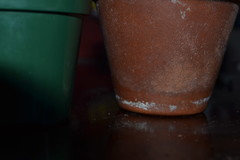
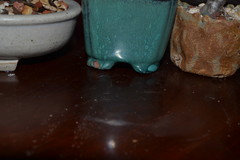
    Elevated footing on the bottom (as Pagan shows) there is also more to a pot than the bottom

    Dime store TC with out any bottom feet vs dime store plastic with 3/16ths feet for slight bottom elevation.

    Small pots to me means any pot that is less than three inches ( of which all three of these are.)

    Left to right shows one hand made with footing a dime store ceramic glazed with footing and a hand made with out footing.

    No they wont get any bigger in a shorter time than the plants already determined by nature " natural habit" if put in a bigger pot simply because they don' t In this example (of species serving as The counter of agreement) they MIGHT become bigger in a time frame of five to ten years even if left in the small pots they are already in. Simply said it would be tragic to "" bigger pot"" any of them before there time with the same watering BTW ,which would ( in a short time of apx one year or growing a season) equate to over watered if put in a bigger pot because size is also relative.

    While your reading the suggested comments from Al be sure to gander over his root pruning suggestions and demos


  • 9 years ago
    last modified: 9 years ago

    I find that treading that line of letting the mix get barely moist and then watering again is ideal for growing the vast majority of succulents.

    'Dry' is not a binary state and even a day or two each watering cycle can make a big difference in results over time.

    The cycle duration is changing constantly, as mentioned above, even indoors and certainly for individual plants.

    Watching plant response carefully above the soil is really the biggest indicator on what's going on below. Just takes a little time figuring what to look for.

    As for root zone temperature, unless the pot is very big, the entire pot and plant will reach ambient/shade temperature within a couple hours.

    Very muchly agreed about preventing an anoxic zone at the bottom of pots. Raising pots above solid surfaces has helped my root and plant health considerably (in addition to pot selection/design and soil mix).

  • 9 years ago

    Well, I have a dracena that I keep up potting into a loose 511 mix. Every time I up pot it, it put out new leaves and grows bigger. The roots don't even come close to filling the pot. The 511 mix allows me to water it copiously without ruining the roots.

    it was a lucky bamboo that grew in water for years, and I put it in mix as an experiment. Over time, I just kept experimenting with it by radically overpotting it. So, in this particular case, it seems that the extra root room does lead to a bigger plant.

    Of course, this is all observational....

  • 9 years ago

    Ewwmayo: I am slowly coming to that realization as well. I am always trying to find the right watering practices that allow the plants to have as much water as possible for good continuous growth without overwatering. But overall, even the succulents seem to enjoy more water than is typically recommended.

    I always feel that allowing them to remain dry for a while is not the best way to care for them, although it won't necessarily hurt them. But this is more instinct than knowledge.

    i am partial to 511 mix because they can get lots of water and not suffer.

    Ive been experimenting with jade cuttings in various media, and the ones in 511 mix are the healthiest. However, they are not growing as fast. But that may be a placement issue.

    Just musing....

  • 9 years ago

    Lauren - Yes, I would say the adage of 'water succulents when the soil is dry' is a simplification. The plant won't die that way but the grower would not see maximum growth or health either.

    One example would be letting the roots dessicate too much and reforming them is slower/wasteful. Another example is some succulents would be over watered if watered each time the soil was dry. This is not just for Mesembs either.

    More root space is very helpful but those of us in maybe Zone 7 and colder face the dilemma of available indoor growing space v.s. cost of that space v.s. fewer bigger plants or more smaller ones.

    At some point we need to pick which ones we want to flourish and which we will stunt.

  • 9 years ago

    Yes, eww, all very good points. Especially the point about a dry plant being technically overwatered when you finally water it.

    i think decide on which plants get bigger pots by choosing those that I know well. That way, if something goes wrong, I can provide an effective fix as quickly as possible. And also by selecting plants that I know look very attractive when they are allowed to grow big.

  • 9 years ago

    how big can a lithops get in a bigger pot that provides more space for more root zone ?

  • 9 years ago

    nomen... Lol! I've seen some bloated popos.

Sponsored
Miller Woodworks
Average rating: 5 out of 5 stars23 Reviews
Franklin County's Trusted Custom Cabinetry Solutions