Software
Houzz Logo Print
rickyk30

subpanel wiring questions

9 years ago
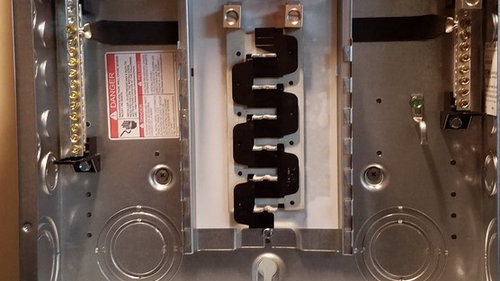
hi I am adding a 100 amp eaton subpanel and have a few questions. It will be approx. 75' from the main panel.

  1. I need a ground bar, correct? it didn't come with one (see attached pic)

2) am I supposed to run a ground from the main to the subpanel? I am thinking no, but I am reading conflicting things.

Thank you.

Comments (15)

  • 9 years ago
    last modified: 9 years ago

    OK, let me explain what you have. There's two insulated neutral/ground bars there tied together with a strap (also insulated) and a little dohickey (near the bottom and to the left of the right hand bar) that is used to bond the bars to the case.

    You could remove the strap and bond one bar to the case and ground but the other bar is lacking a terminal big enough to land your incoming neutral, so it may be easier just to buy a whole new ground bar. Eaton sells them in various lengths.

    Now to answer your second question. There's no "conflict" about this. YOU MUST GROUND THE PANEL. The metal in the panel plus all the equipment grounds from circuits you install in this panel must be connected to the incoming ground wire.
    If there were no 120V loads (unlikely) you could get by without running a neutral wire, but I suspect that is not the case.

    What you may be confused at is that before the 2008 version of the code, you could in some circumstances not run a ground with the feeder to a remote building, but you still had to provide proper grounding at that building. That exception (which was conditioned on their not being any other metallic connections between the two building) no longer exists. Further, it sounds to me that you are within the same building, so that isn't even an issue. RUN FOUR WIRES (TWO HOTS, ONE NEUTRAL, ONE GROUND) between these panels.

  • 9 years ago

    Perfect!! thanks a lot, you answered exactly what needed to know. I appreciate it!

  • 9 years ago

    Also, don't forget that if you really need a subpanel to support 100 amps, you need the right size and type of wire to tie it to the main panel. A 75 foot run of the right wire will not be cheap and it will be large diameter wire. At higher amperages you may also find local differences about use of SER cable vs. mobile home feeder, and copper vs. aluminum, and temperature ratings to use for max amperage calculation. For example you could find that mobile home feeder (2-2-2-4) is only be acceptable up to 90 amps.

    If you can get by with a lower amperage, you can use a smaller breaker in the main panel (60 amps is typical), and wire it to the new subpanel.

    Bruce

  • 9 years ago

    Specifically, you have to put the breaker in the main panel sized appropriately for the ampacity of the feeder conductors you intend to use. It's not uncommon that the panel has a higher ampacity than what it's fed with (better not have lower).

  • 9 years ago

    OK gotcha. Right now I am keeping it at 50 amps which is what was already run to my old double oven. I will just put two double pole 40's in there for the two new single ovens. then when I am ready to switch the rest of the kitchen and my workshop over to the subpanel, I will run 2gauge 3 wire from the main panel.

    thanks again for all the help.

  • 9 years ago
    OK one more question. I have bx from the main to sub. can I use the case as a ground? can I run a ground from the main to the bx case and then from the sub ground to the bx case? or do I have to run a dedicated ground? if a dedicated ground, what gauge? thanks.
  • 9 years ago
    will the bx work as the ground?
  • 9 years ago

    BX is not a legal wiring method today. What are you actually running. Type AC? Type MC?


  • 9 years ago
    OK. it doesn't have a ground wire so I guess that is ac, right?
  • 9 years ago

    Type AC cable has a thin aluminum bonding strip inside the metal jacket. Typically the actual wires are wrapped in paper. The bonding strip doesn't actually enter the box, it's bend back over the anti-short bushing (aka red head). Type MC has a full size ground wire.

  • 9 years ago

    Here's a nice little tutorial on AC/MC cabling: http://www.afcweb.com/wp-content/uploads/2015/06/mc-ac-installation.pdf

    For type AC, the armor/strip, properly terminated in the appropriate box fitting (not an NM clamp) can be used for the equipment ground. MC cable, requires you to actually hook up the grounding conductor.

  • 9 years ago

    perfect, thanks a lot. I do not see the bonding wire and believe that this may have been one of the original BX cable runs from when the house was built in the 40's. If this is the case, is it safe to use this temporarily as a run from the main panel to subpanel? - temporarily probably means several months to a year or two. :)

    Is it up to code? I have run a ground wire from the ground bar to the cable casing in the subpanel. From the looks of the article it seems that this is not necessary as long as I have the antishort bushing

    Also, a side question, I was going to at some point replace this with some new MC cable I got from work, but I think you said earlier that it is not up to code anymore. do I have to use romex when I do this? I don't have to do this until I redo the basement and add some more circuits onto this.

    And my last question, the subpanel is on a 50 amp double pole breaker. I have two 20 amp double poles for the ovens. I have a warming drawer that is supposed to be on single pole 15 amp breaker. do you think I could add this without an issue, or no?

    Thanks again

  • 9 years ago

    It is illegal to use the BX armor for a ground (temporarily or otherwise). I have my doubts if this arrangement was ever legal (feeding the subpanel with BX).

    No, MC is up to code. I just said that you have to use the ground wire contained within it rather than the armor to provide the ground.

    You need to do an actual load analysis to determine. With very, very, tiny exception, that's not just adding up the breaker. You need to look at the specs for all the loads you are going to provide from this panel.

    You need to make sure your wiring ampacity is at least 50A because that is what the feeder breaker is protecting.

    My guess is that 50A is sufficient for the loads you have, but you can't tell for sure without looking at the specifications for your appliances.

  • 9 years ago

    ok, thanks a lot. So it is definitely not legal, but how sage is it? essentially it is the same wire that was run to the original stove, I just put a subpanel and extra breakers between it and the new stove.

    I have my doubts about the electrician that did the original hook up of the last stove. there was no anti short bushing used either.

    follow up question:

    does MC - BX need to be fastened every foot also?

  • 9 years ago
    last modified: 9 years ago

    Stoves actually have a specific grandfathered exception allowing the use of the grounded wire (the neutral) for the equipment ground. Connecting that to a subpanel rather than directly to the stove has always been illegal and DANGEROUS.

    Pretty much all cables (NM, MC, AC) have the same support requirements. You must secure it within 12" of the box and then every 4 1/2 feet. That can be an approved clamp/hanger or just the bored hole in a stud. There's an exception for fishing through finished walls.

    If you're really going to get into this, you might want to buy (or go peruse at the public library) an actual copy of the code. I like the NEC Handbook because it has the code augmented with some explanations and pictures.