Software
Houzz Logo Print
db6040

Flea Beetle Protection.

9 years ago

Hello.

Last year, we were hit hard with flea beetles. This year we know we need to invest in some sort of protection for our young crops. We have read up on this but I am still a little fuzzy on what is the best type of protection. I see floating row cover is often suggested but there are many kinds. Can anyone tell me what they have used that was successful? I'm more concerned with effectiveness than cost.

Comments (17)

  • 9 years ago

    For eggplant, try planting them a week or so later than you would like. They will be bigger, and more resistant to the flea beetles. It worked for me last summer!

    Linda

  • 9 years ago
    last modified: 9 years ago

    The lightest weight insect barrier row cover you can buy. One example: -insect-barrier-4/pest-control

    That said, flea beetles are generally considered a minor pest. They don't normally hatch/arrive until most plants are pretty well established and so pose no threat. The exception would be with later than normal plantings. You don't give your location so is it possible that you are planting out late or maybe too early? With a bit of monitoring one can usually find the date of hatch in their specific area.

    Dave

  • 9 years ago

    I'm north of Pittsburgh in Zone 6. We transplant right around labor day. Last year, we got hit HARD with the beetles. It was much more than a minor pest for us. We have not had this problem before and want to be proactive this year.

  • 9 years ago

    I assume you mean Memorial Day rather than Labor Day in Sep. May 30th seems awfully late for most spring plantings in zone 6.

    Depending on the weather 1st week in June +/- a week is the flea beetle hatch time for me here but by then most all my plants are well on their way and quite tolerant. Sure I get some holes and even a few fully netted leaves but that doesn't hurt the plant at all.

    Dave

  • 9 years ago

    Digdirt2's suggestion of the lightest weight floating row cover to get them through the early stages is most likely the best suggestion, though you will need to remove it when they start flowering. Flea beetles are attracted to sticky yellow cards, so I wonder if having one near each plant would be enough. I find that if I knock them into a container of soapy water in early morning while it is still cool, I can reduce their numbers fairly significantly, but I am working in just a mid-sized home garden, not a commercial operation.

  • 9 years ago

    I use row covers for all brassicas against flea beetles and the white butterfly.

  • 9 years ago

    I've had luck with neem oil and soap blends. A small application for when I see them first and then I follow up a week or two later and that does it for me. Maybe Im not as bad as in some areas though. I us BT for the loopers. I have to use tulle on any summer squash though.

  • 9 years ago

    I did mean Memorial day and not Labor Day, whoops. We use that date as that was what was recommended by people we talk to who have been growing great gardens around here. Last year we were about a week early because the 10 day forecast showed warm weather. That is the weekend we shoot for and then adjust accordingly based on weather and how our starts look. We have been known to get some very varied weather and going in too much earlier seems like a risk. It has worked very well for us the last few years since we started gardening.

    We are going to order the row cover for the early going. Last year we spoke to our local garden center and they recommended these sticky yellow things. I think by then it was too little too late to make a difference. I'll look into neem oil and soap blends as well. Thanks.

  • 9 years ago

    I tried trap plants, row covers, and soaps.... nothing helped. The best combo for me in the Eastern Tennessee is row covers as long as they work - you need to check regularly so the beetles are not actually sheltered by the row cover :) and after they find their way in I used OMRI approved pesticide with spinosad. Sprayed according to directions 3 (maybe 4) times and beetles were defeated! Hope it will work this year, too. Good luck to all of us!

  • 9 years ago

    Surround® WP, a kaolin clay product that acts as a deterrent/repellent against many chewing, sucking, and egg laying pests. Works very nicely for flea beetles.

  • 9 years ago

    I had them last year, too. I plan on planting a crop of radishes as a lure..they are supposed to be the favorite of flea beetles, and supposedly will leave your other plants alone if they have radish leaves to eat. Worth a shot!

  • 9 years ago

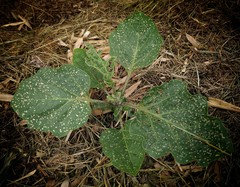
    Donna, I wish! The favorites are eggplants - verified by own experience :(((( So, you may plant a few, but make sure you let the eggplants establish first - if it is a young plant, it can be completely damaged in 3-4 days. In the pic, I've been trying to manage the beetles for a week or so before spraying, then I gave up and sprayed

  • 9 years ago
    last modified: 9 years ago

    I'm also in E. Tn. The flea beetles here are a major pest on certain crops. I don't use 'cides of any sort, so I have had to find non-chemical ways of coping. Potatoes get hit pretty hard with the beetles, but they act more as a host and easily survive the onslaught if I inspect the plants and crush what I see. The kale and turnip greens get the striped flea beetles, but they too don't take too much damage.

    Then there's eggplant... Ouch. Without protection, the flea beetles wipe them out. Last year I combined 2 methods...

    Instead of using a separate type of plant recommended as a trap crop (like the radishes mentioned above,) I used the weaker of my eggplant seedlings. I put about 6 weak eggplant seedlings on the far end of an adjacent bed and put out a 'Welcome' sign lol. I then (as was mentioned above,) covered my main eggplant bed with light weight, insect barrier row cover. I left the row cover on until the flowers started opening so they could be pollinated by the bees and such. Each chance I got, I went over the trap crop plants crushing, with my fingers, all the flea beetles I saw.

    Success! The uncovered, trap crop plants were decimated and were quickly stunted. They were planted in the cucumber bed, and were eventually shaded. They never grew over 1' tall, nor even produced a flower. They were like a magnet for the beetles.

    By the time the main crop was flowering and uncovered, they were strong enough to withstand the beetles. I did crush whatever ones I found on them also, but there was no need to do thrice daily rounds like past years. I got a great crop, and will stick to this program as long as it continues to work.

  • 9 years ago

    Rgreen, have you though about the beetles reproducing? That's what stops me from your technique... fear them taking over the following season! :) Eggplants is the only plant I spray in my garden. That's a great idea to have the weakest plants as trap plants. Will plan it for this year


  • 9 years ago
    last modified: 9 years ago

    "Rgreen, have you though about the beetles reproducing? That's what stops
    me from your technique... fear them taking over the following season!
    :)"

    Yeah, you have to take certain precautions.

    The first thing is to remove all plant debris from the space, then disrupt the soil a couple of times... basically tilling or turning the bed - at least once, but turning the eggplant bed in the fall, then again in the spring, will help. The next thing is to think about crop rotation. It's good for soil health, but rotating also helps to control pests. There are different techniques for rotating. For pest and disease control, I rotate by plant species. Each coming year I'll put the eggplants in a place that hasn't had Solanaceae for 3 - 4 years. It isn't a perfect fix, as some pests enjoy various species, but it's one more layer of protection.

    I've also used my expansions to my benefit. I've been expanding for a few years. each year, the eggplants go into new ground. Eventually, I'll need to put them in previously used space, but the rotation will help.

    A lot of people have smaller gardens, and rotation isn't practical. In such cases, removing plant debris, and turning the soil a few times helps a lot. Because I don't use chemical controls, every proactive step is another layer of protection.

    In our area though, everyone who tries to grow eggplant has the same problem. My stepdad, whose getting too old to do too much, is ready to use Sevin dust on the eggplant. I haven't checked yet to see if it works, but he's tired of not getting anything from his plants.

    Like I say though... it's a learning process, and some years are worse for certain pests than other years. I'll continue using this technique as long as it's working. Hopefully that will be a long time, but you never know.

  • 9 years ago
    last modified: 9 years ago

    Wait... I just re-read your comment. Did you mean that the trap crop encourages the beetles to return?

    If so, trap crops work to attract pests to another area, but it also requires eradication. In some of the university studies of trap crops, they often use a crop that will not be used for food. Chinese Mustard, or certain radishes are popular choices. The pests are then eradicated from the trap crops using chems, or physical capture of some sort. As was mentioned above, you could use the yellow sticky traps... or yellow cards, along with white cards (each color seems to attract different insects) painted with 'Tangle Foot' for flea beetles. You just shake the trap plants and they'll land on the sticky cards.


    ETA: I just used my fingers for eradication lol. There are so many of them now, it can't get too much worse anyway.

Sponsored
Bella Casa LLC
Average rating: 5 out of 5 stars17 Reviews
The Leading Interior Design Studio in Franklin County