Software
Houzz Logo Print
bmjr

need help designing residential softener system w/flushometers

9 years ago

Hi,

My wife and I moved into a property about a year ago, it's on a well that feeds a 2500Gal storage tank that then gravity feeds into our house through an inoperable (and bypassed) Culligan water softener.

While our water comes out clear, we have mild iron staining if toilets aren't flushed regularly. I've spoken with numerous local water treatment companies (incl. Culligan) and have heard everything from 'you have ferric iron and need a stand-alone iron filter or else you'll foul the softener media' to 'you have ferrous iron and our new softeners will take care of it'.

I'm certainly not a water specialist, but suspect the answer is probably somewhere in the middle. That is, some iron is being oxidized in the storage tank and coming down as ferric while other iron is still in ferrous form and doesn't oxidize until it's sitting in our toilets or water heater.

To address this my current plan is to insert a big blue 50u pre-filter before any softener. Hopefully that'll capture most of the ferric iron and any remaining ferrous will be removed by the softener.

On to the softener. It is a 5bd/6ba house with 2 adults. Typical largest fixture (master bath) is 10GPM, but the twist is each bath has a flushometer - which I understand each pull 20GPM.

Water test results (immediately prior to current softener):

pH: 7

hardness: 570mg/L

TDS: 820mg/L

chloride: 29mg/L

fluoride: .6mg/L

sulfate as SO4: 280mg/L

calcium: 140mg/L

magnesium: 55mg/L

iron: 1.4mg/L

manganese: 36ug/L

nitrate as N: .2mg/L


Questions - any recommendations on valve and sizing? thoughts on proposed iron filtration?


I'm struggling between a 7000SXT and 2850SXT. Am concerned that the 7000 doesn't have a sufficient flow rate to simultaneously take one shower and flush one toilet. On the other hand, I wonder if 2850 is overkill. I read the justalurker / midorix / lazypup 2012 post re: 1.5 vs 1.25, and while the conclusion was a negligible difference for an 18gpm SFR I'm not sure the same conclusion applies here.


Thanks, and apologies for the long post.

Brad.


Comments (7)

  • 9 years ago

    Without a ferric iron/particulate size distribution, it's difficult to assure you that your proposed filter will work. They are relatively cheap, however, and your setup nearly guarantees you will have some sort of particulates, so I suggest installing one regardless. I would install two in parallel so that you may run water through one or both and can isolate one to change a filter without cutting off water to your home. 4" diameter filters will be fine.

    Gravity feed: What pressure do you have at your house? What size line? If pressure is marginal at all, you may need to either install a pump or purchase a larger softener

    Softener valve/controller: The 7000sxt is no longer in production. Consider the 5812 (sxt or xtr2). It will allow the flowrates you need along with ease of programming and control. The 2850sxt is fine as well. The pressure drop from the softener will be caused by the resin bed more than the valve.

    Softener sizing: This one is a bit trickier. Your probable water use suggests a 1.5 cubic ft softener. However, your flow rate every time you flush a toilet demands a 2.5 cubic ft softener.

    Iron: If that 1.4 ppm of iron is ferric, you will use 45-68 lb of salt per month, depending upon how you program the softener. However, if that iron is ferrous, you will be lugging a lot of salt - 150 lb per month. For that reason alone you may wish to consider dedicated iron removal upstream from a softener. Get your water tested by a reputable lab. You'll want to talk to them first so they can explain how to obtain and store the sample to ensure accuracy.

  • 9 years ago

    Hi Alice,

    I really like the idea of running two pre-filters in parallel. Will certainly do that.

    Coming into the house is 50psi. Probably obvious, but also 50psi at input to current softener. 1.5" piping going into the house, and current softener has 1.5". There currently is a 1hp booster pump (Goulds J10S) w/bladder tank (~70Gal) that receives the gravity fed well-water and then directs it to the softener inlet. And just to be clear the 50psi mentioned "at input to current softener" is measured before the pump. The 50psi "coming into the house" is measured after both the pump and softener. Both measurements were taken while the pump was not actively running.

    Re: valves - I initially did narrow the Fleck valves down to the 5812, but quickly realized there is very little availability online. I found 3 Pentair (Fleck residential) distributors in my area (San Jose, CA), but all appear to be very small businesses and none returned my call. Do you happen to know whether this valve is only available from local dealers, or is there a reputable internet source?

    Re: sizing, yes that's my understanding so far. I've seen a few posts on this forum that suggest you can 'oversize' your resin, and just backwash less often. I thought that sounded fine, but at the same time wonder whether channeling (which I know very little about) would be an issue and whether I should be looking for something like an upflow valve rather than downflow. Not sure if you have thoughts on this?

    Re: iron, this is such a pain. ;) To add some color (excuse the pun), it was definitely a noticeable issue last winter when we had the water sample taken, but over the last couple of months has not been noticeable. Not sure if the heavy winter rains in CA had anything to do with it - I have read in some places that mineral content is seasonal and fluctuates with water tables - but it is what it is. In any event, I'd like to design to withstand even such possible fluctuations. I've seen your other posts re: different iron removing solutions including stand-alone filters with various media types. I'm generally leaning toward that type of filter (in contrast to an ozone system like Triple O -- I really don't want to hike up to the storage tank, pull out the filter media, wash it, then dump it back in every few months). My concerns though in this regard are twofold: (1) can they even support services rates of 20GPM+ (without running multiple units in parallel) - one local company says no (not sure what type of resin they're using), but BudgetWater says 2.5cu ft of Terminox would do the job; and (2) would the current PSI w/booster pump be sufficient to support a backwash.

    Best,

    Brad.


  • 9 years ago

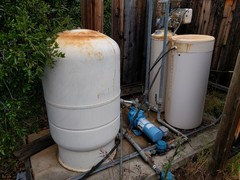
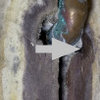
    In case anyone is interested, the current softener, booster pump, bladder tank and plumbing looks like this:


    Tough to tell, but well water is arriving from the top-left of (and into) the booster pump, which is fed into the bladder tank, which then feeds two lines: (1) bottom center and split to the right goes to the inlet of the softener (which has external bypass plumbing), and (2) bottom center and split to the bottom goes to irrigation. Treated water, after existing the softener, can't be seen but exits top center to be directed to the house.

    Maybe all the red is a good indication that its ferric iron arriving at softener and that the bulk of it is being oxidized at the storage tank ...?

  • 9 years ago

    Thanks. That's probably not a bad idea ...

  • 9 years ago
    last modified: 9 years ago

    Here are a couple of other thoughts...

    Although those flushometers require 20 gpm, they should require it for a very short time... what about a large bladder tank (or 2) on the treated side of any treatment system. That way you could get the short bursts of water flow without over sizing your entire water treatment system.

    Alternatively, what about looking at the cost of replacing those commodes with a standard toilet tank?

    It seems that you are going to a lot of expense and trouble to provide the 20 gpm for those flushometers.


  • 9 years ago

    Hi Jake,

    Yeah that's right, they only pull 1.6Gpf.

    Interesting idea about another bladder tank. Haven't thought about that one! Would have to build another concrete pad to support it, but that's certainly not impossible.

    Heheh, yeah those flushometers are the bane of my existence :). Replacing them was one of the first things we inquired about when we moved in. Unfortunately doing all 5 as well as removing and replacing the "unique" (read: outdated) tile around them is going to be $$$.

    My current plan is to go with a Triple O up at the storage tank to address the iron. Our long-time well/pump guy has one, stocks them, and has been much more informational/helpful than salesy. It'll be a nuisance to clean every once in a while, but the sizing of a iron filter with these service rates is just too prohibitive (it looks like even a Katalox Light would be around a 2' diameter media tank).

    Was then thinking of taking another sample at the softener inlet to fine-tune any softener. Likely a 7000SXT or 2850SXT with 3' resin incorporating all of the suggestions mentioned on this forum.

    Will let ya'll know how it goes. And likely beg for assistance in programming the darn thing when we get to that point :)

    Best,

    Brad.