Software
Houzz Logo Print
troy_schuler

Wiring question

9 years ago

I have a light, an outlet and a switch.
The power comes in at the light. The switch is in between the outlet and the light. I cannot get two pieces of romex through my 3/4 inch conduit that leads to the switch. Is there a way to just run one romex to the switch and then feed the outlet without the switch turning off the outlet too?

Comments (13)

  • 9 years ago

    Why are you trying to but NM-B (aka Romex) inside of conduit? Typically you'd only do that if you need physical protection otherwise run individual wires, which will be a whole lot easier. If the house was wired with conduit, then local code often doesn't allow the use of NM-B at all, so you might want to check with your local building code folks before starting the project.


    Troy Schuler thanked mike_kaiser_gw
  • 9 years ago

    I am aware that Romex in conduit is a debated issue. I'm not an electrician, but I believe it is only prohibited by the national electrical code in wet locations or if there are too many wires in the conduit, which I don't believe is the case here. (I agree that some local codes might prohibit it, so if the OP were to check with the local authority I wouldn't discourage it.)

    Nonetheless, since the OP can accomplish his objective without running additional wires, I don't think this is a big deal.

    Troy Schuler thanked kudzu9
  • 9 years ago

    You could use one run of 14/3 between the light and the switch to get what you need.

    At the box for the light, wire nut together the incoming (14/2) white, outgoing (14/3) white, and the white wire to the light socket. Now you have the neutral (white) needed for the light, and a neutral that carries through to the switch. At the light, also wire nut the two blacks together. Connect the outgoing red of the 14/3 to the black/switched terminal of the light, but mark it with black tape.

    At the switch, wirenut the incoming and outgoing blacks of the 14/3 together, along with a black wire that connects to one terminal of the switch. Then connect the red wire (marked as black) from the 14/3 cable to the other terminal of the switch. Also wire the incoming (14/3) and outgoing (to the receptacle) white wires together.

    Wire the receptacle with white and black as usual. Also ensure all grounds are connected together and to each device.

    Bruce

    Troy Schuler thanked Bruce in Northern Virginia
  • 9 years ago

    Thanks for all the replies. I stripped the wires out of the two NM-B runs and ran them through the conduit. All worked out very well. I made something simple into something difficult. My project is complete, switch controls the light, and the outlet is always on.

  • 9 years ago

    I stripped the wires out of the two NM-B runs

    That's against code. You can't just strip the outer sheath totally off the wires. You are supposed to buy the individual wires, not the cable.

    The individual wires from the store will have printing on the wires to identify them. The cable has the printing on the sheath.

    While it's possible that technically that's the only difference between the wires, it isn't guaranteed. The cable is designed and passed through the approval process as a unit. The individual wires in the cable haven't passed anything. You have unidentified and unapproved wires in your conduit now. It won't pass an inspection.

    Troy Schuler thanked greg_2015
  • 9 years ago

    Great. So I need NM-B running to a junction box, which then is connected to individual wires (not sold in NM-B) that runs in the conduit?

  • 9 years ago

    Yep.

    Plus, make sure you use the correct colors for the wires. White is neutral, black/red/other for hot, green (not bare) for ground.

    Remarking the white as a black for a switch loop is acceptable when it's in a cable. I'm not positive you can do that with individual wires. Even if you can, I'd suggest using red instead.

    Troy Schuler thanked greg_2015
  • 9 years ago

    Troy-

    If the conduit is installed to code, you could pull new, individual wires through that aren't Romex: https://www.thespruce.com/electrical-conduit-basics-boxes-and-grounding-1821523

    You essentially removed something you shouldn't have and now to make it right you would have to put in the correct type of wires.

    Troy Schuler thanked kudzu9
  • 9 years ago

    Thanks again.

    One final question, does the fact that the conduit is on exposed concrete wall in a basement make any difference to anything?

  • 9 years ago
    last modified: 9 years ago

    The fact that the conduit is on an exposed concrete wall in the basement explains WHY the conduit is being used instead of just using NM cable. The wiring needs more protection than the NM sheath can provide.

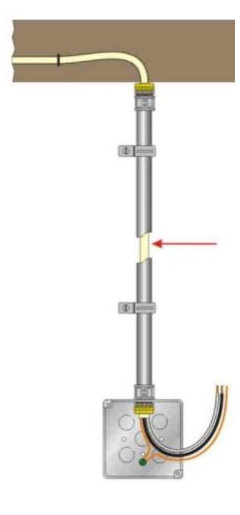
    Note that if the conduit is ONLY being used as physical protection from the joists down to the box, then NM-B can be used in the conduit. In this case, the cable enters directly into the conduit (not through a box) and passes down into the box (as shown below).

    However, if the conduit is connecting two boxes then the individual wires must be used (this is defined as a 'closed system'). NM cable isn't allowed in that case.

    Note: Individual wires can ONLY be used in conduit.

  • 9 years ago

    I believe the distinction used in the NEC is the difference between conduit used as a raceway vs. conduit that is only a sleeve (as above). Sleeves are used for protection in exposed areas and may be continuous or may have breaks. The NEC says a raceway is an "enclosed channel of metal or nonmetallic materials designed expressly for holding wires, cables or busbars". However, all of these definitions have a one or more exceptions in the code, and sometimes your installation may within one of the exceptions.

    Bruce


  • 9 years ago

    NEC 334.15

    (C) In Unfinished Basements and Crawl Spaces. Where cable is run at angles with joists in unfinished basements and crawl spaces, it shall be permissible to secure cables not smaller than two AWG or three 8 AWG conductors directly to the lower edges of the joists. Smaller cables shall be run either through bored holes in joists or on running boards. Nonmetallic-sheathed cable installed on the wall of an unfinished basement shall be permitted to be installed in a listed conduit or tubing or shall be protected in accordance with 300.4. Conduit or tubing shall be provided with a suitable insulating bushing or adapter at the point the cable enters the raceway. The sheath of the nonmetallic-sheathed cable shall extend through the conduit or tubing and into the outlet or device box not less than 6 mm (1/4 in). The cable shall be secured within 300 mm (12 in) of the point where the cable enters the conduit or tubing. Metal conduit, tubing, and metal outlet boxes shall be connected to an equipment grounding connector complying with the provisions of 250.86 and 250.148.

Sponsored
CHC & Family Developments
Average rating: 5 out of 5 stars6 Reviews
Industry Leading General Contractors in Franklin County, Ohio