Software
Houzz Logo Print
otcay

1st time growing tomato

9 years ago

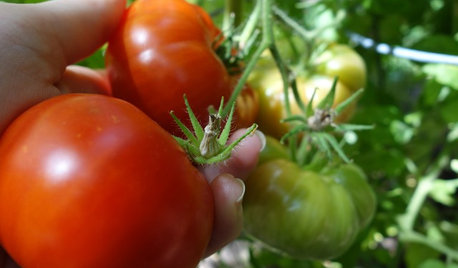
I'm growing a tomato plant this year for the 1st time by default as it came up as a lonely volunteer. I assume the kitchen scraps I buried in the garden these past few months found the environment just right to sprout. The plant is vigorous and fruitful, now standing 5 ft tall with 20 fruits, albeit still green and small. The largest is about egg-sized. I've only learned belatedly to trim the suckers so hopefully I can keep its growth in check and prevent diseases while coaxing a decent yield from it. The question is do I continue lopping off the extra growth to keep it relatively contained in the cage? If so does this hasten its demise if it can't grow leaves to feed itself?


Comments (9)

  • 9 years ago

    Trimming suckers is largely a garden myth. No real reason to do it, except to help shape the plant as a whole. I suppose if your cage is small, then you'll need to keep paring back the plant, but the problem isn't the suckers. The problem is having a cage that is too small. Tomatoes are programmed to bear fruit and seeds. They want to do precisely what you want them to do. So in doing so, if they spit out suckers, it's in the interest of getting more fruit and seeds.

    otcay thanked daninthedirt (USDA 9a, HZ9, CentTX, Sunset z30, Cfa)
  • 9 years ago
    last modified: 9 years ago

    Pruning off 'suckers' does not really hurt the plant unless disease sets in at the injury. It does though, remove opportunity for more fruit. If you are pruning for maintenance to allow for airflow and to keep it supported by a trellis or a cage, then it's a trade-off... potential fruiting limbs for your preferred growth habit.


    Edit... I was typing at the same time as dan.

    otcay thanked rgreen48
  • 9 years ago

    "I've only learned belatedly to trim the suckers so hopefully I can keep its growth in check and prevent diseases while coaxing a decent yield from it. The question is do I continue lopping off the extra growth to keep it relatively contained in the cage?

    Personally I'm sorry you "learned" that ;-) as it isn't accurate and you will find many discussions about this over on the Growing Tomatoes forum here. You will discover that many growers do no pruning whatsoever as they prefer instead to keep the fruit that is lost by pruning. And should it be a determinate variety plant you could end up with no fruit at all if pruned.

    As the others have indicated pruning is an option open to you but it is in no way mandatory. The cage or support should fit the plant, not the other way around and numerous support options are available. As for help preventing disease, good air circulation around a plant can be accomplished without pruning and if you remove healthy foliage then if disease does strike you can't remove the diseased foliage without stripping the plant bare.

    So the goal IMO is to achieve a balanced approach - remove sick or damage foliage and thin out some leaf branches if you must. But leave the healthy lateral branches (aka suckers) alone for the most part.

    Dave

    otcay thanked digdirt2
  • 9 years ago

    Thanks for the words of experience. I'll be more cautious w/ the shears, albeit belatedly. Is it realistic to expect now that the uppermost tips were cut, the suckers will to come off low on the main stem or will they sprout near where the tips were last cut?

  • 9 years ago

    Pruning helps with air flow and prevent diseases that enjoy moist environments. In my opinion It's more troublesome to begin pruning infected leaves after disease sets in than it is to pick off suckers before diseases.

    I trim all of my tomatoes. But in the end it is personal preference. You could try not pruning and seeing if that works for you.

  • 9 years ago

    " Is it realistic to expect now that the uppermost tips were cut, the suckers will to come off low on the main stem or will they sprout near where the tips were last cut?"

    It depends in part on the type of plant - determinate or indeterminate - and you have no way of knowing that. But in general, no or minimal new growth below as those nodes have aready been sealed and bypassed by the circulatory system. Most will develop from the node just below the cut.

    "Pruning helps with air flow and prevent diseases that enjoy moist environments. It's more troublesome to begin pruning infected leaves after disease sets in than it is to pick off suckers before diseases."

    It is broad statements like that, which over 20 years of research does not support, that are so misleading to inexperienced growers. It is old "garden lore" and some cling to that claim because they don't understand the real underlying causes.

    For one, the fungi that cause all the common tomato diseases are air borne as well. And heavy pruning only further exposes the limited number of fruit to pests and sun scorch and reduced energy due to restricted photosynthesis.

    Second, proper spacing, placement, support, and water application methods do far more to reduce moist environments than any pruning does.

    Third, pruning does not mean simply removing the so called "suckers" (they are actually lateral branches). If a plant must be pruned because it exists in an overly wet environment or because it lacks good air circulation then one can simply carefully thin out some of the leaf branches in whole or part and leave the lateral branches fruit producing ones in place.

    And fourth, failing to remove disease infected foliage only encourages spread of the fungus/bacteria within the plant.

    Just some points to consider. And again,all this is discussed in more detail on the Tomato forum here directly linked on this forum's front page.

    Dave

    otcay thanked digdirt2
  • 9 years ago

    Certainly prune off stems that are hanging on the ground. But that's true that trimming fully formed branches is probably smarter than trimming off suckers, which is all new growth, and will be the healthiest part of the plant.

    otcay thanked daninthedirt (USDA 9a, HZ9, CentTX, Sunset z30, Cfa)
  • 9 years ago

    Yes Cornell does have some good info but it is specifically for high-tunnel production and indoor tunnel production requires a very different approach than outdoor growing for several reasons, primarily working and walking room, ease of access, and maximizing per square foot production.

    But even the article makes clear they are talking about very limited sucker removal and that how much is determined by the type of support used. The article goes on to say that while the "suckers" are needed for fruit production not all the leaf branches, especially the leaf branches below the fruit clusters, are necessary for adequate photosynthesis. So their pruning techniques focus on leaf removal and not o lateral branches.

    Dave