

Please help identify disease
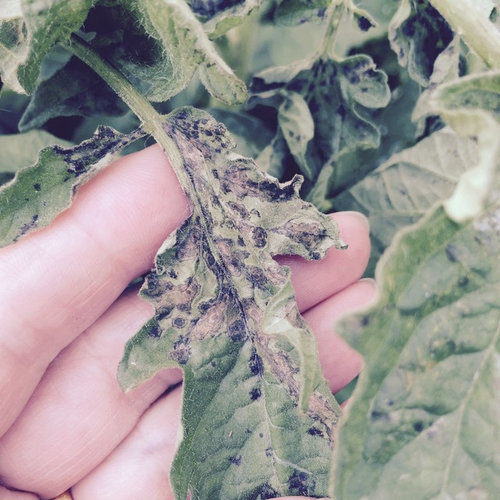
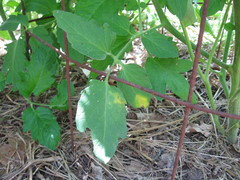
My friend send me a picture of some diseased leaves she had. I have had some fungal diseases, but I haven't seen something like this. I told her I would ask the knowledgeable people here. Can you help?
Thanks,
Jennie
Comments (54)

Jennie Sims
Original Author9 years agolast modified: 9 years agoThank you all! She is in southern Kentucky. This picture was taken with her phone. Except for one branch, the rest of the plant (sungold) looks very healthy. She has been spraying weekly with Daconil. I told her to remove the diseased leaves and will tell her to start alternating with copper. Just wondering, does alternating between Daconil and Copper make each more effective?
Jennie
 9 years agolast modified: 9 years ago
"Just wondering, does alternating between Daconil and Copper make each more effective?"
No they don't affect each other. They each work differently so give a broader base of overall effect for the plant.
I agree that this doesn't look like the typical Early Blight I see - more like grey mold (Botrytis) or leaf mold (C. fulvum) - but in the long run it makes no difference as the treatment is basically the same.
Dave
Related Professionals
Bowling Green Landscape Architects & Landscape Designers · Dayton Landscape Architects & Landscape Designers · New Bedford Landscape Architects & Landscape Designers · Las Cruces Landscape Architects & Landscape Designers · Lake City Landscape Contractors · Concord Landscape Contractors · Norfolk Landscape Contractors · Allentown Landscape Contractors · West Plains General Contractors · Rock Hill General Contractors · Georgetown General Contractors · Grand Rapids General Contractors · Binghamton General Contractors · Concord General Contractors · Los Angeles General Contractors- 9 years agolast modified: 9 years ago
Yeah, I'm in E. Tn. and just removed a good number of early blight-infected leaves this past weekend. The weather between here and SE. Kentucky is not much different. While I was doing a quick walk-through early this morning I saw another infected leaf. I'll try to get a pic and post it after a while. Assuming a proper diagnoses (although, I could be completely wrong lol,) the most common symptom seems to be yellow patches with a dark 'lesion' in the yellow area. We're expecting late afternoon storms all week, so I'll soon have knee/waist-high bare stems lol.
I get early blight every year, it's just our climate. The plants usually outgrow it, but some years are worse than others. I don't know what that problem is in the photo, but I sure hope it stays north of the state line :-P.
 9 years agolast modified: 9 years ago
Kentucky :-)
There could be gray mold in there too, which, for your friend is another reason to alternate, especially as once an attack begins:
(1) other pathogens have an easier time to get in the lesions from the first bug, and using two alternating is a way to combat this since sometimes one is more effective than the other and this way you get added prevention of new pathogens.
Other reasons to alternate:
(2) By only using one fungicide, resistance can build up and you can select for the resistant strain which make things less effective down the line not only for her but in general for everyone.
(3) Copper containing ones, although organic approved fungicides, builds up in the environment and persists, while Daconil doesn't, and some people like me are less comfortable with overusing copper in bad years.
Mancozeb was also suggested and if she can find it, and afford it, could work better. I personally am intimidated by it and some won't ship it here. But toxicology information is inconsistent so no stone thrown in glass houses...
Cheers
PC
Jennie Sims
Original Author9 years agoI have read on here a lot to rotate between the two and wondered why. Thanks Dave and PC for the great explanations. I passed on the information to my friend. PC, I have always used Daconil for that very reason. But I think if I get a fungal disease (not if, when here in TN) I might rotate some copper in.
Thanks again,
Jennie
- 9 years ago
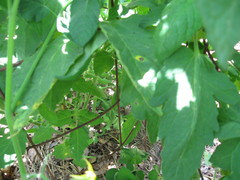
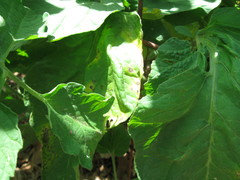
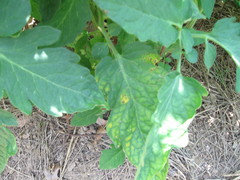
Here's a few images of what I've known as early blight. Unfortunately, it seems to be spreading fast this year.
- 9 years agolast modified: 9 years ago
Re Daconil and copper, is there a reason to rotate between the two? I mean, why not just mix and apply together if they don't interfere with each other? It would be easy to make up a ready-to-spray Daconil/copper mix that, one gathers, would target a range of fungi.
- 9 years agolast modified: 9 years ago
Dan, The problem is likely that Daconil has be taken up by the cell in a certain concentration since it participates as an inhibitor in certain metabolic cycles of the pathogen, and putting something else in there upsets the already low solubility in water. If you can't get the critical dose in, as the logic goes, it doesn't work as it is doesn't reach the level to kill the bugs that's needed (and will even select for more resistance), so it essentially is like applying copper alone.
Just like any (broad spectrum) antimicrobial.
Cheers
PC
 9 years ago
I never knew that Daconil was a systemic acting fungicide... I always understood it as having to make contact with the actual spores of the pathogen in order to kill. I tank mix Daconil and copper quite a bit. I have never heard that mixing the two will negate the effectiveness of the other. I suppose I should investigate this further.
- 9 years ago
Ooops. I misread your post... you are saying that Daconil has to be taken up by the cells of the PATHOGEN, not the tomato plant.
Anyone else use tank mixes sucessfully?
- 9 years ago
Rgreen... that looks more like what I tend to see as Early Blight here, as opposed to the OPs picture. That picture looks like it started out as Septoria and then Grey Mold set in as a secondary pathogen.
- 9 years agolast modified: 9 years ago
Yeah nc, it's spreading fast this year. We haven't had rain in a week. I'm not watering, and the dew alone has been enough to cause it to spread faster than I can remember. I do hope the OP can get what they have under control.
- 9 years ago
Everything I have ever read negates mixing the two. Not only do label recommendations say not to intermix but chemists "claim" there are negative interactions if you do. To me common sense and a bad experience in high school chemistry tell me to NOT mix things when I don't know what may happen.
Dave
- 9 years ago
I was told a while back by an expert in the field that as long as the two chemicals do not form a precipitate (a solid) when mixed, then all is fine. When I worked at a commercial nursery, we tank mixed chemicals all the time and never had a problem. We sprayed something every day, and never saw any problems. I have even mixed fungicides with insecticides with no problems.
- 9 years agolast modified: 9 years ago
My take: Chlorothalonil has a spreading and solubility problem. Daconil is a product formulated to make a homogeneous emulsion that overcomes these issues. Adding things to the emulsion is not contemplated in the manufacturers formula. Compromise the emulsion and there will be plenty of safe spaces for the target pathogens to fester. "Negative" interactions is a loose word that is not descriptive. A precipitate does not have to be formed for an emulsion to not do its job.
Cheers
PC
PS, Anyone mix primer and paint in the same tank and apply it? Any luck? ;-)
 9 years ago
Chlorothalonil works by binding to structures on the leaf that the disease also binds to. Mixing something in it will cause the Chlorothalonil to bind to it instead and reduce the effectiveness of it and whatever else you mix with it. You don't have to worry about resistance with Daconil but it doesn't work on everything, like grey mold. It's a good idea to alternate with copper or something else for that reason.
- 9 years agolast modified: 9 years ago
Thanks, I was always curious if those all in one primer paints were any good.
It's possible some exhaustive R&D is behind all-in-one formulations to insure optimal performance/trade off for both priming and finishing under a variety of reasonable mixing and application conditions though.
Cheers
PC
- 9 years agolast modified: 9 years ago
Well, if the instructions say not to mix, then I won't mix. FWIW, my Daconil instructions don't say anything about mixing. Don't say much about anything regarding preparation, actually. Yes, I understand that chlorothalonil isn't very water soluble, but somehow Daconil concentrate is diluted in water so manages to be water soluble. Some growers mix Daconil with foliar nutrients. Go figure. At some level, things get mixed on the plant when they are sprayed alternately. Certainly after you spray copper, there is going to be a load of copper sitting on the plant when you spray Daconil on it. But you would think that if there were a higher performance fungicide that could be made by mixing chlorothalonil and copper, it would have been done already.
- 9 years ago
I can not remember seeing a label advising against tank mixing... I will have to look close the next time. Dave, which labels are you referring to?
- 9 years agolast modified: 9 years ago
I can not remember seeing a label advising against tank mixing... I will have to look close the next time
I seriously doubt this is spelled out on the label, too. But it is clear. The label has instructions to dilute it in water. If you do anything besides that, you are not using it as directed, and the label should say not using as directed is illegal.Comments on the label are usually restricted to dosage and safety. The legalese is really a mess and a company could open itself up to a lawsuit by warning not to do things that are already illegal. For example, if some other pesticide they sold didn't have that warning and someone got hurt mixing, a lawsuit could be started saying, well on the Daconil label it said don't, but on the XYZ it didn't warn him and so he took that as a hint he could mix XYZ with ABC and was hurt.The company was negligent!
Meanwhile the labeling lawyers say, stick to business. If you have any question, call them and if you want to do anything not written on a label you get told no.
Cheers
PC
- 9 years ago
A quick Google search shows many labels that do indeed describe which other chemicals are compatible and especially which are not. So, I am not sure where you are coming up with the above info.
I will stick with what has worked for me and thousands of others for a long time. A little common sense and precautions are in order though when doing so.
Below is just one link that encourages tank mixing certain fungicides.
http://msue.anr.msu.edu/news/benefits_of_tank_mixing_cercospora_leaf_spot_fungicides
And below is a quote from another University study:
"To determine compatibility, start by reading the label on the chemicals proposed for mixing. Many chemicals are not suitable for mixing and labels will say so. Many labels will list other chemicals that can or cannot be mixed with the pesticide. Also, many labels will detail methods for mixing that you should follow. If labels do not make any recommendations, you must perform your own compatibility test. To do so, follow these simple methods to determine if the chemicals you want to mix are compatible."
- 9 years agolast modified: 9 years ago
I could say that since the label instructions read something to the effect of
"It is a violation of Federal law to use this product in a manner inconsistent with its labeling.
Daconil must be used only in accordance with recommendations on this label or in separately published
SYNGENTA supplemental labeling recommendations for this product."and since the label directions provide no instructions for mixing in other ingredients one is in violation of the law by mixing it with other ingredients. However -
Sygenta labeling goes on to add:
DO NOT combine Daconil Action in the spray tank with pesticides, surfactants or fertilizers, unless your prior use
has shown the combination physically compatible, effective and noninjurious under your conditions of use. DO NOT
combine Daconil Action with Dipel®, Latron B-1956® or Latron AG-98®, horticultural oil, and products containing
xylene as phytotoxicity may result from the combination when applied to some species on this label. A tank mix of
Daconil Action with Chipco® Signature® can result in physical antagonism if not mixed properly.GardenTech brand label gives the same "violation of the law" warning and adds under the specific crop application instructions "Do not apply in the presence of other chemical treatments including... (long list including all the above).
As for copper, even the pH of the water you mix it with can affect its effectiveness. The more acidic the water the greater the release of copper ions but since most community water has a pH of 7.0+ phytotoxicity isn't usually a problem. Alter that pH by adding other chemicals and you risk toxic effects on the plants.
https://cvp.cce.cornell.edu/submission.php?id=140
__________________
How to get the most out of your fungicide sprays
"Tank-mixing certain fungicides can increase the risk of phytotoxicity. For instance, do not tank-mix sulfur and oil-containing products nor spray them within two weeks of each other. Do not apply sulfur to sensitive crop cultivars or at temperatures above 80°F. Do not apply copper under cool, slow-drying conditions. Also, do not tank-mix phosphorous acids (Prophyt, Phostrol) with copper, as copper can become more available and phytotoxic in acidic solutions. Also, do not apply phosphorous acids to plants that are stressed (i.e., due to heat or drought stress). Tank-mixing products containing difenoconazole (Revus Top, Inspire Super) with non-ionic surfactants or foliar fertilizers can increase the risk of phytotoxicity, particularly on succulent, fast-growing plant tissues. Some crop cultivars are sensitive to strobilurins – ‘Concord’ grapes are sensitive to Pristine and Flint. Captan can become phytotoxic when applied with oil or within four days of an oil spray.
Tank-mixing some fungicides can inactivate one or both. For instance, don’t tank-mix copper with the biofungicide Serenade (Bacillus subtilis – a bacterium), since copper is toxic to bacteria and can inactivate Serenade. While part of the activity of Serenade is due to antibiotics resulting from the fermentation process used to produce Serenade, some of the efficacy is related to activity of live bacteria. Similarly, the biofungicide RootShield (Trichoderma harzianum – a fungus) is incompatible with the fungicides Orbit (propiconazole), Elite (tebuconazole), and Procure (triflumizole) which can kill theTrichoderma spores. Also, don’t tank-mix bicarbonates with phosphorous acids or use lime with Captan as fungicide activity will be reduced. Fixed copper formulations and lime should not be used with Guthion, Imidan, Sevin, Thiodan, Bayleton, or Captan as efficacy may be lessened and the risk of phytotoxicity increased.
Chemical compatibility also needs to be considered. For instance, fungicides in dissolvable bags are incompatible with spray oils and boron-containing fertilizers because these materials prevent the bags from dissolving. In addition, chemical incompatibility may cause products to go out of solution or suspension and precipitate in the bottom of the tank. When tank-mixing chemicals, read the label for indications of incompatibility with certain products. Also, add products in the following order unless otherwise directed on the product label."
Your choice.
Dave
- 9 years ago
So, after reading my references and yours, I think it is fair to say that some fungicides can be beneficial to tank mix and others are not compatible. Experience, common sense and testing should be top priority.
If interested, one can Google fungicide compatibility charts...
- 9 years agolast modified: 9 years ago
NC, I'll bridge my reply to your specific points.
A quick Google search shows many labels
that do indeed describe which other chemicals are compatible and
especially which are not. So, I am not sure where you are coming up with
the above info.I mentioned labels generally stick to application dosage and safety. You noted 'incompatible' chemicals often crops up on a label. Usually these are due to a known safety issue or regulation. There is no safety issue that results from mixing Daconil and most copper products to my knowledge. It is just antagonistic to Daconil to mix it with anything that decreases its solubility and dispersion. Thus, the mixing copper with Daconil does not cause a known safety issue, and can only cause the manufacturer additional liability if added to the label. The instruction is only to mix with water, so putting copper in it is illegal in it as I posted. Labels are intensely crafted and regulated works of art. The manufacturer is perfectly happy to sell you more product to do anything you want, illegal, etc., as long as you are liable and they're not.
Regarding the 'compatibility'. If it happens, you can be fairly confident that a tank mix with the compatible product is essential for the success of their product in the market. The company volunteers it there despite opening additional potential liability, after testing themselves, because they essentially have formulated their product by accident or intent to be an easy add on to a current practice giving them greater market penetration. They don't put it there to be our friend!
I will stick with what has worked for me and thousands of others for a
long time. A little common sense and precautions are in order though
when doing so.You lost me here. If you don't use your product as directed on the label, it is an illegal use. By calling it an illegal use, I am simply stating a the law. You, millions of others and I use products illegally sometimes because we know the use is proven effective and harms no one, and I'm not criticizing us for it. Common sense and precaution are requisites, yeah, and so is understanding it is an illegal use.
Below is just one link that encourages tank mixing certain fungicides.
http://msue.anr.msu.edu/news/benefits_of_tank_mixing_cercospora_leaf_spot_fungicides
I agree that there are probably one million more such encouragements to illegally use products, formally and informally by people that have no liability, like this University^^^.
And below is a quote from another University study:
"To determine compatibility, start by reading the label on the
chemicals proposed for mixing. Many chemicals are not suitable for
mixing and labels will say so. Many labels will list other chemicals
that can or cannot be mixed with the pesticide. Also, many labels will
detail methods for mixing that you should follow. If labels do not make
any recommendations, you must perform your own compatibility test. To do
so, follow these simple methods to determine if the chemicals you want
to mix are compatible."This is an excellent summary, but note: it is not encouraging mixing at all. It mentions if you do something not supported by the label (meaning probably illegal), the onus is on you. It is actually a nice and sneaky way of saying if anything goes wrong and there is any liability, you can and will be prosecuted. If nothing goes wrong, nobody cares and the illegality is purely academic.
Cheers
PC
- 9 years ago
These are good points. But the fact remains that if I spray copper on my plants and a few days later spray Daconil on them, those plants are going to have a mixture of copper and Daconil sitting on them. If that's illegal, the police would have to come in and arrest my plants.
I think PupillaCharites has it right about avoiding liability. As in, if you mix our stuff with other stuff and it turns out bad, you can't blame it on us!
But, as I say, if you could make a powerful broad spectrum fungicide by combining Daconil with copper, Syngenta would have done it already, and jacked up the price a bit on what they could call CuDac. So Syngenta must have a good reason for not doing so.
Instructions not to combine chemical fungicides with biofungicides are sort of drop-dead obvious. If you kill the bacteria, they won't do the job. If they combine on the plant, they'll have a chance to do the job before they get killed.
- 9 years ago
I guess my primary question would be, given all the variables involved and the potential for creating problems, why mix?
Can anyone actually document a controlled experiment improved result from mixing them or is it purely anecdotal? Is it done out of a thorough understanding of all the underlying chemistry that the rest of us don't have? Great but please share that with us.
Is it done merely for convenience? If so then it is your choice of course as no fungicide police are going to come arrest you. ;-) But it is also your price to pay in terms of wasted product or negative effects on plants. Convenience always has a price.
I agree with PC that labels and instruction sheets always take a conservative, self-protective approach but when using chemicals that isn't necessarily a bad thing or something to be scoffed at.
Dave
- 9 years agolast modified: 9 years ago
Well, the reason for mixing would be simplicity. You spray once, and target different fungi. Works the same way for fertilizers. I could laboriously apply nitrates, potassium, phosphorus, and minor nutrients separately, but MiracleGro has already done that for me in one package.
But that's exactly right that it would be best to get some validation before mixing random fungicides. Does it hurt? Does it waste? So if someone out there has successfully mixed Daconil and copper, please advise!
There is actually a lot of material available on line about compatibility between chemical and biological fungicides. I did find this about comparison between Daconil and other chemical fungicides, but I don't recognize any of the brands listed as being copper-based.
Daconil is pretty tank-mix compatible with all of these, except Terrazole (which isn't compatable with anything, it would seem). In fact, just about all fungicides are tank-mix compatible, except Terrazole.
Here is another chart.
http://hortus.net.au/pdf/Chemical-Compatibility-Chart.pdf
The effect of Daconil/chlorothalonil mixed with copper is here considered "not known or necessary".
- 9 years ago
Dave wrote:
"Can anyone actually document a controlled experiment improved result from mixing them or is it purely anecdotal? Is it done out of a thorough understanding of all the underlying chemistry that the rest of us don't have? Great but please share that with us."
Did you take the time to read the article from Michigan State U that I posted a few posts back?
Tank mixing of fungicides and pesticides is commonly used in the commercial horticultural business.
- 9 years ago
Yeah I did. Some of the links I posted also talked about commercial tank mixing of various products. But they all reference very specific products that can be mixed and only in specific proportions. Is that what you are doing? What mixing and application rates commercial equipment can compensate for are quite different than what the average home gardener works with.
My comments were specifically addressed to the two in question - Daconil (chlorothalonil) and copper, especially copper - and to home gardener products and application equipment. Can you choose to ignore the recommendations and label instructions? Sure. But that in no way means it should routinely be recommended to others.
Dave
- 9 years agolast modified: 9 years ago
Dan, I see where you are coming from but am personally not so enthusiastic, let me explain my take or the difference in interpretation based on some of your points which I put in italics and comment after.
Yes, I understand that chlorothalonil isn't very water soluble, but
somehow Daconil concentrate is diluted in water so manages to be water
soluble. Some growers mix Daconil with foliar nutrients. Go figure. At
some level, things get mixed on the plant when they are sprayed
alternately.I try to use product names when dealing with commercial formulations that can have differing properties and potentially behave differently, as you did somewhat here, but elsewhere there is sometimes confusion. Labels are specific to the product. For example, GardenTech's Daconil Fungicide Concentrate is the product name I should use where I wrote Daconil.
I agree Daconil FC used alternately with copper will result in both being present on the leaf.
But that's exactly right that it would be best to get some validation
before mixing random fungicides. Does it hurt? Does it waste? So if
someone out there has successfully mixed Daconil and copper, please
advise!OK, you understood the solubility (and dispersion) problem of chlorothalonil in water. In more detail, there are two separate pertinent questions.
(1) Will a sufficient amount of DFC be delivered homogeneously to each and every leaf? and
(2) Will there be some antagonisic interaction on the leaf cutting product effectiveness?
I am focused upstream on (1), where I commented before the critical nature of the solubility to deliver it, and you downstream on (2). Since chlorothalonil has such poor solubility in water my reasoning is the first bottleneck is clearly (1). If not enough is delivered to the leaf it will not reach the typical range of the toxic threshold level of the target pathogens, and downstream doesn't matter. Regarding (2), once the chlorothalonil is on the leaf, it is going to dissolve into the waxy (epidermal) leaf cuticle quickly. Chlorothalonil is paired with propylene glycol in Daconil Fungicide Concentrate which insures this happens since both are attracted to lipids in the cuticle, and to each other, where PG piggybacks it over like the errand boy, so you can imagine when it is delivered to the leaf it essentially dissolves or is sucked into the cuticle layer charging the entire surface film of the leaf nicely, turning it into an armor of sorts if you can picture that. I cannot even speculate on how dissolving ionic copper will alter that any, once the chlorothalonil is in the hydrophobic cuticle layer days later. If you disrupt the propylene glycol association ("tank mix") you can't get the uniform spray needed to have chlorothalonil delivered to the leaf. The manufacturer has determined we need 2.4 grams PG per gram chlorothalonil to accomplish this feat in their user's water.
Before worrying about validation I ask myself, skeptically much like Dave in his post, is there any benefit to applying both at the same time, or if I take pains to do it alternately, is that just as good? Bear with me and ask the question to yourself I first did: Both have toxic threshold levels, so the hypothesis is I need to give full doses of both, not half and half, to be viable. That is a lot of waste if they generally do the same thing, both being broad spectrum fungicides. Other fungicidal formulations do combine active ingredients, but they are usually pro formulations. I am just a guy with a yard and minimalist when it comes to pesticides, as are many home gardeners. Not a commercial conventional grower who is struggling with yield such that 1% makes a big difference. He would likely use more potent combinations or cocktails and these fungicides alone or in combination could be a little wimpy.
When I apply Daconil FC it is to avoid home brewed copper sulfate and vice versa, and alternating avoids selection, nothing is noticeable to me in a single application but I sleep better knowing that I am not altering the bad fungi and bacteria to relatively more resistant species or strains of one or the other over the long term in my yard.
By all means, it is a valid research project to see what combinations of DFC and some specific copper product potentially are more effective. Here is one study I found which concluded that there was no benefit whatsoever to combining them. The problem is that exhaustive testing is required to prove anything or you just become an anecdote, or an anecdote with a cult following :-). The study looked at a specific crop (peanut) under specific conditions with a specific approach to formulation for a specific pathogen. I couldn't find a tomato study though, so I suppose it doesn't prove much except to say nothing much going on with that combination.
Cheers
PC
- 9 years agolast modified: 9 years ago
I find it unconvincing that mixing fungicides makes a toxic medium. Because when I spray copper on my plants, it's still there when I spray the Daconil on. No poison is created when they mix on the plants. No I'm not going to wash off my plants before applying fungicide. That's ridiculous. Also, the posted information on tank-mixing compatability suggests that there is little evidence for bad things happening, with a few clear exceptions.
But what we may be ignoring here is fungal resistance. It is well known that fungi evolve quickly to be resistant to individual fungicides. In fact, that's precisely why using multiple fungicides with different mechanisms of fungal toxicity is a good idea. But if you use half strength of one combined with half strength of the other, it may not be enough to really kill, and just exerts pressure to evolve resistance.
On the other hand, if you combine full strength of one with full strength of the other, it may end up being a concentration that is toxic to plants.
Certainly the package dilution instructions are given with regard to minimizing resistance breeding. It's bad to make it stronger, and it's bad to make it weaker.
As to "why mix?", the subject of this discussion is "why not mix?" I don't laugh at convenience, and it is convenient to apply differently aimed fungicides at the same time. Much as it is convenient to apply different nutrients at the same time.
- 9 years ago
Dan you might be perfectly fine doing what you are doing. It is a bit of an experiment I guess and if you have good results and you are happy with it, go for it. For me, I would not have tried it to begin with if for no other reason than the expense. It would basically be twice as expensive and my question would be is it worth it? As far as resistance goes, there is no resistance build up with Daconil because it doesn't really work by killing the fungi but rather by blocking it.
- 9 years agolast modified: 9 years ago
I don't think what we're discussing bears on expense. There is no question (for reasons that I stated) that using multiple fungicides is a generally effective strategy. Much moreso than using one. In principle, the expense is the same, because if you're using two fungicides, you'd use each one half as often.
That s true that the risk for resistance development is lower for fungicides with multi-site activity like both copper and chlorothalonil.
- 9 years ago
"Much as it is convenient to apply different nutrients at the same time."
Good simile. So if your plants were showing signs of phos deficiency you'd give them a good dose of N-P-K plus micros just to treat the phos deficiency?
"As to "why mix?", the subject of this discussion is "why not mix?"
Uhhh because that is a negative hypothesis and you really can't prove a negative. If you try all the burden of proof and the need for providing supporting documentation falls on the one advocating the negative hypothesis.
So all you can really do is try to DIS- prove the positive which in this case is - mixing of chlorothalonil and copper-based fungicides is not generally recommended by the manufacturers because the associated risks outweigh the rewards.
Dave
- 9 years ago
In principle, the expense is the same, because if you're using two fungicides, you'd use each one half as often.
I don't really understand this? The longevity on the plant will be the same as would be the amount you use per app. I think the confusion may be on how you apply as opposed to me. I use one or the other every 7 to 10 days, not both within that period so for me it would be twice as much product.
- 9 years agolast modified: 9 years ago
there is no resistance build up with Daconil because it doesn't really work by killing the fungi but rather by blocking it.
Cyanide poisoning in humans then doesn't work by killing people, it only blocks them (by blocking oxygen from binding to hemoglobin)? No! The pathogen is not blocked, but killed.
Chlorothalonil is a fungicide, by definition a fungi-killer- which is taken up by most fungi and bacteria in close contact to the leaf cuticle where it is absorbed after application.
Once absorbed by the pathogen or its spore, multiple metabolic processes of the fungus or bacterium are poisoned, including but not limited to germination and respiration. The mode of action of this poisoning specifically is by binding with and deactivating glutathione-dependent biological molecules essential for core metabolic processes (respiration and others) occurring within the pathogens.
The manufacturer is smug to claim no resistance is built up, and they have bragging rights. However this is both true and misleading at the same time, in my opinion, and is often quoted in marketing. The basis of this claim is that multiple mutations would have to occur to address each and every lethal enzyme or macromolecule that is poisoned, and multiple mutations are unlikely to happen vs a single site mutation which is common in microbes.
It is misleading because all species are not equally sensitive due to reasons beyond straightforward gene difference, and by this I have in mind cell architecture, for example. There will be selection to some degree for those species with higher tolerance (and possibly lines), and this selection, will put pressure on replacing the pathogen community with the ones able to fill the niche being vacated, just like antibiotics tend to upset the microflora blance in humans. As for resistance it is an incredible multi-site intracellular poison, and the EPA considers it low risk, not zero risk for developing resistance. Life adapts and survives. The reason for alternating regardless, stands, because though usually similar in results, copper and chlorothalonil have completely different modes of action, and a balancing act is helpful in any case.
Cheers
PC
- 9 years ago
You are correct PC, my apologies for throwing out incorrect information. I thought I had read that somewhere but maybe I was a victim of someone else's incorrect information. I had heard that there was no resistance as well so I assumed the reasons I stated.
- 9 years ago
As to the amount of product used, I use both copper and Daconil. If I used just one, I would use it weekly. With both, I use one on one week, and the other the next week. I use the same amount of product every week. So aside from the outlay for twice as much fungicide, that much fungicide lasts twice as long. For a given period of application, the expense for two products is the same as for one. You pay twice as much, but they last twice as long. I don't understand. You're saying you apply both every week?
If I sprayed both, one right after the other, it sure would simplify things to mix them! You can mix 'em in the bottle, or mix 'em on the plant.
With regard to resistance build-up against Daconil, if you believe the manufacturer, NO (acquired?) resistance has ever been identified. That's pretty good, if true.
- 9 years ago
Dan I understood that you were mixing both together and spraying every week so a double dose so to speak. No, I spray once a week alternating between them.
- 9 years agolast modified: 9 years ago
In principle, the expense is the same, because if you're using two fungicides, you'd use each one half as often.
That is one way to look at it and I agree. But I want to point out Daconil Fungicide Concentrate costs me 49.8¢ per gallon and copper mixture, about 18.5¢ per gallon to make Bordeaux mixture, with similar amounts of mix used, though I go slightly heavier on spraying the copper.
Also, the copper lasts at least twice as long, at least that's my experience with the results, making Daconil FC up to 5 times more expensive the product and twice as labor intensive. But, you get your product and there is no waste by alternating - a good feeling. Too bad I prefer Daconil to copper :-|
Cheers
PC
- 9 years ago
PC, certainly we weren't factoring in product cost. That's a fair point. But why does copper last at least twice as long? Lasts longer in the bottle, or on the plant? Evidence?
- 9 years ago
No hard proof. Depends so much on rains for both fungicides that I'm just an anecdote. Copper bordeaux spray seems to have an opaque coating longer on the leaves and I do not have a regular spraying cycle like others have mentioned here. I spray when I see it is washed off and it is a pain enough to spray one fungicide than to have done a test side by side. Copper is inorganic so as long as you see it, you know it's active. Interestingly Daconil FC is organic, so it is harder to know if it is still effective after say 10 days, but I'd guess it is stable from the literature.
The copper mixture also clogs up my sprayer and doesn't go on as uniformly (requiring more spray), and has injured leaves a few times ... so that's negative, and in the end that is the main reason I prefer Daconil FC. If you buy a commer$al copper product this should not be a problem and probably it washes off even quicker than Daconil so they can sell you more lol, but I have lots of copper sulfate here from making my fertilizers so I am happy to put it to some use, rather than having to pay manufacturers for potential carcinogens, I can choose to poison my soil with copper. Just being sarcastic on the last one, but when I shell out $15 for Daconil FC and get it on my skin and in the air I breath when spraying, I'm allowed to cuss a little.
Cheers
PC
 9 years agolast modified: 9 years ago
PupillaCharites: Interestingly Daconil FC is organic
I don't think that's correct, unless you're speaking in a chemistry sense and not in the agricultural chemical classification sense.
- 9 years agolast modified: 9 years ago
Certainly in the chemistry sense, when talking about chemical degradation, but I didn't qualify it because I did qualify I was having a little sarcastic fun because as a little independent gardener I am appalled by the opportunistic and misleading information marketeers use to sell their products.
Even chemists don't always have a consensus of what is "organic" in the sense of organic compounds.
Daconil clearly is not and should not be approved for "organic" farming use. Nor should copper. The irony (sarcasm) is that the organic compound is not ok for organic farming and the inorganic one (Cu) is. But that is nothing more than a result of political and marketing lobbying. Copper after all, is a toxic heavy metal if we throw around labels like these and don't pay attention to the applications and thresholds.
I am so happy that OMRI's days are numbered!
Cheers
PC
 9 years ago
Copper after all, is a toxic heavy metal and it is also called an essential trace element in human nutrition. Mineral (nutrient) - Wikipedia - [Cu] Required component of many redox enzymes, including cytochrome c oxidase.
It gets complicated when we start including or excluding something because of a label.
- 9 years ago
Speaking of OMRI, is there an explicit definition about what they define as "organic"? I guess it's nice that someone is defining things as "organic", but I'll be darned if I can make out their rules. Nothing that I can see on their website about that. Is the metric whether the substance can be found in nature? Of course, there are a host of hugely poisonous things that can be found in nature (copper is one of the less poisonous natural toxins), and a host of hugely benign things that aren't, so that classification shouldn't necessarily be reassuring. I don't want to start an argument about organic gardening, but I'd just like to know who makes the rules and exactly what they are.
- 9 years agolast modified: 9 years ago
I'd just like to know who makes the rules and exactly what they are.
I'm biased ...so,
"He who has the gold makes the rules."
"Money buys influence."
OMRI certification requires a lot of gold and letting them into your process which may be a little art you want to keep under wraps, and applies to the inputs used by organic farmers. They are a third party. That is one piece of the puzzle for organic products.
Organic food can be marketed if it meets the National Organic Program laws overseen by the USDA. The USDA is the federal agency responsible for regulating food.
OMRI doesn't certify produce, only inputs. Another third party could be used too, they don't have a monopoly.
Regarding regulating, you need to go to the codes and laws of the USDA administered NOP. For example, if you grow hydroponically or want to generally use any commercial soluble mined fertilizer salts, it cannot be labeled as an organic food. Here is the part of the code that prohibits that, and you can see a lot of people in government have jobs due to things like having to maintain the "National List of synthetic substances allowed for use in organic crop production". It really is regulation out of control because at the base of it... it is subjective and subject to influence:
BTW, I am a supporter of organic farming. Just not being regulated into oblivion for the benefit of rich & political interests.
Cheers
PC
- 9 years ago
PupillaCharites: The irony (sarcasm) is that the organic compound is not ok for organic farming and the inorganic one (Cu) is.
There are many different compounds of copper, and they tend to behave differently and vary in their toxicity. "Organic" has never meant "nontoxic at any dose". And it doesn't mean "natural" necessarily, either.
But it's true that "organic" as a term is a constantly moving target.PupillaCharites: I didn't qualify it because I did qualify I was having a little sarcastic fun because as a little independent gardener I am appalled by the opportunistic and misleading information marketeers use to sell their products.
I try to keep in mind that there are new gardeners reading these posts, and if I'm being sarcastic about something like this, I try to make it super clear.
- 9 years ago
Thank you. These rules are smart, though I have to think that they are largely aimed at people who don't know how to read MSDS's. That is, if you don't know how to assess health danger, then just punt, and only eat things that can't be labelled as "synthetic". As I say, I don't want to start an argument, and I'm not telling people what to do, but that's just where I sit.











PupillaCharites