Software
Houzz Logo Print
joelk_gw

hand pollination

9 years ago

Is it worth hand pollinating my tomatoes to increase yield? I have read that people do this with an electric tooth brush. Is this safe to do? Does it cause the blossoms to fall off?


Comments (22)

  • 9 years ago
    last modified: 9 years ago

    do you suffer from insomnia or have trouble sleeping?
    it's generally a waste of time, but i hear others say it helps them sleep better at night. ;)

    Edit: to properly answer your question :
    nope, no harm to it. tomatoes self pollinate so this is not required. you can "help" it if you want, but by the time you start tickling it, it has long been pollinated.

  • 9 years ago

    Thanks for the laugh.

  • 9 years ago
    last modified: 9 years ago

    Nearby is this suggestion. It reads well as if the poster knew their stuff.

    tomatos flowering in june - The time is optimal when the thermometer reads 25C (77F) and hygrometer reads 68% relative humidity, on the flower that is just opened, and then a day later again, on days the temperature will not exceed 31C (88F) nor the night go lower than 12.5C (55F). Different varieties have different heat tolerances and night time cool tolerances, but they all probably agree reasonably closely on what is optimal and therefore give the most bang for the effort invested.
    Cheers
    PC.

  • 9 years ago

    We're talking about increasing yield. We don't have a clue if the OPs yield is abnormally low. A tomato plant has only so much energy to devote to fruit development. If you make it fruit more than it should, your fruits simply won't mature. They'll abort. A tomato plant's purpose in life is to produce viable seeds with mature fruit. If stressed in some way, a tomato plant simply won't produce as much viable fruit no matter how much coaxing you give it.

    But the OP hasn't told us their locale, so it isn't possible to assess whether poor fruiting is simply because of heat. You can read about heat tolerance of tomato fruiting EVERYWHERE.

    If it's too hot, no amount of flicking or toothbrush vibrating is going to make it fruit.

    BTW, my plain Jane tomatoes fruit admirably with daytime temps in the low 90s, as long as the nighttime temps get below 70F. The summer nighttime temperature is almost more important than the daytime temperature.

  • 9 years ago
    last modified: 9 years ago

    It's not necessarily a waste of time. It depends on your conditions.

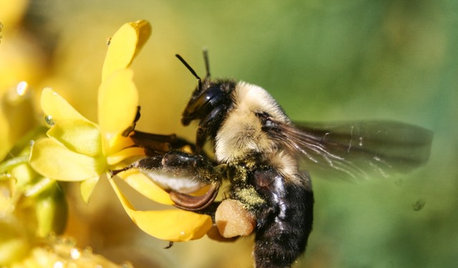
    The buzzing from the toothbrush mimics the sonication of bumblebees and other buzz pollinators (video here of how it works), which is really the best way to pollinate flowers in the solanaceae family which have tubular anthers that enclose the pollen with only pores to let the pollen out. Vibration releases the pollen in a little cascade or cloud and makes it more likely that more of the ovules in the ovary will be pollinated. This means more likelihood of bigger and better-formed fruit. Partially pollinated fruit will often abort or just never develop or can develop smaller or with a distorted shape.

    An electronic toothbrush will work better than flicking.

    If you have lots of buzz pollinators like bumblebees that work your tomatoes already, though, the toothbrush may be redundant and therefore a waste of your time. Also, if your conditions are poor for pollination in the first place (too much heat inactivates pollen, too much humidity makes it sticky and unlikely to move, etc.), then the buzzing won't be able to correct that much if at all. And if your plant is near its genetic limit of its ability to support fruit, then there's no point in trying to force it to make more.

    To use the electronic toothbrush, lightly touch the back of the tip of the electronic toothbrush to the stem end of the blossom. If you shove the bristles with heavy contact onto the flower end, you could damage the flower. Under the right lighting conditions, you'll see pollen cascade out of the flower. You can also use a tuning fork.

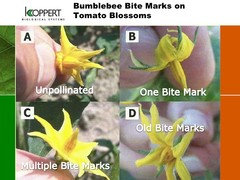
    BTW you can monitor bumblebee visits to your tomato flowers by looking for the bite marks they leave on the anther cones. They bite the cones to hold on while they buzz the flower to release the pollen.

    Source: https://www.slideshare.net/UMNfruit/minnesota-high-tunnel-presentation

    Note that "unpollinated" in the above graphic doesn't mean the flower is unpollinated and will therefore die without making a fruit. Just that it hasn't been pollinated by a bumblebee. Tomato flowers frequently pollinate on their own, from wind movement, etc.

    joelk thanked gorbelly
  • 9 years ago
    last modified: 9 years ago

    Hi albert, that was for the guy in England, at the latitude of Southern Alaska, so there was no need to discuss optimal night temperature. He was squeaking by the late season around 12C (55F).

    Optimal night temperature is near 17C (63F), and not in excess of 23C (73F) at night, generally things begin to go south, though cherries are usually higher. Below 55F cat-facing becomes an issue and then the pollinizing itself as the plants deal with cold stress.

    60-70F night temp is considered generally the happy zone for maximizing commercial poundage in a greenhouse in Florida, which considers the bang for pollinizing.

    Optimal is the best and most interesting reference point if you can choose when you put the work in.

    I agree the use of a toothbrush is not as waste of time. If conditions are marginal -far from the optima-, it can be advantageous! That's where knowing the viable range comes in, to determine what's marginal and decide if it is worth the time being a pollinator.

    Cheers

    PC

    joelk thanked PupillaCharites
  • 9 years ago
    last modified: 9 years ago

    Tomatoes don't need bumblebees to pollinate, and their buzzing also isn't essential. In fact, wind pollination (the wind blowing the flowers back and forth) is how it mostly happens. Natural shaking. An electric toothbrush (or a bumblebee) gives lots of little shakes. A finger flick gives one big shake. Take your pick. There is some attraction in using a machine, though. Vroom! Vroom!

  • 9 years ago

    Back, perhaps 1968 or so, I was working evenings and taking day courses and a professor suggested cosmetic brushes because they were designed to pick up and deposit stuff.

  • 9 years ago
    last modified: 9 years ago

    "Essential" and "optimal" are not the same.

    "Studies show that visitation by native bees increases fruit set by approximately
    45 percent in Sungold cherry tomatoes, relative to wind pollination. Bee visitation
    also results in larger tomatoes. On average, the weight is nearly doubled.
    When native bees visit and vibrate these flowers, they not only cause the pollen
    to release, but they also often cross-pollinate the plants. This data suggests
    that the extra yield caused by bee visitation is due to both of these factors."
    -
    Native Bee Pollination of Cherry Tomatoes, Xerxes Society

    Article: Native bees pollinate tomato flowers and increase fruit production
    from Journal of Pollination Ecology

    Note that sonicating bees co-evolved with tomatoes. Solanaceae have evolved their anther structure specifically to use buzz pollinators.

    joelk thanked gorbelly
  • 9 years ago

    Albert, cosmetic brushes work for many types of flowers. I use one for my squash, for example.

    But most solanaceae have tubular anthers that enclose the pollen. It emerges through small pores on the end. A brush is not very effective for those kinds of flowers.

  • 9 years ago
    last modified: 9 years ago

    Quote:

    Studies were conducted in a 30-foot by 96-foot double polyethylene greenhouse at the LSU AgCenter Red River Research Station in Bossier City. Tomato varieties Caruso and Trust were raised in 15-gallon polyethylene bags filled with ground pine bark. Four tomato plants were planted in each bag in two parallel rows, and 30 plants of each cultivar were grown under the same conditions for testing the effect of each method of pollination on tomato yield and fruit characteristics.

    Tomato plants in the blower pollinated treatment were vigorously vibrated on Monday, Wednesday and Friday of each week. Vibration took place around noon using an Echo P.B.- 1000 air blower. Vibration started at the beginning of blooming and continued for 13 weeks. The blower was held approximately 15 inches from the tomato plant and directed toward the flower clusters as the operator walked between the tomato rows.

    Flower clusters in the electric vibrator treatment were vigorously vibrated by touching the flower stalk for about two seconds. Pollination was conducted using a Dutch-made electric vibrator on the same days and time as the blower.
    [...]

    Test results indicated vibrator pollinated plants of each variety produced greater marketable yield than did blower-pollinated plants. Within varieties, marketable yield was greater and yields of culls were lower with vibrator-pollinated plants. Fruit weight and diameter and the number of seeds per fruit were greater in vibrator-pollinated plants. Marketable yield of Trust was greater in the first year, but yield for Caruso excelled in the second year.

    Source: http://www.lsuagcenter.com/portals/communications/publications/agmag/archive/2005/winter/pollinatinggreenhousetomatoeswithvibratorsblowers

  • 9 years ago

    Bottom line:

    The evidence is very solid that vibrating flowers is better than not vibrating flowers in many cases.

    The question of whether it's better enough to be worth your time to buzz your tomato flowers manually is something determined by your growing conditions and your goals and priorities.

    But it's not some baseless fad to pooh-pooh.

    joelk thanked gorbelly
  • 9 years ago
    last modified: 9 years ago

    But it's not some baseless fad to pooh-pooh.

    Yes. Asserting the pollinization efficiency of tapping or shaking plants to be equally effective as buzzing them under any conditions is unfounded without a controlled experiment to back it up.

    Cheers

    PC

  • 9 years ago
    last modified: 9 years ago

    Touch the flower stalk for two seconds? Maybe another second or two to move to another. I've got several hundred flower stalks. That's time I'd rather spend on other things.

    I never said that toothbrush pollination didn't work. I'm sure it does. I never called it a "baseless fad". Those are your words. I just said that other methods work pretty well. The original question was whether it was safe to do. The answer is certainly yes. Just not clear to me that it's worth the trouble. That's just my preference. Yours may differ.

    The guy in the picture at the LSU website sure isn't using a toothbrush! Well, maybe an elephant toothbrush? Also, did he try flicking fingers? That would be a lot faster.

  • 9 years ago

    Dan,

    As I've said over and over again, it depends on your individual priorities and conditions.

    If YOU don't want to do it, it's a perfectly legitimate decision. Guess what? I don't buzz my tomato flowers. It's a choice I've made based on... my individual growing conditions and priorities ! (Hey, how 'bout that?)

    But to be scornful of the idea itself is uncalled for. I know plenty of good, experienced gardeners that do it and are very happy with the results.

    It can be a valuable practice for some. I would say that the evidence is compelling enough that it's a good recommendation for people who have the time and inclination to go ahead and try it on a plant or two and see what happens, since electronic toothbrushes or tuning forks are hardly a big outlay.

    As long as it's an informed choice. Unfortunately, you were spending more time putting down the idea than on informing. Which is why I pushed back as I did with information.

    And, actually, I may take my own advice and try it on a couple plants this year for comparison purposes. I've always assumed it would do little good because I have plenty of bumblebee activity in my garden, but you never know--they can't get around to every flower.

    And it likely takes far less than 2 seconds, and you can probably vibrate sections of truss and not each individual flower. FWIW, I know people who do this, and it doesn't take them much longer than flicking the flowers.

  • 9 years ago

    Many high tunnel growers of early season tomatoes purchase bumblebees from Kopel or other supplier to help with fruit set of first few blossom clusters. I've never purchased bumblebees and used the electric toothbrush on some year's tomatoes not knowing what the results would be. This year I did nothing and although fruitset looks good I have noticed a large percentage of first ripe cherry tomatoes, especially Sunsugar and Sungold, that are marble sized.

    Time is valuable to everyone and so it is hard to put a figure on the benefits of using either bumblebees, electric toothbrush or other methods. I could benefit from a few more ripe tomatoes now at local farmers' markets. The ones I have picked have sold very fast and for a very respectable price. In a few weeks the dynamics will change as more local tomatoes become available and price drop.

  • 9 years ago
    last modified: 9 years ago

    Barrie: Time is valuable to everyone and so it is hard to put a figure on the benefits of using either bumblebees, electric toothbrush or other methods.

    More research needs to be done on this, but the LSU study I referenced above did compare the economics of vibration vs. wind blowers, and the vibrators came out on top for profit:

    "The time needed to pollinate 640 plants for 13 weeks was 7.13 person hours using the air blower and 11.75 person hours using the electric vibrator. Labor cost for pollination was $49.92 for the air blower and $82.25 for the vibrator. The yield reduction using the air blower for pollination was not offset by the savings in labor cost.

    "We conclude that smaller greenhouse tomato growers should use the hand-held electric vibrators to pollinate their crop for maximum fruit yield, size and profit."

  • 9 years ago
    last modified: 9 years ago

    640 plants ... ... 11.75 person hours using the electric vibrator.

    That
    study used some very talented individuals @ $7/hr: 40 seconds buzzing
    required per plant per mechanical buzz-pollinator visit. Didn't notice the plant size. It takes me about a minute per plant, if I do straight
    pollinizing.

    I have never had reason to do controlled
    comparisons. When light gets
    unacceptably low, I have used my toothbrush and interpreted a big correlation in reduction in
    puffiness when using my toothbrush. Oral b Triumph (a.k.a. Pro 5000). I
    understand it buzzes at about E5 (660 Hz). Bumblebees buzz in the 150 - 400 Hz range. But the manufacturer exaggerates under perfect conditions, not typical old brushes running on half charged batteries, so I bet it is right in the middle of bumblebee range.

    I do not agree with others'
    subjective viewpoint that buzzing the flowers is a straight loss of my
    time, which is how this whole thing is basically being framed. To me it is an excuse to see the conditions of the plants by
    scanning them for flowers and anything else that needs attention, like removing caterpillars or necrotic foliage. Pollinating is fun, too, knowing you are trying to make the tomatoes bigger and juicier that you are going to eat.

    The toothbrush does the trick with 15 - 37 plants. The only problem is if plants are out of reach, but you don't have to pollinate every flower! If designing an experiment, I would actually use the same plant half and half, and label the trusses, which IMO is a better control.

    Cheers

    PC

  • 9 years ago

    I'll need to read the research article but the aspects that Gorbelly & PC mention are much beyond anything I have ever done in all aspects of the process. Using a toothbrush I do 500+ plants in about 15 minutes total. I usually only vibrate on 2 clusters on a plant for a few seconds each. After 6th cluster I usually call it quits for the vibrator because those first fruits in cooler weather are most critical for me. After that the weather is warmer and bees are around but I still use the other two stimulators.

    My Stihl backpack blower moves the plants vigorously and it only takes about 10 minutes to cover 500+ plants. Over the years I noticed that my 4 circulation fans vibrate the nearby stringline support on each plant (& plants) when running so this year I relied only on that.

    I just can't imagine any justification for 1. Season long stimulation, 2. Time spent per blossom cluster/plant or 3. Total time allocation. But such is research and I've been involved in many such projects in my 35 university years.

  • 9 years ago

    <Since tomatoes have complete flowers and are self-pollinated, it usually
    is unnecessary to hand pollinate the flowers for fruit production. If
    there is a lack of wind and insects or the humidity is high, you can
    simply shake the plant gently to help distribute the pollen.>

    Hand Pollination of Tomato for Breeding and Seed Production

    I have found that tomato plants that don't get enuff direct sunlight do not pollinate (have blossom drop) but I never thought of hand pollination at the time, not sure that it would work in that case either.


  • 9 years ago
    last modified: 9 years ago

    Considering that studies consistently show that sonicated flowers produce more and larger, better-formed fruit, and not a slight difference but a large difference, the question of whether vibrating the flower is better than not if other conditions are good for growing is settled.

    But how much better depends on the circumstances. All things being equal, you're going to get a higher percentage of fruit set if you do something to shake up the pollen. You'll probably get more fruit if you flick or tap your blossoms than if you shake the whole plant, and you'll definitely get more if you buzz the blossoms. But if the problem isn't one of the mechanics of pollination in the first place, like a plant not getting enough nutrients or sunlight or the pollen being inactivated from extreme heat, then you're just increasing the chances that any viable flowers have the best chance of getting pollinated. In some conditions, the population of viable flowers could be zero or close enough to zero that it's not worth the effort. And if the problem is something that causes successfully pollinated flowers or set fruit to abort, and that's where the "fruiting bottleneck" is, the pollination assistance doesn't really help all that much except to increase the number of fruit and therefore increase the hopes that a few more of those won't abort. Whether it's worth it is something only the individual gardener can decide. But it's probably worth a small experiment. If you only have 1 or 2 plants and the difference could be between zero fruit and 1 or 2 fruit, some hobbyist gardeners might consider that worthwhile. Others may not.

Sponsored
Peabody Landscape Group
Average rating: 3.5 out of 5 stars8 Reviews
Columbus' Reliable Landscape Design & Contracting