Software
Houzz Logo Print
jlx3

How to treat front load washer spider-arm so that it wouldn't corrode?

9 years ago
last modified: 9 years ago
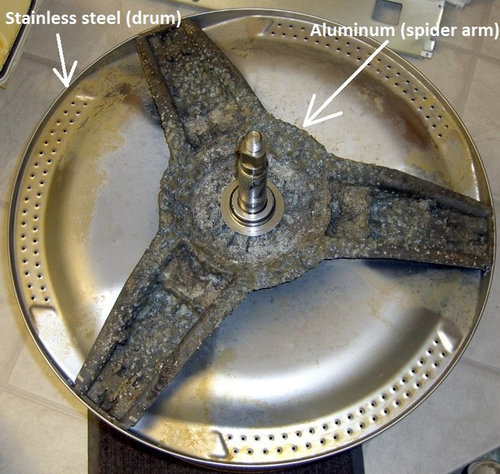
Brand new Daewoo front load washer, 3 years in and the spider arm needs to be replaced. Can't believe it! A little research reveals that it is a common problem on front loads these days, particularly Korean brands (LG, Samsung, Daewoo...etc). Where is this info when you need it… like when researching before buying.

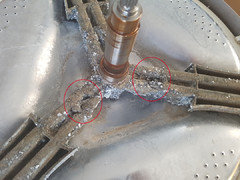
This is sorta what it looks like…

Here are some more examples from Google images.

Anyway, the reason the spider arm goes quick in these machines is because of an effect called “galvanic corrosion.” You see, the spider arm is made of aluminum, and what it is attached to - the drum - is made of stainless steel. Put these 2 metals together, add a little air and water, and you got the perfect recipe for corrosion – in this case, it’s the aluminum component that corrodes. Basically, the stainless steel causes the aluminum to corrode through an electrochemical process. I can’t believe they still manufacture them with suck obvious defect! How the hell are they not sued black and blue?!

At least that's the theory. Some say it's not galvanic corrosion because if it was than the corrosion (or most of it) would be at the points were the two metals meet - the shaft and the 3 ends.

In any case, now I’m getting ready to put in a new spider arm and trying to figure out how I can “treat it so that I could get at least 10 years out of it. Came across a post somewhere where this guy anodized his spider arm before installing. He reported back about 5 years later saying the machine was still as good as new. Would have been awesome if he’d reported back again a little later. Read also that Chromating it would work. And then there is priming it with epoxy zinc phosphate.

No idea which way to go. Anyone tried doing this? Any tips?


Also…the bearing looks perfectly fine. Is it usually replaced along with the spider arm for good measure…it’s not exactly cheap so I was wondering if I’ll end up regretting not doing so.

Comments (26)

  • PRO
    9 years ago

    I don't think you can do anything as a consumer about it but I think Alcoa (or now Arconic) research should be working on solving this problem.

  • 7 years ago
    last modified: 7 years ago

    I went to do a washing load and I heard a terrible noise from my washing machine... I knew it was the shaft that was broken. It could spin by itself but without any force so today I fixed my Spider Arm/Shaft on my Samsung machine. Using the video below It's not that difficult at all it just takes time.

    Purchased the part (DC97-12528A) at: https://electropiecescowansville.com...aft-et-spider/

    Helpful Video to disassemble the part: https://youtu.be/gTXoKMHHpLs

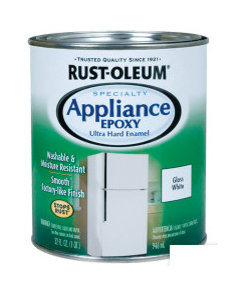
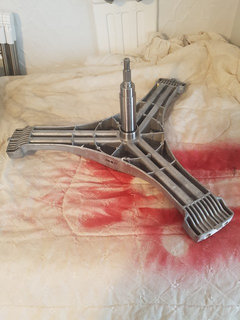
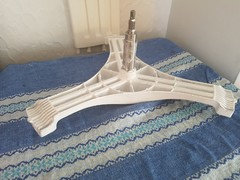
    I gave 2 Coat of Rust-Oleum Specialty Appliance Epoxy Paint on the shaft.


    Here are the results:

    Before & After


    Broken


    New part + Paint


    Let's see how this stands out

  • 7 years ago

    This issue reminds me of the BMW E60. That has an aluminium front which is attached to a steel "rest of the car". I think they used glue and special rivets to attach the front to the rest. I like this approach and its very clever. Interesting that the spindle that holds the bearing is steel too. Is the spider held on by long stainless steel bolts that run through from the other side. Quite the mix of metals. Good luck with the project.

  • 7 years ago

    Wow syberpro that looks really nice. I hope it works well for you.

  • 6 years ago

    @Syberpro ㅤknow it’s a year later but had the same issue. Recently got a new spider arm and prepared to coat mine with the appliance epoxy as well. I’m curious though, how has that worked for you in the year passed? any white chips in your clothes? Reading the back of this epoxy is does not reccommend use on anything that’s constantly submerged in water so I want to be sure.

  • 6 years ago

    @Matthew Digby Had to issue since then. I wouldnt dare disassemble it but no white chips. Works great

  • 6 years ago

    How long you've been using it now?

  • 5 years ago

    i experimented with mine by etch priming a new spider and then filling the hollow side with epoxy resin n filler ( keep the weight down ) this lasted 10 years , 3 controllers and 2 motors and 2 pumps on a machine that was already 6 yrs old , yes it can be done but stock up on essential spares

  • 5 years ago

    What did you use for etching and filling

  • 4 years ago

    In a solution with a ph greater than 7 (soapy water) the electrode potential difference between stainless steel and aluminum results in galvanic corrossion.

    Clean water rinses help to extend the life of the spider (the sacrificial anode), but changing the spider to stainless (best option), or passivating the aluminum with an alodine coating are better approaches.

    The question becomes: do I spend $500 on a new drum/spider (the Frigidaire spider/shaft cannot be purchased separately), plus $100 to passivate the spider, or apply that money to a new commercial machine with a stainless spider (e.g. Maytag, Speed Queen). . . ?

  • PRO
    4 years ago

    As I wrote before, this is a problem for Alcoa (Arconic?) research to solve. I wonder if they have.

  • 4 years ago

    Only if the company purchasing the aluminum from Arconic specifies passivation.

    I'm surprised there has not been class action lawsuit against the various manufacturers (that has nothing to do with Arconic).

  • 4 years ago

    I feel like, as a consumer, I should be able to spend $1,000 and not have to worry about applying an epoxy to my washer parts to make them last. But here I am, on this thread! And after 3 replaced drain pumps, I think I will just purchase an ugly top loader.

  • 3 years ago

    Decided to keep you updated since my last post (4 years ago).... Still using the same washing machine :)

  • 3 years ago

    I couldn't agree MORE! I do maybe 2 loads of laundry a week. I blew through 2 front loaders in 8 years. Not overloaded at all. These two machines had a broken spider arm. Designed to die? Makes you 🤔. Waste of money! A repair costs close to the price of a new machine. They would replace it with the same thinthing that rotted!

  • 2 years ago

    These are Absolutely designed for the spider to fail just after the warranty expires! The spider replacement is the cost of replacing the machine if you have it professionally repaired! This is not an oversight but fraud!

  • 2 years ago
    last modified: 2 years ago

    Miele use the same aluminium diecast spider. My Miele W5835WPS broke sudden loud bang . Crap unusual Miele practice. $$$ machines that Miele own warranty states will last 20 years of domestic use - what a laugh! Why not use a brass or stainless steel version? Using reactive aluminium is just asking for trouble bad enough, but to use a diecast version? Alkaline salts used in normal laundry detergent will react with Al. Just the worst of design engineering!

    Come on Miele!! -- you can do MUCH better than that. This a large "Achilles Tendon" in its current design.

  • 2 years ago

    We have a Miele W3204 which after 12 years of no problem use has failed due to spider failure on rear of drum , managed to obtain a used meile of same model. £80 from facebook market, works perfect. As an exe engineer on rolls royce aero engines, i decided to strip down the old machine, these are extremely well built from heavy gauge stainless steel. finally got down to the spider which was broken and heavily coroded, seems a shame that the quality machine is let down by such a bad design , a pressed stainless steel spider would have extended the life of washer by 10 years.

  • 2 years ago

    Just finished my first 'front loader' repair experience- the spider on a Samsung. What a shock it was to see that inside! And my first thought like others- "What were you thinking when deciding to put a pot metal component into such a caustic environment other than manufacturing cost?! Most of what I found was actually a drain pipe packed end to end with little beads of aluminum "shot", In considering potential ways to extend the spider's lifetime with minimal impact to the crucial weight balance needed for something like that spinning at 1200rpm or more, I'm planning to either powder coat the spider first, or going with the slightly easier surfacing method in giving it a bake-finished ceramic coating, which I've found to be super-tough and durable when applied to other items.


  • last year
    last modified: last year

    Whirlpool did some research on spider corrosion. The main type of corrosion they identified is oxygen concentration cell corrosion, aka crevice corrosion.

    It is caused by a biofilm made up of bacteria growing in the residue from liquid detergent and softener, lint and general washing grime forming a coating the spider. This biofilm retains a very small amount of moisture and also depletes and excludes oxygen from the surface of the aluminium, creating variations in oxygen concentration on the surface of the spider. Oxygen has a negative charge, so areas with lower oxygen concentration are anodic and get eaten away due to the flowing current.

    I use a powder detergent which includes an oxygen bleach and do most washes at 40 degrees Celsius, or above, my machine is nearly 16 years old, still has the original spider. I changed the bearings a few years ago, the machine was nice and clean inside, no corrosion on the spider, no grim on the tub, the outside of the drum was nice and shiny, even though I use fabric softener. The oxygen bleach kills bacteria in the wash, cleaning the machine in every wash, helping to prevent a biofilm forming. Only maintenance I do is an annual descale with citric acid because of our very hard water.

    I also leave the door and draw open between washes to reduce the humidity inside the machine, this prevents mould growth as well.

    If you prefer using liquid, you need to do regular hot machine cleaning cycles with an oxygen bleach based machine cleaner to get rid of the bacteria and residue, be sure to leave the door open because liquid detergent residue is hygroscopic, so will absorb moisture from the air.

  • last year
    last modified: last year

    Replaced the spider on our 2011 machine in 2018, so lasted 7yrs. Here we are in 2025 and it just happened again. Big job but straight forward for DIY. Wouldn't be feasable to pay a professional repaiman though.

  • 9 months ago

    I'm presently looking for a spider arm for my Frigidaire front loader 41739022891. I disassembled it and found the original spider arm broken in half on two of the spider arms. My machine is 27 years old.

  • 9 months ago

    "HU-692203168: I'm presently looking for a spider arm for my Frigidaire front loader 41739022891. I disassembled it and found the original spider arm broken in half on two of the spider arms. My machine is 27 years old."

    The spider doesn't appear to be sourced as a separate item. It's included part-parcel with a replacement drum. P/N 131618500.

    Your model number is Kenmore syntax, 417.39022891, 417 being the manufacturing source-code for Frigidaire. Frigidaire = Electrolux.

  • 9 months ago

    WOW...it amazes me that the drum/spider is $540, when a new machine is in the $800/$900 range.

    How are all the other components of your 27 year old machine?

    I'm sure it was built way better back then but is it cost effective?

  • 9 months ago

    Yes, a difficult choice to make when I can put that $540 into a new machine. The issue is that "they don't make them like they used to" comes into play. If I buy a new machine will it last another 27 years? I did replace some parts during that time period.

    I replaced the motor about 4 or 5 years ago. Just replaced the shocks on the drum. Also I did have a problem or two with the mother-board on occasion. I had to remove it and re-solder a few contacts on the board that melted away do to a bad door catch. The plastic door catch began to wear, weakening the strength of the holding power of the catch to keep the door shut tightly. If the door becomes loose while closed, the door-closed sensor begins to buzz or hum from a weak contact connection. This causes the circuit on the mother-board to heat up which de-solders the connection.

    I haven't made a decision on which way to go yet. Do I buy new or fix the old? While I'm waiting to make a decision, my clothes are getting dirty, lol.