Software
Houzz Logo Print
sjwoo_gw

HELP! Weeping Cherry Tree Dying...What Can I Do?

9 years ago
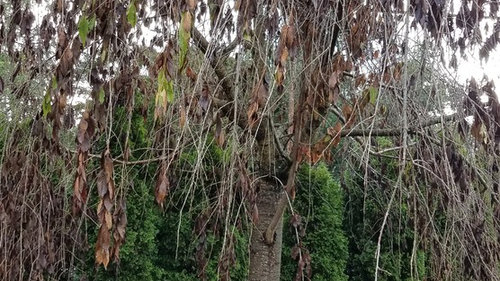
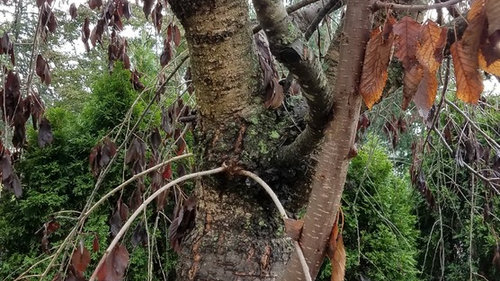
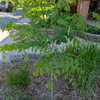
Folks, my wife and I have a weeping cherry tree that's probably been growing for about ten years. Last year, we noticed that the tree didn't bloom as robustly as it had the previous years. In retrospect, we should've done something then...and now this past spring, half the branches had no leaves and the other half had a decent but not great bloom of flowers and leaves. And now it's August, and look what's happened to the tree.

What can we do at this point? We poured one of those weed and feed solutions onto the tree, but we're afraid it's too late. Any advice at all would be greatly appreciated. FYI, we live in NJ, in zone 6.


Comments (17)

  • 9 years ago

    We poured one of those weed and feed solutions onto the tree,


    ==>> what does that mean ...


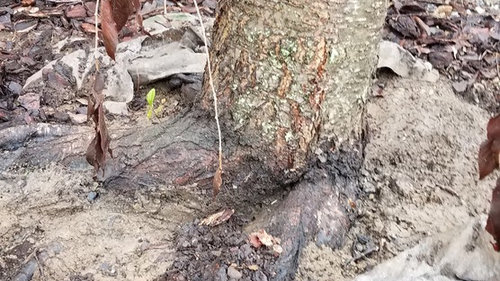
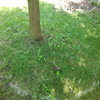
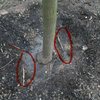
    and is that landscape fabric or plastic???


    your pix are loading very slow.. but if i click on them.. they show up ... in case anyone else is having that issue ...


    if it looks like that in august.. im thinking its basically dead ... sorry ,... there isnt much to do .... beyond removal and replacement.. without the fabric/plastic ...


    ken

  • 9 years ago

    Sorry, I should've clarified. This is what we poured on there:

    http://www.homedepot.com/p/Bayer-Advanced-32-oz-Concentrate-3-in-1-Insect-Disease-and-Mite-Control-701285/202019105

    That is landscape fabric you're seeing. We lifted it up and removed the mulch in order to pour the Bayer 3-in-1 Insect, Disease and Mite Control.

    That's a terrible shame if there's nothing we can do. It just turned like this, BTW -- it had green leaves just even two weeks ago.

  • 9 years ago

    Oh, dear. Did you pour the neat product onto the root area? It's designed to be heavily diluted in water and used in a spray on the foliage. The instructions are on the container. And you chose a product without identifying the problem. So I'm afraid you have probably made matters worse for your poor tree. It is vital to first diagnose the trouble and then use the appropriate product in the appropriate dose by the appropriate delivery method. Just like treating people.

    Can you excavate a bit and see if the roots are rotting or the soil is waterlogged?

    Another possibility is a bacterial infection described at This link

  • 9 years ago

    We did dilute it big time...a couple of gallons, and we poured it around the base of the tree. So we followed the directions, but you are right, we did this without really figuring out the issue. I'll dig around the root and write back what I find...thank you!

  • 9 years ago

    What has your weather been like this summer?

  • 9 years ago

    Good you diluted it. But it's meant to be sprayed on the top growth.

  • 9 years ago

    I actually pasted the wrong url. Should be this one: http://www.homedepot.com/p/Bayer-Advanced-32-oz-Concentrate-Tree-and-Shrub-Protect-with-Feed-701810A/202616493

    The weather this summer has been fine...got hot here and there, but we had plenty of rain...never had any drought conditions.

  • 9 years ago

    Linking to the wrong product explains the confusion.

  • 9 years ago
    last modified: 9 years ago

    Remove and replace with something other than a fruit tree. No plastic/landscape fabric should be used.

  • 9 years ago

    It should be unnecessary to point out that a weeping cherry is not technically a "fruit tree" despite the common name :-)

  • 9 years ago
    last modified: 9 years ago

    "It should be unnecessary to point out that a weeping cherry is not technically a "fruit tree" despite the common name :-)"

    Well, yes, because it doesn't produce edible fruit. I should've been more specific. Since it is a prunus (likely a cultivar of prunus x subhirtella) it is a cherry/stone fruit, meaning it is in the rosaceae family. Most plants in the rosaceae family are disease and pest-prone (some more than others). This family includes fruit trees (even ornamentals) including cherries (prunus), plums, peaches, pears (pyrus), apples (malus), roses (rosa), and I believe there are a number of other ornamental and fruiting plants that I did not list. In other words, do not plant another rosaceae tree in place of this one, because there could be pathogens in the soil, and some left in the area from plant debris (leaves, twigs, etc.).

  • 9 years ago

    The above is really not of much of a concern. The Rosaceae is a huge plant family with more than 90 different genera and by no means are they all subject to the same pathogens or insect problems so lumping them all together as problematic or to be avoided is just plain silly. As well, many of the genera that are prone to disease issues have had cultivars bred to be very disease resistant. This is especially true of many of the fruiting plants included in this family.

  • PRO
    6 years ago

    It looks like you could have Fire Blight, which is a bacterial infection and is very hard to get rid of if not caught and pruned out in the early stages and is nearly impossible to stop. It presents with dying portions of the tree, brown areas, curled, hooked dry leaves & oozing blisters with sap-like material on the bark. Look into it and see if it matches your situation.


    We have it in a crab apple and sadly will have to remove it as the blight bacteria have spread throughout the tree and also killed our roses. Beware of companies that claim to be able to spray the tree, it doesn't work and you'll be out the money. It's a real shame, I wish you the best!

  • 6 years ago

    Mine is not this bad but is getting there. Suggestions?

  • 5 years ago

    Did anyone end up saving their tree? Have the same issue with mine

  • 5 years ago

    I think it could be cherry borers. Check the bark a few feet off the ground , look for rot or sap leaking from holes. If early, I am hoping a systemic insecticide will save my tree.