Software
Houzz Logo Print
neptune25

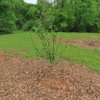
Young persimmon tree chopped down

9 years ago
last modified: 9 years ago
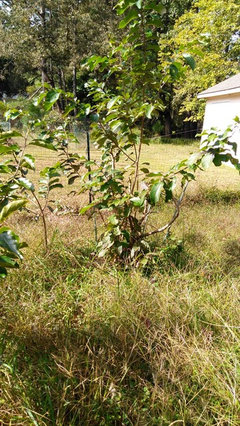
We had some people cutting our hay, and unfortunately about a day ago they chopped down our Ruby persimmon tree which was about 4 feet tall. (It was enclosed in a wire-mesh cage, yet they still chopped it down, and didn't even bother to tell us. Isn't that nice?) I just discovered their "deed" about 30 minutes ago.

Anyway, I scratched the tree, and it's still green. Is it possible to put the tree in some water and hope for the best, or is that just a foolish fantasy? Thanks for any help.

Comments (27)

  • 9 years ago

    Good thought but it won't work.

    How long had it been in the ground?

    Show us a picture of what remains. Or at the very least, tell us how tall the stump is. If of sufficient height, it's likely to sprout new growth from which you could select the best one and train a new tree,

    neptune25 thanked Jean
  • 9 years ago
    last modified: 9 years ago

    Jean,

    Thanks for your reply. It had been in the ground over 10 months. With all the grass cut and lying on the ground yesterday, I couldn't actually find the stump. I was kind of in shock too, which didn't help any. I'll have to search for it. But based on the appearance of the trunk itself, it seems to have been cut pretty close to the ground.

    Since most trees are grafted, though, is the stump even relevant? In other words, would it even sprout a Ruby persimmon, or something totally different?

  • 9 years ago
    last modified: 9 years ago

    I found the stump. It's about an inch high. Is there much chance that there will be any new growth? If so, how likely would it be a Ruby?

  • 9 years ago
    last modified: 9 years ago

    There will almost certainly be re-growth, but it's unlikely that it'll be anything other than shoots from the seedling persimmon rootstock.

    It's certainly possible that you could bud a piece from the grafted 'top' (if it's not too dessicated) onto the understock and have it re-grow, but with only an inch above ground level, you don't have much to work with. Otherwise, you'll probably need to chalk this one up as a loss, and purchase another 'Ruby' next season.

    neptune25 thanked lpittman8
  • 9 years ago
    last modified: 9 years ago

    Thanks for the info, lpittman8.

    The tree was becoming really desiccated, even though I had it in a bucket with some water. And last I checked, one of our dogs (who is less than a year old and unfortunately very destructive) must have run off with it, because it's no longer there. ;)

    I guess I'll just have to spring for another tree—at least fall's a great time to plant. The one bright spot is that the tree that got cut down was in a very poor location (which is a big reason it got cut down—even though it was enclosed in a wire-mesh cage, it got surrounded by tall grass and the workers cutting the hay apparently couldn't see it). It also hadn't started bearing yet, so at least I didn't lose a prolific tree. I'll make sure a new tree is in a better location.

  • 9 years ago
    last modified: 9 years ago

    I went outside and eventually found what I believe to be the top of the tree. Apparently our dog just wanted to chew the tree into pieces. Since working with the stump in the ground is out, I took a stem cutting and put it in some potting soil. We'll see if it roots. If it does, great; if not, I haven't really lost anything. :)

    I still hope to order another Ruby tree, but I'd like to see if something from this tree roots at least. Then the tree won't be a total loss.

  • 9 years ago

    The value in what you have left lies in the rootstock. Depending upon the vigor of the tree, you may have developed a decent sized root system under the stump that can push some vigorous growth next year. In late June of next year if the growth is about the caliber of a pencil you can graft onto this green growth. On the other hand I can guarantee you 100% that putting the severed top in water or soil is a waste of time - nothing good will come of it.

    neptune25 thanked creekweb
  • 9 years ago
    last modified: 9 years ago

    creekweb wrote:

    In late June of next year if the growth is about the caliber of a
    pencil you can graft onto this green growth.

    Interesting. Exactly what would I graft onto it?

    On the other hand I can guarantee you 100% that putting the severed top in water or soil is a waste of time - nothing good will come of it.

    Well, it's a small cutting, and I read an article on the Web yesterday that said one way persimmon trees can be propagated is through stem cuttings. But even if it doesn't work, at least it won't have been much trouble. :)

  • 9 years ago

    You can obtain scions from nurseries that offer them for sale such as England's Orchard and Nursery during the winter and keep refrigerated until ready to graft. I have a number of these second chance trees in my orchard: an old multi-grafted Asian persimmon on virginiana rootstock that succumbed to Kaki sudden death has been regrafted into a multi-grafted American persimmon; an NC-10 American persimmon that died to the rootstock from cold injury has been regrafted to several hybrid persimmons. I now have a 16 year old Great Wall that is in the midst of dying from what I believe is a fungal disease that has new 4 foot shoots that I will be regrafting to hybrids next year.

    Well, knock yourself out then and try to root those cuttings and prove me wrong .It's just that everything is stacked against you. True, it's not impossible in theory to root persimmon cuttings, but it's very hard and even under the best of conditions I know of very few who have been able to do it. But you have poor conditions: wrong time of year for gathering wood and for rooting and you're working with actively growing dessicated wood,


    neptune25 thanked creekweb
  • 9 years ago
    last modified: 9 years ago

    You can obtain scions from nurseries that offer them for sale such as
    England's Orchard and Nursery during the winter and keep refrigerated
    until ready to graft.

    Thanks for the helpful info, creekweb. I had no idea that you could obtain scions yourself from certain nurseries. I have a question: If you can only buy scions in the winter, wouldn't it be too early to know whether my stump will end up sending out any viable shoots?

    Well, knock yourself out then and try to root those cuttings and prove
    me wrong .It's just that everything is stacked against you.

    I only took one cutting and stuck it in a pot. I should know within a month or so whether it has taken. Very little trouble. If it doesn't take, I'll just chuck it out. :)

  • 9 years ago

    : If you can only buy scions in the winter, wouldn't it be too early to know whether my stump will end up sending out any viable shoots?


    Yes, there is some risk involved there that you can temporize in several ways. You can wait an additional year to see what you have to work with. Or if you order this year and are unable to graft onto your stump, you can try to root the scion - this will be dormant wood and you can do this at the right time of year which will considerably improve your odds of success though it remains challenging.( There's more to it than just sticking the cutting in a pot.) One additional option would be to purchase a rootstock if yours could not be grafted upon.


    neptune25 thanked creekweb
  • 9 years ago

    Thanks for all the helpful info, creekweb. It's good to know that the stump in the ground might still have some hope. :)

  • 9 years ago

    Sounds interesting, Tony.

  • 7 years ago

    Creekweb, I just noticed something you said above, and I'm wondering about it in light of something I recently read from someone else. You said, "...an old multi-grafted Asian persimmon on virginiana rootstock that succumbed to Kaki sudden death has been regrafted into a multi-grafted American persimmon..." In some other discussion about growing Asian persimmons and KSD someone said that when a tree dies from KSD he's never been able to successfully graft Asians back onto that same rootstock again (which the person was offering as evidence that KSD must be virus caused). Did you graft American varieties onto this tree for that reason? Have you ever tried grafted a kaki back onto the roostock of a kaki that died with KSD symptoms?

  • 7 years ago

    No, I think that if a kaki dies of ksd then there are either incompatibility issues or viral infection so either way the rootstock would not support another kaki and would only regraft to Virginiana.

  • 7 years ago
    last modified: 7 years ago

    Thanks. It would be interesting, though, to see if, as this other person suggested, grafts would never even take initially. If a kaki graft took one time only to fail from incompatibility issues later, I would think a kaki graft ought to take at least as well a second time, but if all second attempts to graft a kaki failed that would seem to indicate that KSD is somehow acquired over time and then persists in the rootstock after that.

  • 7 years ago
    last modified: 7 years ago

    I follow your logic, but I think that along the way I have grafted kaki onto these failed root stocks and have had takes, but these eventually succumbed to ksd again.

  • 7 years ago

    Hello I am novice to persimmons. I have 3 persimmon trees, all Fuyu kaki. ( That is what was on the label). the fruits look like what you get at Costco.

    I have a kaki (the one with bigger fruit), that died after turning brown. The root stock seems to growing healthy. Is there a way to figure if it is (infected?) and not suitable for grafting( Something i was planning on experimenting)?

    I have 2 choices; either removing it and replacing with another fuyu or by grafting on the root stock with scions taken from my other healthy Fuyu kaki plant in spring.

    Any help is appreciated.

  • 7 years ago

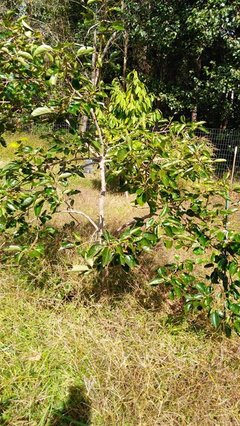
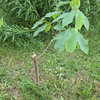
    rootstock picture

  • 7 years ago

    Kaki persimmon healthy plant picture

  • 7 years ago

    sorry for the bad quality of pictures ( taken on cellphone)

  • 7 years ago

    I don't think there's any way to figure out if a rootstock will cause problems for a potential kaki graft other than to try one, but based on what creekweb and others have said if the tree died from symptoms at all suggestive of kaki sudden death (ksd), then you should probably assume it's not worth grafting another kaki onto that same rootstock.


    Are you completely sold on fuyu, though? There are astringent-until-ripe kaki cultivars that have better long-term survival prospects than fuyu in our area. (I'm in NC, too, just a couple hours west of Raleigh.) There are even some non-astringent kakis that probably have slightly better prospects. And there are some outstanding native virginiana cultivars, if you haven't ever tried any of them, that I would definitely recommend trying, and you shouldn't have anything to worry about grafting any of those native cultivars onto the rootstock you already have.

  • 7 years ago
    last modified: 7 years ago

    It would be important to first get an idea why the graft died. Especially to rule out the possibility of KSD. Persimmons dying of this disease show typical black veins in the leaves and stems appearing in the late spring. If it did look like KSD, you might consider removing the tree in case it's infectious, having some chance of spreading to your other trees, or take a riskier path by keeping the tree and regrafting to an American persimmon scion . If it did not appear to be KSD then it's reasonable to regraft to a kaki.

  • 7 years ago

    Hello Creekweb and Cousin floyd, Thank you for the input. Here is what i remember.


    This happened a couple of years back. I do remember seeing the long branches turning black and crispy on tips and then spreading to the center. I did try to save by cutting all dead wood... ultimately removing to the point that i am now left with the rootstock. At the same time I noticed the root stock throwing many shoots up from the ground near the main trunk. At first, I removed them all to save the main plant.

    I am not sure what killed the graft, but from the suddenness of the symptoms, i assumed it to be KSD; this was the larger fruited Fuyu.


    I was planning on saving it and my husband on removing it and replacing with a new persimmon. I do like the Fuyu. I am open to (preferably) a few non astringent variety suggestions. I still like the crunch.

  • 7 years ago

    Based on the reports I've seen and some extremely limited personal experience with the variety -- a couple winters and I haven't even let my tree fruit yet -- Tam Kam might be a slightly better bet as far as survival.

  • 7 years ago

    Thanks Cousinfloyd, I will look it up.