Software
Houzz Logo Print
uscroy

Can you patch over an open electric box?

9 years ago

I have some spots where I have a two-gang electric box but only one is being used. There is no wiring for the open gang so no blank plate is needed to meet code.

Is it possible to leave the box in and patch over the open gang? Would I have to put a metal plate or something over the opening to prevent it from caving in by someone missing the switch and hitting the wall too hard where the opening was?

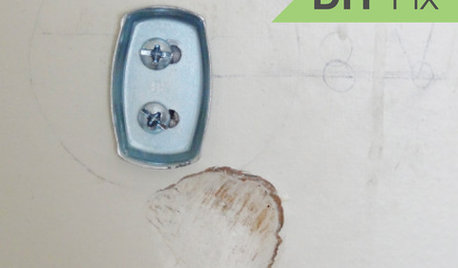
If not possible, what is the best way to make this hole disappear? Photo below for reference.

Comments (16)

  • 9 years ago

    No problem meeting electrical code. Big problem replacing each of those boxes.

    Wouldn't putting a thin metal/plastic plate or something like that over the opening solve the problem of securing the drywall?

  • 9 years ago

    Yes, but what are you going to attach the thin metal or plastic plate to?

  • 9 years ago

    Couldn't you epoxy it to the box? Or if epoxy isn't suitable for metal (I think it is) use an adhesive that is suitable for metal.

  • 9 years ago

    Use a faceplate with a blank on one side and the hole on the other.

  • 9 years ago

    That is not an appealing look for me. Plus it looks like there was a mistake. I would prefer to make the other side disappear.

  • 9 years ago

    I don't know where you got the idea that the divider in the middle makes it two separate boxes, but your entire justification is flawed, and not a single inspector I know would even have time blink before seeing what you intend to do as a code violation.

  • 9 years ago

    This box is an example for demonstration purposes. This is not an actual case where I'm going to do this. The photo above is a dual voltage box with low voltage on one side.

    But if I wanted to patch over the low voltage side I don't believe that would be a code violation anyway.

  • 9 years ago

    Wishful thinking won't get you anywhere here. I have been an electrician for more than 25 years, and know exactly what the box shown is. If you thought your misinterpretation of the code would have worked for your "example", then you are probable making the same wrong assumptions for the actual case. Take a picture of the real thing and post it here, so you can get accurate information.

  • 9 years ago

    I'm not sure what you mean about misinterpretation of the code. Or wishful thinking.

    In the example where I'm going to do this, all the wires are going to a keypad on one side of the box leaving nothing but a hole on the other side of the box. So I want to patch over the vacant side. Are you saying that is a code violation?

  • 9 years ago

    Are you saying that is a code violation? Yes

  • 9 years ago

    My electrician is a Master Electrician and he advised me patching over the vacant side would of the box be OK. So one of you is wrong. Now I gotta figure out who is right and wrong.

    Why would it be a code violation to do this when all the wires to the box are in use? I get why a blank plate is required when you have unused wires in an electrical box, but that is not the case here.

  • 9 years ago

    You can not even have an intelligent conversation about this without posting a picture of the actual box and everything inside the whole box. A divider does not make the box into two separate boxes. All holes in the box need to be closed with a listed plate or plug. All parts of the box must be accessible. Using a listed box in a way that is not approved by the listing is a code violation.

    The only way that putting anything in that box that is foreign to the electrical installation, or closing off the unused side of the box with anything other than a listed face plate would meet code is if the box were not required in the first place. In that case, it should be much easier to rip out the box and replace it with an easy to install mounting bracket.

  • 9 years ago
    last modified: 9 years ago

    I'm bumping this thread for the benefit of anyone that comes across it in the future.

    Fred - You keep talking about dividers foreign objects and I said multiple times that the situation where I plan to drywall over the unused portion of the box does not have any foreign objects or unused wires or a divider. Although it probably makes sense to use a divider so I just might.

    So far as I can tell, much of what Fred stated about dividing electrical boxes is incorrect.

    After doing some research I very quickly discovered that you absolutely CAN put a divider in a box and treat them as two separate boxes, one for low voltage and one for high voltage.

    Here is a discussion about this very thing with relevant sections of the electrical code included.

    And here is an example of a partition that would be used for this.

    From the product description: RACO low voltage partitions are used to separate low-voltage circuits from current carrying circuitry. The partitions are for use with masonry boxes. Allows installation of a communication device with standard switch or outlet.

    There are lots and lots of dividers for sale on the Internet that are used for this. So in case anyone finds this thread while searching for this subject, make sure to get a second opinion.

  • 9 years ago

    More wishful nonsense. You need to understand what a "listed" product is, and what that means. The divider is specifically listed to divide the box to a degree short of making them two physically different boxes for the purpose of putting separate voltages in each side. It is NOT listed to make the box into two ENTIRELY separate boxes for the porpose of abandoning half of it behind drywall. PERIOD


    By your logic, I can put a curtain across the middle of my living room and sell my house as a duplex. The listing on the divider is just as specific as the listings of wire. You can buy a 16 gauge lamp cord and use it in your house, but the minute you try to put it inside a wall, it becomes a code violation. You can use 14 gauge NMB inside the walls, but the minute you try to put a 20 amp breaker on it, it becomes a code violation. You can put a divider inside a box for the purpose of putting two separate voltages in a box, but the minute you try to use that divider as an outside wall of a box for the purpose of covering up half the box, it becomes a code violation.


    There is no way you can drywall over a box that is supposed to be flush with the finished wall surface without putting the drywall in the box. You would just be violating the codes in different ways no matter what fool reasoning or method you keep coming up with.


    The only benefit anyone is getting from you bumping this is A GOOD LAUGH.


    Just because you just discovered dividers, does not make them the cure-all for your laziness of not wanting to do this correctly. I have been using dividers correctly for over 30 years, on a regular basis. Believe me, I have known what they are allowed to do long before you posted a picture of one here.


    "There are lots and lots of dividers for sale on the Internet that are used for this." --Just because you can substitute the word "this" for "the purpose of putting two different voltages in the same box" does not mean that you can then turn around and add "illegally covering up a box" into your own definition of the word "this".

  • 9 years ago

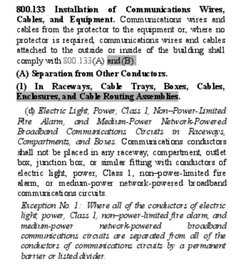
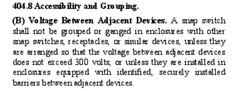
    Here are the two instances where the NEC gives permission to use a barrier within a box.

    Neither says that a barrier makes the box into two separate boxes. I merely provides a means to keep the conductors separated within the complete box.