Software
Houzz Logo Print
enduring

Kimono Silk Washed

9 years ago

I had a length of vintage kimono silk and washed it on my silk cycle in the 3033 Miele. It looks beautiful still but is all shrunk up. It is not distorted at all, just a lot narrower. It was about 13" wide, now about 8" wide. I can pull it out but bounces back. It is still damp. I've hung it to dry.

What do I do? Am I to iron it damp to dry, pulling the fabric to get back to original size? How do Japanese kimonos get cleaned, like in the old days. I just assumed they cool washed in water.

I used Purex natural detergent without enzymes. I have more to wash, but I am wondering if I should use another cleaning solution. I want to use what is easy to use, as I am making these lengths into scarves for xmas presents.

Comments (18)

  • 9 years ago

    So iron the West, going salvage to salvage, one iron’s length wide. Then iron the warp, within that same spot. Then move on to the next segment. Is that right? I’m going to see what I’ve got when I iron this. It is perfectly straight, though bunches up. It’s on grain.

  • 9 years ago

    Yes, that’s how I do it, after I’ve done a boards length of the selvage.

  • 9 years ago

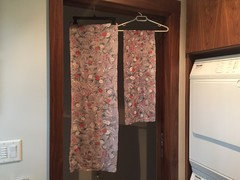
    Ok. Well I did mine like I usually do which is a mash up of ironing. Lol. Here is one length done and the other not.

    Don’t look at the lengths. One is draped over the hanger. I can’t rememb if they were the same length or not. But the width is back to normal. In the old days how did Japanese women clean these things. I could almost imagine a large padded board with the garment pinned down all over to pull the fabric taut while drying.

  • 9 years ago
    last modified: 9 years ago

    That looks great! Beautiful fabric, btw. I think you’re right, blocking of laundry like that was much more common then than it it is now.

  • 9 years ago

    Was the water temperature set to no heat?

  • 9 years ago

    @cal, no, it's in the weave of this length fabric. I can Iron it out but it is a bouncy fabric when wet. it just springs into a very small width and length. the others that I just washed came out more like I expected. I have been washing silk for years without issue. The wash cycle on the Miele does not allow it to be set too high for temp. Cold is the hottest it goes to.

    Thanks @aamassther. I have a lot of different prints.

    Now that I have the second load out of the washer, I noticed the 2nd load smells like moth balls. The first batch did not. Can I do anything about the moth ball smell?


  • 9 years ago

    You're using a very cool iron, right? There is a technique for blocking lace that uses long wire inserted through T-pins inserted into a board. Once pinned you let it air dry. I'm wondering whether the fibers have not relaxed enough when you iron that they spring back? I wash silk too. Haven't seen the spring back if it dries flat. Can you secure the width while it dries? Interesting question.

  • 9 years ago

    Enduring: sorry to hear that happened, and happy to hear you corrected it.

    That having been said, I am afraid that kimonos were not washed the way we think about it. According to a book a friend gave me (Make Your Own Japanese Clothes, by John Marshal), kimonos are built in a very specific way and they are spot cleaned and/or dry cleaned, but in their mind, the *best* way to clean a kimono is to carefully disassemble it, sew it back into the yardage it was before, clean it, then sew it back into the kimono, which is why they are built in a very specific way to allow for that sort of thing.

    To be honest, I do not believe modern people do that anymore, they probably have the yardage washed then sewn into a kimono so it will avoid the entire problem from the start.

    And just for completeness and because I think were supposed to be among friends, no, I've never sewn a traditional kimono. I used many ideas from the book, but what I was making wasn't even a kimono to begin with, it was just a robe to wear after showering and lounging around the home, it was never going to even remotely look like a kimono, my intention was that it'd be a "kimono-style" robe that might resemble the real thing. For that, it worked really well until it fell apart 10 years later from being sent to the washer and dryer. I should make another one. In fact, it was a regular cotton garment outside lined with cotton flannel inside, very cozy during winter.

    Good luck with your projects!

  • 9 years ago

    Enduring Beautiful fabric.

    I read somewhere that its important to wash hands with a good grease cutting surfactant (dawn) before touching silk as just the natural oils on hands can damage silk...now how true that Is I don't know. Lol.

    Think I remember my daughter telling me that years ago silk kimonos were not washed. They were put out in the shade to air out, folded and put away.

    Scarves will be stunning.

  • 9 years ago

    Poppy the iron is set to silk.

    Pcpr-gw thanks for the great information. So, if the kimono was disassembled and put back into yardage, would they wash it? Surely they used water before dry cleaning was invented. Or was it just spot cleaned in the yardage form?

  • 9 years ago

    Mamas we cross posted. Thanks for that information. With good undergarments I could see how you wouldn’t need to wash kimonos, but just spot clean. I woul imagine that the under garment would get the wash.

    The silk is a heavier weight then what we normally see for clothing and scarfs. It still drapes. I visualize these for winter-wear. They’ll be wide enough to bring over the head if needed.

    Ill tell the recipients to dry clean them for best results.


  • 9 years ago

    I could be wrong but I don't think they were spot cleaned as it will leave water marks on the silk. But that was years ago. As said above I think they were disassambled and the stained areas replaced....haha.

  • 9 years ago

    Enduring I love the fabric. How wonderful that you are taking such care in creating a beautiful and loving gift. I love fabric of all kinds, though I haven't taken the time to learn to sew. Maybe it is time.

    If I had that fabric I would display it in some way. Maybe frame a small piece? I know this may not be your thing, so please ignore my suggestion.

    I buy way to many scarfs for the simple reason they are beautiful. I sometimes drape them over a chair or hook on the back of a door just to look at them.

  • 9 years ago

    Thanks hmorton, I know what its like to LOVE fabric. I will keep you all posted.

    I did hand wash one length and I think out of the 2 loads that were machine washed it came out really good. But then it could be the weaves that make the difference. Or are some of these rayon, but listed as silk. I burn the threads and cant tell for sure, because of the mothball sent the is burning. Oh well it doesn't matter what its made of now, they are going into scarfs to wear with coats.

  • 9 years ago

    Enduring I find the same kind of fabric sometimes behaves differently each time it is cleaned. It is always a mystery to me why.

    As for mothball smell, the only thing I have found that works is a good cleaning, rinsing and fresh air. If it hasn't come out yet that means that the paradichlorobenzene is still embedded in the fabric. It is highly toxic to humans and should be aired outside until all odor is gone. I have been known to hang it on the porch and put a fan blowing on the garment until the smell is completely gone. It will dissipate slowly but I wouldn't want it airing indoors.

  • 9 years ago

    The book mentions spot cleaning and dry cleaning, nothing about washing with water.

    It has been a while since I read the book, so I'm going by memory here. Apparently the fabric back then was traditionally 15 inches wide and everything was based on that format. The clothes would be cut in specific patterns/ways and hand sewn to be easy to take apart, than hand basted back into the "yardage" it used to be, then they'd carefully remove stains, maybe dry clean the whole thing, then they'd "correct" (hand paint/dye) the fabric into the prints they used to have, take apart the basting and sew a kimono again. Way too much work, which was I think done once a year or so.

    I am supposing (without any basis except for they didn't have dry cleaning before) that this was in the last 250 years after dry cleaning got popular. I'm willing to bet they used to wash, book then iron the yardage before then.

    One tidbit that amused me to no end is that because the fabric was 15 inches wide, they needed 2 lengths for the back, which would have a seam. I forget why but one length would have the prints the right way up and the other side would have them going upside down. Maybe it was to save fabric, I dunno. So, anyway, for centuries that's how they were made, so, wouldn't you know, when 30 inch wide fabric came out, they were super happy about it, *but* they kept cutting it into 15 inches wide fabric to build the kimonos so it would have a seam in the back and have the prints going in opposite directions, "the way it had always been". I found that super cute, if it were Western culture, there'd be a period of time of a few years when the "double wide" fabric would be way more expensive and the rich folks would make sure to use it for the back to show off. So, I dunno if the wider fabric was more expensive, but the kimonos didn't "advertise" they were made with more expensive stuff. I suppose that might have been obvious from the prints, I dunno. We'd have to ask someone more familiar with Japanese culture.

  • 9 years ago

    Amiee loves scarves also and has tons of them. They can make so many outfits go from really nice to WOW.

Sponsored
Wannemacher Interiors
Average rating: 5 out of 5 stars26 Reviews
Customized Award-Winning Interior Design Solutions in Franklin Cnty OH