Software
Houzz Logo Print
ann_marr26

Please help with tree selection and placement

9 years ago

My daughter bought her first house this summer and named me official gardener. Then she asked me to choose a tree and I don't know anything about doing that. It is Zone 4a - not far from Chicago. Sandy soil - small sections of flower beds look and act like beach sand, but most are more like dirt.

This is a very hot backyard. Photo was taken from about 10 feet from the house and is facing full west. The sun sets to the left of the big tree beyond the yard. There is no shade from the west or south. Want a tree to hopefully (eventually) shade the second story of the house and to shade the area so the yard is not so blasted hot that you don't want to be there in the afternoon. At least it is a blank slate with no existing plantings to worry about.

Utility post is against the back fence. Wires run along the back fence and up both sides of the yard to the house. The area is about 40 x 40 feet. The cement is a patio with a curved edge.

Daughter doesn't insist on a fast growing tree, but she wants something that isn't messy or hard to mow under. She said she would love an elm at the back by the fence, but the wires don't allow that.

I want to do something so that as time goes on, daughter ends up with a nicely designed yard that people want to be in.

Help me, please! I need suggestions for one or more trees that will not take over the whole yard when mature and kill the grass, but will give some decent shade. Also, where would you plant them?

Comments (21)

  • 9 years ago

    With the wires you are hosed. You have a small ground space to work with, and a small aerial space to work with. I would stick to something small that doesn't get up in to the wires like a juneberry, lilac, or hawthorn. If you REALLY want height you could try some sort of columnar tree, but if it fell over - bad news.

    A mature elm might actually kinda squeeze in there with the wires running underneath the canopy, but no way I would ever do that.

    Ann Marr thanked corkball (z6 TN)
  • 9 years ago
    last modified: 9 years ago

    As long as that basketball feature is standing there an attractive garden setting within the same space is not going to be possible. Also stray balls and ball players chasing after them can be murder on new, small plants.

    Ann Marr thanked Embothrium
  • 9 years ago

    As to the zone, I will check, pretty sure it was right. What is messy? She doesn't want to have to pick things up before mowing - I don't want to step on anything nasty with bare feet. I hate suckers. And the basketball hoop and net by the fence are history. They were left by former owners and daughter gave them away. She doesn't have kids - but if she did, Grandma would teach them to stay out of flower beds!

    All of the landscape places I talked to recommended flowering pears, river birch and crimson king maples. Sure don't want those. So what might work?

  • 9 years ago
    last modified: 9 years ago

    Flowering pears are a terrible idea...River Birch is actually a decent idea.

    I'd say you have room for two decent sized tees right near the middle of the yard. Each one third of the yard's length from the side of the yard. Shade tolerant shrubs would be good along the fence and along the house.

    Low mess trees are always tough...different people have differet standards. To avoid fruit you could go for a male of a tree that has separate genders, like male American Persimmon (Diospyros virginiana) although suckers could be an issue with that one.

    Tupelo (Nyssa sylvatica) is low mess but grows slowly. It's a bit finicky, but (Cladrastis kentukea)? Musclewood (Carpinus caroliniana)? Bald Cypress (Taxodium distichum) is low mess and fast growing but might eat up too much of your yard.

    Ann Marr thanked edlincoln
  • 9 years ago

    I have some suggestions for you. State Street Miyabei Maple, Autumn Gold Ginkgo, or Skymaster English Oak, I would plant it more toward the south end for the best shading of the house and best aesthetic appeal. Planting a tree exactly in the center of the yard would look odd. It seems to me that the one wire running toward the house on that side is low enough that it should not cause serious problems. You may have to prune a bit but I don't see it as a deal breaker.

    Ann Marr thanked Mens Tortuosa(5b Omaha, NE)
  • 9 years ago
    last modified: 9 years ago

    Unless a small-growing selection like the one at the link below is chosen river birch is a quite large growing tree. As is Norway maple, unless the shrubby, green-leaved 'Globosum' is purchased grafted onto a standard - which it usually is - to produce a small, eventually mushroom-shaped tree.

    And it's often hard to get anything to grow under Norway maple. Which is also a weed species in the northern U.S., filling wooded places - including urban parks - with millions of persistent seedlings. (There's an episode of Law and Order - Criminal Intent where the "woods" a scene was filmed in appears to consist pretty much entirely of Norway maple, in various stages of development).

    CHICAGOLAND GROWS® PLANT INTRODUCTION PROGRAM - Trees

    http://www.chicagolandgrows.org/trees/

    Ann Marr thanked Embothrium
  • 9 years ago

    I checked the Zone - it is 6 not 4. I was looking at a very old map in a book - didn't realize it changes. Someone suggested Stewartia, but it sounds like it might be a poor choice - not liking full sun and branches dying. Any thoughts on that? And I will look into all your suggestions.

  • 9 years ago

    I'd ask locally before planting a stewartia. It is a tree I've avoided due to a reputation for requiring acidic soil. It also may not appreciate the hotter, drier climate of the midwest.


    Ann Marr thanked mad_gallica (z5 Eastern NY)
  • 9 years ago
    last modified: 9 years ago

    Stewartia is gorgeous but finicky. If you like the the look of Stewartia you might like American Yellowood (Cladrastis kentukea) or Sycamore (Platanus occidentalis).

    Ann Marr thanked edlincoln
  • 9 years ago

    Based on the height of the basket ball hoop, it looks like you have about 35 feet between the garage and the fence. Properly spaced you should be able to get two nice size trees in the yard. One about 20' from the fences in the back right corner. and one in a similar position on the left side front of the yard. This should give you a lot of shade in the yard in about 20 years.

    Ann Marr thanked krnuttle
  • 9 years ago

    I would put Stewartia pseudocamellia in the same class with paperbark maple. It's more of a specimen tree that can reach shade tree size after many years. I considered yellowwood for you, but ruled it out because it gets quite wide(40-55 ft) and it produces 4-inch seed pods that you would probably consider messy. One more to consider is Fire Dragon Shantung Maple, which supposedly grows to 35 feet tall and wide. There are a few other acer truncatum cultivars which you can see here. I don't know if any of them are available in your area.

    Ann Marr thanked Mens Tortuosa(5b Omaha, NE)
  • 9 years ago

    The trees at my above link were selected in the area for the area.

    Ann Marr thanked Embothrium
  • 9 years ago

    I think that my strategy would be to plant a few small trees rather than one large one, far enough from the fence so as to not get into the wires. If you put garden beds around the trees or more accurately put the trees within garden beds, she won't need to worry about mowing under them. As far as placement, put them where they will provide desired shade, but far enough from the fence and wires so that they won't cause issues. Exactly where that is will depend on how she uses the yard and the particular trees used. Does she want room for a dog to run or to sunbathe or a volleyball net or . . .? Is she planting a tall slim tree such as the columnar sweet gum Liquidambar styraciflua 'Slender Silhouette' or something shorter and broader?

    The Fox Valley river birch AKA Betula nigra 'Little King' could work for you. IME they drop a fair number of little twigs, but that they are fine enough so that they can be mowed over by the lawn mower. Fastigiate or columnar trees could be taller since they will grow narrower. There are a range of flowering crabs, and some are quite short and have quite small fruits that are readily eaten by the birds; the fruit that does drop I wouldn't consider a mess unless it was falling on pavement since they are small enough to disappear into the garden plants below. She would want to avoid larger fruited trees. You could also look at some of the larger shrubs and limb them up. Large panicled hydrangeas (H. paniculata) are often pruned to tree form, and some are large enough to form small trees. Look also at other large shrubs recommended for your area and research to see if they respond well to tree type pruning. Check out smaller Japanese maples for your area, especially some of the hardier species such as Acer japonica. Another alternative would be a trellis with tall vines such as Lonicera sempervirens, a native honeysuckle, growing on it.

    Here is a link to the USDA zone map. You can type in your daughter's zip code to get the zone, but generally Chicago is zone 5, either 5a or 5b.

    Ann Marr thanked NHBabs z4b-5a NH
  • 9 years ago
    last modified: 9 years ago

    You'll need deeply rooted trees as to avoid surface roots as the tree matures.

    sure you may have some small acorns way down the line but who cares

    consider a prairie stature oak. I really like this one for its form texture durability fall color and the list goes on. It won't be overwhelming but still a decent size. It varies by year but generally speaking it hangs onto its leaves in the winter which could be a bonus as it acts as screening in addition it's a welcome sight in the middle of a cold bitter winter

    Ann Marr thanked whaas_5a
  • 9 years ago

    Whether they also have specialized anchorage roots or not all trees outside of desert areas, where there are species that go deeply in order to deal with serious drought produce pancakes of roots concentrated near the surface. Especially where significant rainfall results in lower soil zones being airless.

    Ann Marr thanked Embothrium
  • 9 years ago

    Surely the suggestion of a sycamore was a joke. These are massive trees easily 100 feet tall and 50 or more feet wide. And any birch will be impossible to garden under--myriad surface roots, worse than maples.

    Ann Marr thanked laceyvail 6A, WV
  • 9 years ago

    Is your daughter in an area where they would consider burying the utility wires? She would have to pay to have it done, but sometimes it's an option. Not sure which area she's in, but if you are near the city I would encourage you to drive around some of the older neighborhoods and see what they are growing and how it looks when it's all mature. The standard city lot is usually 50 x 100. Drive around the Oak Park area if that's close, nice old homes. I like the suggestion of smaller trees rather than something large plunked in the center. Should be a fun project!

  • 9 years ago

    " And any birch will be impossible to garden under--myriad surface roots, worse than maples."

    I have not found this to be an issue with birches at all!! They are often used as a specimen planting to anchor a mixed bed, especially multi-trunked or clump forms, and are quite easily underplanted.

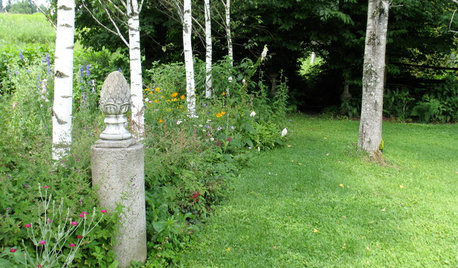
    This is a grove of Himalayan white birch, underplanted with shade plants.

  • 9 years ago

    River Birch in particular is brutal to garden under in our area. Worse than any maple, including Norway and Silver Maple.

    Some of the white barked birches aren't nearly as aggressive though.

  • 9 years ago
    last modified: 9 years ago

    You could call a few Chicagoland area nurseries and ask for suggestions for understory trees or ornamental trees that are sun tolerant, with the other specifications you prefer. The trees you hear several times are likely to be the ones to consider. I am too far south to offer good suggestions.