Software
Houzz Logo Print

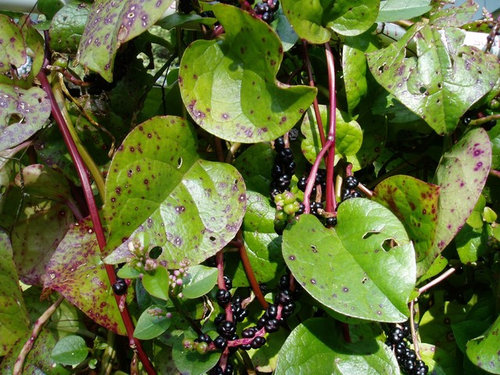
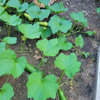
Yo Malabarians. I've had tremendous success with malabar spinach this year. My first time growing it. Although the germination rate was horrid (still trying to figure out why), the plants are insanely productive, and the vines are taking over a corner of my house. But in the last few weeks the leaves are becoming spotted and less appetizing. See here.

Not completely clear what's going on. This is a tropical, hot-weather loving plant, and the temps are now pushing into the low 40s. I'll lose it completely come first frost. Is this a disease or a temperature effect? Or just old age? No visible insect pests.

Comments (20)

  • 8 years ago

    Looks like Cercospora leaf spot to me.

    Rodney

    daninthedirt (USDA 9a, HZ9, CentTX, Sunset z30, Cfa) thanked theforgottenone1013 (SE MI zone 5b/6a)
  • 8 years ago
    last modified: 8 years ago

    Good catch. Thank you. I need to get out the Daconil. About half of the plants are infected, so maybe it isn't to late. But, as I said, they're on their way out anyway. I never treated them with anything. Next year I'll regularly treat them with fungicide, as the leaf spot is probably endemic in my soil now. I have chard nearby (so far uninfected), and that needs to get treated as well, I guess. Unlike the MS, that should last the whole winter easily.

  • 8 years ago

    Maybe you need to consider rotating your crops or replacing some of the soil if it is tainted and solve the problem at the source. Definitely prune away the bad foliage now and dispose of it properly.

    Thinking that you can just spray chemicals to “solve” the problem is old-school thinking IMO. Hope there are no kids eating your vegetables.

  • 8 years ago

    No, spraying fungicide is not "old school thinking". It's very modern thinking, and these fungicides are well researched and understood to be non-toxic. LD50 for Daconil is huge. I don't spray toxic stuff.

    Replacing soil? Give me a break.

  • 8 years ago

    Malabar Spinach is usually a very healthy plant. Try spraying with neem oil till the infestation does away. This is a good growing guide:

    How To Grow Spinach (Malabar Spinach)

  • 8 years ago
    last modified: 8 years ago

    Neem is an insecticide. This appears to be a fungal infection, not an insect infestation. No insects around. Need to choose your bullets more wisely.

    Yes Malabar spinach has been enormously successful for me. It was a very healthy stand. This problem started in *November*, when the plant is about to get killed by frost.

    My main obstacle for next year is germination. The seeds I bought last year, and the seeds I've now harvested, have *extremely* low germination rate. Less than 10%. Of course, as of now, I have a zillion seeds. But it would be nice to understand seed preparation (including scarification) of these better. I'll probably just soak a few hundred, and pick out and plant those that germinate.

    Interestingly, on the video you recommended, the end-of-season leaves had the speckling that I'm seeing now. So they had the problem too, it would seem, but didn't point it out.

  • 8 years ago

    Neem is an insecticide, fungicide as well as a miticde.


    From Wikipedia:

    >>>>>>>>

    Neem oil also controls black spot, powdery mildew, anthracnose and rust fungi.

  • 8 years ago

    You referred to an "infestation". My malabar spinach doesn't have an infestation.

    Oils in general are used as fungicides, at least in that by coating the surfaces of the foliage they prevent penetration of the fungi. I don't think there is anything special about Neem oil in this regard, except that Neem oil is considerably pricier than other horticultural oils. Those trying to sell Neem oil may argue with this, however. See https://www.extension.purdue.edu/extmedia/bp/bp-69-w.pdf. As an insecticide, Neem is uniquely chemically capable, especially the Azadirachtin in it.

  • 6 years ago

    OK, back atcha, two years later. Each year, in November, my Malabar has declined, as in my original post. This year, I sprayed Daconil on, every two weeks or so. I have NO such problem this year. Rodney was right. The lesson was that it *was* a fungal infection. The stuff is now doing great. Problem solved.

  • 6 years ago

    That’s interesting Dan, thank you for that. You remember we spoke about this a while ago - when I was growing it, I too used to see that spotting come winter (around late May/early June I think - equiv. your Nov/Dec). The spotted leaves would stay dormant (plus a lot of die back) through the winter, but then in spring all the new growth would be totally healthy. I never treated with anything.

    Whatever fungus it is must be only able to take hold when the plant is weakened by cold.

    How much longer will you get out of it? If you‘re planting new every year, would it be easier to just uproot the old plant at the first sight of the disease so that it isn’t allowed a host from which to spread?

  • 6 years ago
    last modified: 6 years ago

    Well, my first frosts are in December, so my Malabar spinach will usually die then. In fact, we had an early almost-freeze this year, and that took some of it out. But knowing this trick should let me get a few extra months of productivity out of it. The way it was, without fungicide treatment, the stuff became almost inedible in late October. Now it looks like it will be good until it freezes.

    Now, around here, it is hardly "cold" in October, and can actually be quite hot, so I think the infection must be driven by something other than low temperature. But that's a good point. If fungal infection is going to set in, why does it wait until late summer to try to do so?

    If you never have a frost, yes, new growth might be OK. Do you grow it as a perennial?

    As an aside, I have noticed that the leaf sizes in Malabar spinach change during the season. In high summer, the leaves are palm-sized or larger and, late in the season, the leaves only get to about half that size. Curious.

  • 6 years ago

    "If fungal infection is going to set in, why does it wait until late summer to try to do so? "

    Because the conditions that foster the development of the pathogen become most favorable in late summer and into fall - moderately high temps, high relative humidity and extended periods of leaf wetness overnight (higher dewpoint).

    Powdery mildew is similar in that it also tends to be a late season issue. And for somewhat similar reasons.

  • 6 years ago
    last modified: 6 years ago

    Well, I'm not sure it's that simple. Down here, we don't get a lot of moisture in September and October. Furthermore, in previous years, during mid-summer, the stuff was watered every three days by above-ground spray. Leaves were getting very wet, and temps were very high, and yet the fungal infection didn't set in until October. If anything, the leaves were drier then.

    Leaf wetness is a matter of humidity, not dewpoint. If the dewpoint is high, but the temperature is a lot higher, everything is going to be pretty dry.

  • 6 years ago

    You theorised in the previous thread that it could have been the stress of berry production - maybe that contributes to vulnerability.

    Yeah I used to grow it as a perennial for quite a few years. You would think that once it has the disease, you would see it year round, but I only ever had the spots on the old growth through the winter. But since I never actually really harvested the plant for eating and since it would always come back without them, the spots didn’t bother me and I didn’t even realise it was a disease.

    If you’re growing as an annual, I guess you just have to weigh up the cost of the fungicide vs a couple months longer productivity.

  • 6 years ago
    last modified: 6 years ago

    The cost of fungicide is just pennies. It is remarkable that this condition just went away for you when springtime came around, and it's fascinating that you've grown it as a perennial. But yes, the plant is under some stress with berry production (which may also explain the small leaf size late in the season).

    The great thing about Malabar spinach is that it self-seeds effectively. I never plant it! In fact, in the spring, it's an effort to thin all the sprouts. I guess if you grow it as a perennial you still have all those new sprouts to deal with.

  • 6 years ago

    I can’t imagine spraying fungicide on food. Am I a crank?

  • 6 years ago
    last modified: 6 years ago

    Yep. The MSDS shows Daconil to be very low health risk, and it washes off anyway. But keep cranking.

  • 5 years ago

    I do not eat meat unless it is well done, drink alcohol, or sun to get a tan, all for health reasons. But if you do it is your choice. I will, however, use fungicide and even insecticide if I have to for growing food. Lets face it, the air you breath around large metropolitan areas is worse for your health than what you will legally spray on your garden. And I know what I spray on my food. If I buy it at the store, esp. if it is grown out of the country, I really have no idea what is was sprayed with.

    Spraying things just to spray is not smart. But if you have a reason to spray and it will correct the problem, that becomes a personnel choice.

  • 5 years ago

    Some people are petrified about stuff that has been established as being safe. I concede that. I don't garden organically, but I garden SAFELY.