

Completely overwhelmed
In need of ideas of where to start with purging and redecorating our home of 40 years. We aren't at hoarding level, but there's plenty of emotionally-charged family memorabilia and too many inherited furnishings. Projects have been done along the way so we're not in horrible shape, but even the master bath remodel is 20 years old.
There are so many choices of problem areas I can't decide where to begin and want to retire to my bed with the covers over my head. Husband was diagnosed recently with ADHD (at least there's an explanation for the madness all these years) so there's not much organizing help to be found there. Has anyone found a system or starting point that works?
I've exhausted the library's stash of organizing/purging books - some of it's helpful but most skip from where you know you need to clean up right over the decision-making and emotional stuff.
Any tips are appreciated, thank you kindly.
Comments (18)
 8 years agolast modified: 8 years ago
"emotionally-charged family memorabilia"
There are some organization consultants who don't just help you get organized, but work on a psychological basis to help people deal with the emotional problems that come with organizing/cleaning up. (edited to add: my sister found someone to help her partner with that when they had to get rid of about 2/3 of their possessions when they were downsizing. The person they found did connect with her emotionally and was able to help her agree to let many of the things go without a relationship-destroying fight.).
I heard about a book called "The Gentle Art of Swedish Death Cleaning" that talks about the slow and gradual process of winnowing down your belongings before you die, so your survivors don't have to do it for you. It sounds macabre, but someone who's read it told me it's actually quite good and thoughtful.
I always look at winnowing down my possessions not as losing things, but as finding new and better homes for them -- places where they will be more loved and used than in my home. I donate furniture and decor things to an organization that gives furniture away to those starting new homes (for people already working with social services, so there's no question about truly being in need), for instance. I drop off clothes and books to a downtown soup kitchen/drop in center. The toughest things for me are the things that I have to throw out, like piles of old family photos and memorabilia like saved concert tickets! That takes determination - harder than passing things along to others who are in need.
Related Professionals
Little Rock Custom Closet Designers · Panama City Custom Closet Designers · Rock Hill Custom Closet Designers · Spanish Fork Custom Closet Designers · Ottawa Custom Closet Designers · Evansville Interior Designers & Decorators · St. Louis Interior Designers & Decorators · Fargo Interior Designers & Decorators · Amherstburg Interior Designers & Decorators · Fayetteville Home Remodeling · Columbia Home Remodeling · Wilmington Home Remodeling · Oneonta Home Remodeling · Youngstown Home Remodeling · Williston Home Remodeling 8 years ago
Generally, when I start a large project that I don't want to do; I set a limit. As in, I will clean out this ONE drawer today. Usually I find that starts a snowball effect.
As for the decision making, here's the criteria I use. Does it fit? Does it need to be fixed and will I fix it? Do I have more of this item than I need? Do I use it? Do I LOVE it?
It's taken a while, but I've learned to leave the guilt outside of the process because if it's not something I need/use/wear or love then it has no real purpose in my house.
 8 years ago
Read the first three Houzz stories about how to deal with inherited items, I think you'll find some useful info. Here's the link. https://www.houzz.com/ideabooks/query/inheritance
Personally, I would start editing/purging before even thinking about a major renovation job. As long as your home is safe, no risk of fire, clean and comfortable, decorating can wait. Don't deal with photo boxes or albums until you are near the end of your quest, they are a massive time consumer.
When I procrastinate, I force myself to set a timer for an hour and I get to it. If I feel like continuing, I set the timer for another hour or 1/2 hour. My goal is to accomplish a task in the timeframe without leaving a bigger mess than I started with. Works for me.
Here's the Houzz link for stories dealing with organizing and clutter.
https://www.houzz.com/ideabooks/Organizing/query/clutter
- 8 years agoThere are few new books that have come out recently, but if it fits your budget, you might find it helpful to hire a professional organizer—if only to help you get started.
If I’m recalling correctly, the new book about “Swedish death cleansing” (or something like that) suggests starting with large items first (furniture) and leaving sentimental objects for last (photos, etc). And remember that if you are donating items, you aren’t throwing them away—you are helping other people and adding to their enjoyment.
Another suggestion, as others mentioned, is to tackle one room at a time. - 8 years agoI would go visit flylady.com. Sign up for her emails. And only do what she suggests if it works for you. I’ll be up front. I stopped her emails because I have mental health issues and couldn’t handle it (house stuff in general) until recently - and now I just visit her site daily to see what to work on because her emails overwhelm me. But before I was ill I was able to declutter my entire house 15 minutes at a time. I would say your husband could get on board with some of her methods because they’re quick. If you’re on a time crunch to clean your house it probably won’t work. It took me months to do it. I’ve also read ‘the life changing magic of tidying up’ (also known as the KonMari method) which is a good read about how to decide what to keep. I found her method really good for my stuff but hard to get the rest of the family to follow. Good luck. And try to change your thinking from ‘getting rid of stuff’ to ‘giving to others’. I find when it’s a gift, even to a stranger, the process easier. :)
 8 years ago
I am doing the same thing right now except that I moved a huge storage and camper into one small house. I have no decorative items to speak of but boy do I have some stuff. It has been very difficult and sometimes I do go hide in the bed lol.
What I have learned in 12 days... start anywhere. If it's too hard to handle switch areas. Sometimes I start going thru bins and it's too hard so I wash dishes, purge clothes, purge kitchen clutter. Then when I feel up to it I go back to bin and force myself to finish.
There are many ways and ideas and books and videos but one thing is certain to work just start. Put it into your schedule play music or inspirational audio and dig in. I make myself do 4 hours per day ( technically I am not working yet) no matter what it is just do it.
After you declutter you can work on the other.
And don't beat yourself up if you don't meet your goal for the day or week just keep on going.
Kim
barbp451
Original Author8 years agoThank you all for the wonderful ideas - starting small (with the help of music - something I'd been thinking about) makes sense, and purging before decorating also makes sense. I read the Kondo book and had a problem with her frequent reversion to putting things - often other people's things - in garbage bags and throwing them "away". She seemed a little OCD to me. As tree huggers point out, where exactly is "away"? She does have a great method of folding shirts on end in drawers, however...
Bette, I will look at the linked articles, and Cheezewhiz, I struggle with emotional issues as well, having grown up in an alcoholic home. My things bring me comfort, remind me of loved ones, have "juju". I feel the need to rehome them to the proper place, which slows things down considerably.
And I'm a bit leery of professional organizers - anybody ever watch Helen Buttigieg on the old "neat" show? She once held up a flower arrangement during a purge and questioned the homeowner about whether this couldn't go, whereupon the woman ran from the room weeping - it had adorned her father's casket. I'm afraid I would find myself protecting/defending objects instead of planning. If you had the right earth mother type, it might go well. Where do you find such a person, I wonder?!
 8 years ago
I set the timer for 15 minutes and some days that was too long. Photos were killers. Save sentimental stuff for last when your declutter muscle is strong. Definitely save paper for later. At least half my paper was sentimental and half of the rest was scary to go through and decide whether it needed to stay or not.
I'd start with categories that are easy. Maybe your clothes. Bathroom empties/hates/past dated were easy for me. Both made a nice difference in the room, even with closed storage a room feels airier when spaces are less stuffed.
I didn't deal with a lot of heirloom stuff. Perhaps pack the small stuff away well labeled so it isn't cluttering up your house? Tell yourself it is for safe keeping. As for extra furniture? Make a decision and place it in your house, offer to others in the family, sell it or give it to a thrift store.
As for starting? I got to start on a high note. New stove and dishwasher! Before they were put in I started putting the kitchen in better order and haven't stopped since. A thread Jan Moyer started last year helped keep me going, this year there's another thread, 40 bags in 40ish days.
 8 years ago
Good for you for clearing out and creating some breathing room in your life! We go on purging binges around here. I'm less attached to things than my husband; however, we both have things that conjure up emotions & memories. Those, we've set aside, and will figure out how to incorporate into our home or learn to detach ourselves from them.
Here's what is currently helping us as we declutter:
-- If the house caught fire, besides people & important documents, what's most precious to us to save? (This one really puts our 'stuff' into perspective!)
-- If we can't find a home for it (not stuffing into a closet or attic!), we need to purge it.
--- Is the item holding us emotionally hostage? If it brings up bad memories, or feelings of guilt b/c a loved one gave it to us & we just don't like/use it, it needs to go.
--- What do we want this room to look like, and does this thing serve a purpose in the function of this room? (This has probably helped us the most. It detaches us from the thing, and helps us clarify what we are trying to achieve.)
Best of luck to you as you clear up ad clean out!- 8 years ago
One pitfall to de-cluttering is that you often try to make too many decisions at once ...and the proponents of "handle each item only once" force that on you.
If you are trying to decide, for EACH object, whether to keep or discard, and if discard is it trash or to be donated and if donated where ... that's burning all your brain cells. it's overwhelming.
I do binary sorting, even though it means making multiple passes through any area, because it's a yes/no decision, not multiple choice. I also make the decisions that move things out of the house first because it makes room for the things I want to keep.
Dealing with Distractions: How to handle the things that belong
elsewhere. DO NOT LEAVE THE AREA! You know you will never get back to it
because something will need doing elsewhere.
Example: If you are
cleaning the bathroom and find a screwdriver that belongs in the garage,
don't take it to the garage yet. I put the things that belong
"elsewhere" into a plastic tote and at the end of a cleaning session, take
them back to their homes. It keeps me on track.First: Trash or not trash? Go through each area and discard all the things that are obviously trash ... old ads, newsletters, empty containers, product dried out and gone stale, irrevocably damaged clothing, broken electronics. Stand there with a trash can and liners and dump stuff.
I take everything out of the cabinet or drawer, wipe it down and de-trash before I put things back in. You don't have to de-trash the whole house, but it's the fast way to make room for sorting and storing and the decisions are usually clear.
NOTE: If you plan to add shelving or storage organizers, take measurements while the area is empty. Just put them in a notebook for later.
NOTE: you can have a "trash" and a "recycle" container.
NOTE: Putting all of one sort of item into a bin or at least in the same area of a shelf minimizes buying duplicated because you can't find things.
Second: Donate or Keep? By donate I mean give away to strangers, because the emotional baggage of heirlooms is too much to explain right now.
Identify one or two charities, ideally close to your work or house so you can drop off things easily, or ones that will come pick up at your house. We were clearing out to move, and I had one charity for the household goods sort of things and another for the high end boutique things. And one for the hundreds of books (but that's a special case).
A Craigslist "FREE AT THE CURB" works for all kinds of things. There are people who make a living picking up, fixing and reselling discards.
Sorting: Collect all of one kind of item - perhaps all the kitchenware, or all the clothing, or all the tools - into one area and sort them out by function. If there are duplicates, decide if they make sense or if they are surplus. "Surplus" depends on your lifestyle. I have lots of measuring things because I like to cook an entire dinner without having to stop to wash things.
Put the surplus into the DONATE box and put the rest back.
TOUGH One: Sell or Donate? Some things will be worth selling, but it's a hassle. Ask yourself if you want to spend the time and energy or if you just want your house back. Work on the de-trashing and de-cluttering first.
If you have the time and energy, price and store things for a yard sale as you de-clutter. If you don't, don't worry about it.
TIPS:
Think "cubage" ... how much space any discard or donation will produce. Get rid of the large stuff first.
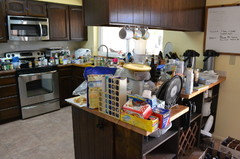
Take photos of before and after and during to you can remind yourself that you ARE making progress. Here's my kitchen being de-trashed and surplus stuff going to charity. About 2 wine boxes (our standard measure for small things is a Charles Shaw wine box) went to charity, a box went into the trash and the rest fit into the cabinets a lot better.
barbp451
Original Author8 years agoThank you all again for even more thoughtful ideas. I should read the book about Swedish "death cleaning", which resonates because of the experience of clearing out my late mother-in-law's home. It was me doing it or letting my husband throw everything in a dumpster. And since her system involved lots of plastic tubs full of mingled items (example - paper trash mixed in with things like marriage and death certificates and family photos), the dumpster was not an option in my mind.
I would find something - the world's ugliest sweater, for example - and wonder why in the world she had kept it. Now that she was gone, there was nobody to answer that question. And I could imagine my own daughter having to clear out our space, and didn't want that task to be a burden.
Agree that a good charity where household items and furnishings are welcome would be helpful - there is a nearby abused women's shelter, literally those who have walked away with the clothes on their backs - but they swing between taking everything to wanting only new things. I need to find more charities, clearly.
- 8 years ago
"I need to find more charities,"
I don't know where you live, but when I was downsizing I discovered my city had a lot of small groups who wanted different kinds of donations, and I liked that better than just giving stuff to Goodwill or the Salvation Army to sell. Things like donating art and craft supplies to an after-school program, a support group for teenage mothers would take baby and child clothes/gear, and an organization that helps people dress up for interviews would take business-type clothing. There's an organization that takes old electronics and, if can be refurbished (or if they're in working condition), they donate them to charities and social service agencies. So maybe if you spend some time on Google you might find your location has some atypical kinds of charities that are in need of what you might have.
- 8 years ago
barbp451, I am in a similar place that you seem to be. My father passed away recently and his house is currently undergoing clean out. It's given me so much pause for thought in regard to our home, what is in it, and what someone else will later have to go through. It's an interesting perspective to take and hopefully helpful.
In my father's case he was rather a minimalist toward the end when it came to personal and household items, but when it came to consumables he kept everything thinking it might someday be useful. DH and I hauled out so many outdated and bad household chemicals and similar products. He also seemed to do a little hoarding of office supplies and "nice" cardboard boxes- you know a heavy box that something came in and you think, "that might be good to store something in later." His garage was full of stacks of boxes and we thought they must be full of something, but no, he had a garage full of nice quality empty boxes...
I like Marie Kondo's book because she introduces a very natural order of going through things starting with clothes and moving to categories that are more emotionally challenging. When I did her method a few years ago, the momentum started off well and kept up--- but her method is long and if you have any kind of life, it's easy to end up off track.
I also like Brooks Palmer's book. He looks at things in a very psychological way. Makes you think about why you keep the things you do and what they really mean to you.
It's helpful to me to donate small loads at a time. As much as I'd like to get rid of a huge amount of stuff, doing a lot at one time becomes overwhelming for me mentally for some reason. A small box here and a small box there are easier for me to deal with than those same number of boxes going out all at once.
Someone once told me that when she declutters she asks herself what something is contributing to their lives. It's easy to get caught up in little odds and ends and not realize that those things are clogging up drawers and not contributing much positive to your life.
Just do a little at a time and don't burn yourself out! There are not an infinite number of items in your house, so if you keep working at it, eventually you will have less!
- 8 years ago
Before you go to the extent of reading books Barb, read the Houzz articles I linked above about inherited stuff. Quick and easy read and it will get you motivated.
 8 years ago
Barbp, my first advice to you is...stop reading books. They are distracting you from the task at hand. I've been there. Lazy_gardens has some great ideas. Do at least one of them. It seems hard, it really does. But once something is gone, you don't miss it. Really, you don't. It's just . . . Poof.
- 8 years ago
My tip is an emotional one. Take a deep breath. Remind yourself the old saying "How do you eat an elephant?" The answer is "One bite at a time." That is the saying that sticks we me when I do my yearly March to May cleanse of all the things my hoarder husband has brought into the house during the year.
barbp451
Original Author8 years agoYes, sometimes the book reading, the "getting ready to get ready" is a convenient way to get nothing done. 40 years in the same house means we've never had the moving purge. An ADHD spouse means impulsive buying, and it's never enough. Being the adult child of an alcoholic adds emotional baggage. We're self-employed and still working, and caring for 13 animals (mostly rescues). I can feel the weight of the clutter, even when it's stashed out of sight.
And yes, I've kept those "nice" cardboard boxes because surely they'll be good for storing something.
Sitting around paralyzed, wondering whether to try to complete one entire area or just shotgun purge here or there until it's down to the truly important stuff, there's where I get stuck. The many terrific tips in the thread give me lots of possible ways to tackle this, and I greatly appreciate all your input.









skmom