Software
Houzz Logo Print
sfnewbie

Vent Hood Ducting Issue - How to deal with too many turns and screws??

8 years ago
last modified: 8 years ago
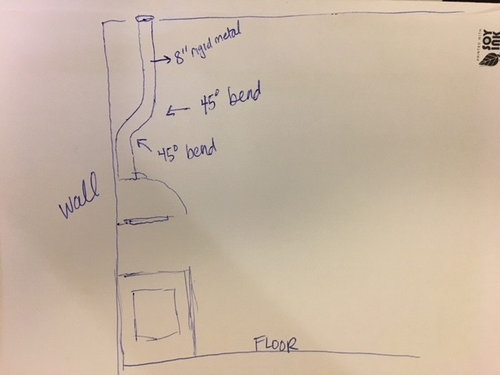
Not sure if I'm in the right forum. We have a ducting issue for our range hood and hoping there are some experts on here that can help!

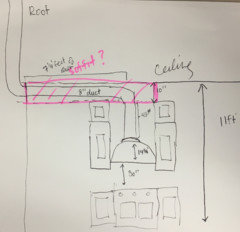
I bought a hood that is 600 CFM blower system equivalent to 900 CFM. The manual said we need 8" inflexible duct, which we had the contractor install. The issue is that my contractor wasn't able to place the duct against the wall where my range will be installed because the floor joists was directly above. Therefore, the opening for the duct was moved six to eight inches away from the wall. Because the duct is not directly over my wall hood, we will have to install TWO 45 degree bends to meet the location in the ceiling. Also, there is a soft 90 degree transition to the ceiling in order to fit between floor joists and then another 90 degree transition once the duct is outside of the building to exhaust to the ceiling (we live in the city and the code is very strict about blowing air when you are less than a couple feet from your neighbor's). See badly drawn picture.


I've spoken to the manufacturer and they are basically saying that the hood is going to be louder and smoke may not be able to escape because of the back to back 45 degree turns and then a 90 degree turn which is probably less than four feet away. This isn't great.

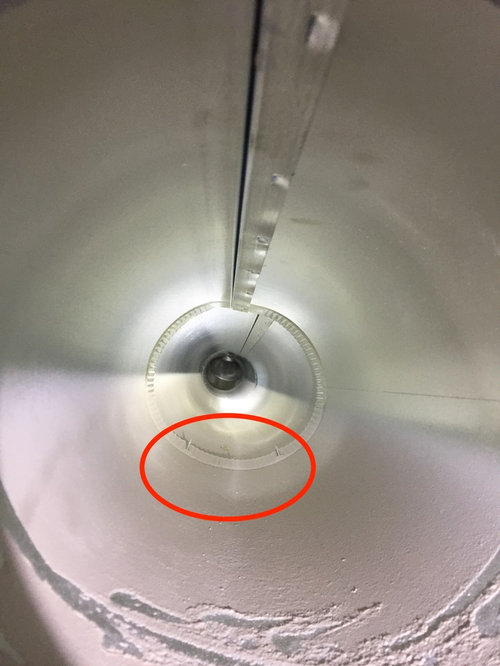
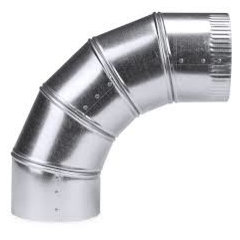
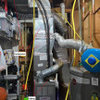
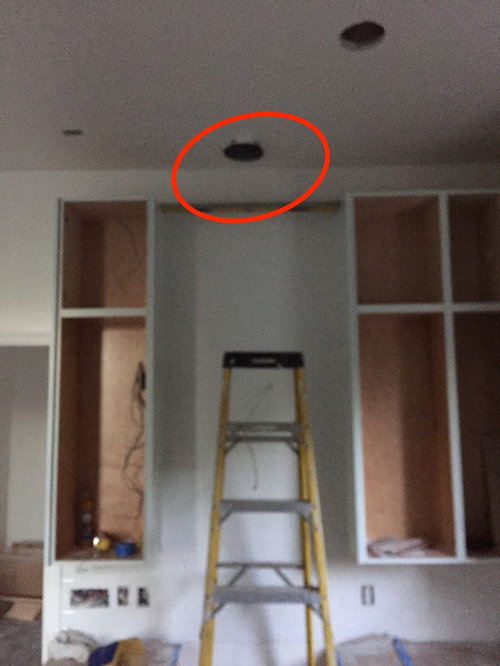
In addition, my husband looked at the vent and the contractor put screws along the outside edges (please see picture)?! I have heard that this will cause turbulence and air leakage.


So, maybe we can build a soffit closer to the wall, which we didn't want to do. Do we have any other options? I would like my vent hood to be functional.

Comments (22)

  • 8 years ago

    A few comments.

    The OP's reference to CFM suggests a Vent-a-Hood system, and it is worthwhile in the context of the OP's questions to note how misleading the rated CFM actually is. Normally, blowers for this purpose are rated at zero static pressure -- essentially hanging in the free air -- itself misleading to those not informed, but useful because the real value can be estimated. This of course is not how blowers are used. One has to account for pressure losses getting air around the loop from outside the residence to the hood and then to the outside again.

    I believe VaH are claiming that their hood (which has no baffles) with blower has 600 CFM output (hanging in free air) and if the hood did have baffles, this would require a 900 CFM blower. This is not quite correct because the 2/3 factor is more likely (with conventional baffled hoods) to encompass reasonable duct losses and reasonable MUA pressure losses.

    But wait, there's more. The flow rate of a blower is a decreasing function of the pressure difference between its input and its output. The quantification of this effect is usually summarized in a fan curve. (See Broan's web site for examples.) VaH has published some data that suggests that their equivalent fan curve has a greater flow rate handicap with pressure loss than typical conventional (centrifugal and axial) blowers. I suspect this is due to using a squirrel cage blower to provide combined air movement, grease slinging, and fire stopping.

    So, the configuration reported by the OP is the worst possible for use of a VaH "magic lung" blower, and we haven't even addressed yet how make-up air (MUA) is going to be supplied and what its pressure loss will be. (No air leaves the house that didn't get into it, and if this induces a pressure drop -- as it will without its own blower -- then there is a further degradation of the hood blower's flow rate.)

    VaH's response reported by the OP is at least honest; the achieved flow rate can be expected to be too low to meet the flow rate needed for adequate cooking plume containment by the hood. (This value is roughly 90 CFM/sq. ft. for baffled hood systems; it could be different for the conditions under the VaH blower.) In baffled residential hoods, the pathway to the baffles (the containment boundary) is usually smooth, while the VaH has some structures exposed that can induce turbulence and potentially have uneven flow rates at the hood entry aperture.

    So, yes, capture and containment of the expanding plume may well fall short of the desired result. A conventional baffled hood with a higher performance blower (in hood or external) should be able to overcome the duct configuration. Alternatively, any scheme that will smooth out this tortuous path will help. A HVAC analysis is called for, but first the MUA approach must be defined.

    It is normal, if not ideal, for duct sections to be secured with screws. The screws may affect turbulence and may be capture points for lint and grease, but I would guess that the tortuous path turbulence will dominate the screw turbulence in this case, and the squirrel-cage blower may dominate them both.

    kas

    future materializes thanked kaseki
  • 8 years ago

    Thank you Kaseki. You certainly know what you are talking about! Yes, it is a vent-a-hood hood I managed to get for a "steal" because it was a floor model. I profess that I do not understand the nuances of everything you wrote (I don't know what the MUA is). So I hope you will confirm my understanding below?

    It sounds like this configuration is not ideal and I won't get much functionality out of my hood. What if we create a soffit up against the wall, so that the duct would not need to do this 45 degree turn TWICE? This way, it would just go straight up into the soffit which I think we can do a soft 90 into a soffit? We have about 10" of space above the cabinets that could encase a 8" duct. I think this could give us about 3.6' of run from the top of the hood to the soffit. Then it would be about 7.25' run between this turn and the turn outside to vent to ceiling. Would this be a possible solution and increase functionality?

    Or, do you recommend going out and buying a "conventional baffled hood with a higher performance blower (in hood or external)"? And can you recommend or send me a link of one?

    We are short on funds, so the soffit solution would be better financially for us, but I do want a good hood as I do pan frying quite a bit.

    Thank you so much for your advice.

  • 8 years ago

    I would not want to recommend wasting money if it doesn't fall from a tree in your living room (or pour from a conduit connected to the Federal Reserve). I would argue for an 8-inch duct. I would argue that the two 45's are not desirable, but shouldn't be a dominant pressure loss; the two 90s will dominate, I think. However, I would make the entire path 8-inches if at all possible. Last, I would argue that you should go ahead and try your hood unless you think you can sell it easily. Just avoid making the installation so constrained that you can't upgrade to a hood that is closer to optimal at a future date if you decide you want to.

    [There are, in my view, some deficiencies with your present hood relative to my views of optimal hoods, but they are not so overwhelming that the hood should be discarded. I think baffles are better; I think external blowers are quieter, and I think for the same overall end-to-end flow rate conventional blowers are likely quieter than a VAH blower right at your ear without any baffles. However, many have reported here satisfaction with their VaH hoods. I am not going to recommend any hood I haven't owned, nor am I going to de-recommend any hood I haven't owned. I prefer to criticize configuration deficiencies rather than manufacturers.]

    MUA: For much more on make-up air, search for it on this forum. The MUA system is essential for several reasons I won't address in this message. MUA should be defined at the same time, and to the same level of detail, as the hood system.

    Also, for background about the entire topic of ventilation, see Greenheck's Guide and read the first dozen or so pages. Most all that is relevant to commercial kitchens is relevant to residential kitchens to a lesser degree, except hood sprinklers.
    http://www.greenheck.com/media/pdf/otherinfo/KVSApplDesign_catalog.pdf

  • 8 years ago

    Why not go into the cavity behind the wall. If there is a joist immediate above, go behind it, not in front. Will need to cut out the cavity top cap of wall. Since assuming the joist is in the way, this is not a load bearing wall. On this one, we also had to scab 2" from the bottom of the joist to make room. We bolted stiffeners on both sides of the cut out joist before making the cut.

    If a stud is in the way, cap it like you would a header.

    future materializes thanked Stormsearch
  • 8 years ago

    Thanks Tony. The wall is not load bearing, but Wouldn’t I still have that extra turn to make since the hole still wouldn’t be directly above the hood? This is a nice idea though because I could avoid a soffit.


  • 8 years ago

    Yes, still need a turn, but ridding of the soffit was our goal also. We used a very short piece of flexible duct here and the bend is less than 30 deg for us.

    future materializes thanked Stormsearch
  • 8 years ago

    Duct has to be steel; I hope the flexible part wasn't aluminum. Some 45-degree ducts are made so that with some rotations of parts one can generate any lesser angle desired.

    future materializes thanked kaseki
  • 8 years ago

    I think the soffit is the way to go, at least my hood will be functional. I already have 8” galvanized steel duct, since this is what ventahood manufacturing instructions require. This way I’ll only have two very soft 90 degree turns spaced Nearly 9’ away. I really dislike the look of soffits, but I value functionality more. Thank you Kaseki and Tony for weighing in

  • PRO
    8 years ago

    The best would have been the hood on an outside wall , every time ducting needs to make a turn you lower the CFM so then you will need a stronger hood , and long runs of ducting creat other problems likemgrease actually collecting in the ducting .

  • 8 years ago

    Patricia provides a good reminder that a long line of horizontal ducting won't drip grease back into the kitchen hood if there is some great grease build-up one needs to know about before having an unplanned household flambe. (I've never had a build-up, myself.)

    Some access to the garage ducting should be retained, even if the access is via screwed in sheetrock with the screws exposed. The duct sections in that area should be attached using clamps, rather than using overlapping sheet metal with screws, so sections can be removed for inspection. Suitable clamps can be obtained from Fantech, or via such sources as Amazon.

    Fantech 8-inch clamp

    future materializes thanked kaseki
  • 8 years ago

    Patricia and kaseki - yes, in a perfect world with new builds, yes having it go directly outside is ideal. I live in San Francisco and this is a remodel. Our unit is on the property line and building code states that you cannot vent out less than 3’ away from the property line and near any operable opening in a building. I live on the first floor and the other condo owners live above us. Unfortunately, this means we have limited options.

    the ducting is behind drywall between joists.

    thank you Heather for the input. It is helpful!

  • 8 years ago

    Flex duct is stainless steel. We don't use much of it due to expense. Very typically we install in commercial applications where environment needs to be controlled for chemical handling.

    future materializes thanked Stormsearch
  • 8 years ago

    2 45s are better than 1 90. So don't obsess too much over them.

  • 8 years ago

    Thanks weedmeister. The issue is that current setup is two 45 degrees and then one 90 degree within 2 feet of each other! The other option is one 90 degree...

  • 8 years ago
    last modified: 8 years ago
    A few very quick thoughts.

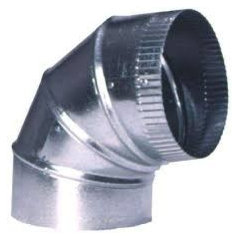
    Wide sweep smooth 45's & 90's will be much better than tighter radius or segmented. Two 30's would be better than two 45's and two 15's better than two 30's. An oversized end cap (eg, 8" to 10" reducer + 10" cap) will be better than a typical 8" cap. IOW, almost anything that can reduce the static pressure will help. 10" duct would help as well but might also result in too low of air velocity.

    MUA is Make Up Air. If you're sucking 600 CFM (with your setup about 100 CFM is more likely) out of your flat then you need to bring that same amount back in. In your case it is doubly important as too little MUA, as @kaseki mentioned, will cause your hood blower to have to work much harder against the vacuum that will be created in your house and so it's performance will go down even more. You need to do everything possible to help your hood do it's thing.

    You need to talk to a competent HVAC person.

    future materializes thanked opaone
  • 8 years ago

    Some quick examples;

    1) Narrow (or Short or Tight) Segmented (or Adjustable) 90°. Static pressure generally about equiv of 11' of straight duct.


    Wide Sweep (or Long) Segmented (or Adjustable) 90°. Static pressure generally about equiv of 8' of straight duct.

    A smooth rather than segmented (adjustable) is a bit better but is not always available.

    future materializes thanked opaone
  • 8 years ago

    Opaone - yes, I think I should hire a Hvac expert. The Hvac duct options you’ve given me is very helpful with the static pressure equivalencies. I had no idea 90 degree bends came in so many different types.

  • 8 years ago

    We had a large vent-a-hood (rated at 900 cfm, with a 10 inch duct?) in our previous home (installed in about 2008) and have a smaller high performance hood in our current home (rated at 600 cfm, I think), Based on my limited experience, make-up-air really makes a big difference in the hood performance.

    If my wife has any question about sufficient draw from our hood, she just adds to the MUA by cracking open the back door a few inches and it makes big difference in keeping the kitchen free of food odor and heat. Our gas range puts out a lot of heat when you use multiple burners, and without a good draw from the hood, our A/C struggles to keep the kitchen cooled down while cooking.

    Bruce

  • 5 years ago

    We're installing a new range hood in an existing house. Duct already has several bends. It is not feasible without considerable expense to make structural changes to the house. However, with crawl space access to a long duct run, I plan to install a booster fan switched on when the range hood activates. This will offset the impact of the bends in the behind the wall duct work and should be less expensive than structural mods.

    I did this in a factory environment decades ago which conveyed plastic particles over 200'. There were a number of intermediate valves causing air loss. The capacity of the system was increased considerably. If you can get an inline booster for the duct fine. If you want to add the air from an external fan in the crawl space, make certain it is injected at a sharp angle in the direction of flow.

  • 5 years ago

    In principle, an in-line or external supplemental blower will help. In practice, you have a slight chance of the two units together having an interaction. I would go for it, but not assume until tested that everything will be fine.

    For in-line, distance from the hood might affect any possible interaction. It may be necessary that the in-line blower be configured to have a much longer time constant to final speed to assure stability. This may naturally occur if the hood is marginal in CFM, and the in-line blower is selected to provide sufficient CFM in the presence of the existing pressure losses. It may be bigger and slower to reach full speed.

    And if doing this, why not dump the hood blower altogether and put in a sufficient in-line blower with a silencer between it and the hood, and gain a lot of quieting.

  • 5 years ago

    Two blowers will often result in harmonics that are much worse than the noise from a loud hood.

    -----

    "why not dump the hood blower altogether and put in a sufficient in-line blower with a silencer between it and the hood, and gain a lot of quieting."

    This.