Software
Houzz Logo Print
mike_schuler90

Builder Appliance Upgrade costs

8 years ago

I'd like to get some other people's experiences on pricing they receive from the builder for kitchen upgrades.

I'm working with a big builder, think MI, Stanley Martin, etc, and I'm getting charges more than the vendor MSRP for some of the upgrades. I get that they're not going to give me a Home Depot or Amazon purchase purchase, but I naively thought it'd come in at MSRP considering I should get credit for the standard level as well.

Has anyone else found something similar? Is there anything I can do, other than put in my own appliances after closing?

Comments (25)

  • 8 years ago
    last modified: 8 years ago

    Builders always charge more for upgrades. Plus a change order fee. They get to say what the costs are for them, even if you don’t think it’s reasonable. Read your contract.

  • 8 years ago

    I'm in well before the change orders kick in.

    I'm more looking to confirm that is a consistent experience everyone has for this build route. It sounds like you're saying that I should be expecting very overpriced upgrades.

  • 8 years ago

    That is how production builders make their profits


  • 8 years ago
    last modified: 8 years ago

    Yep... My husband and I have only built 2 large-builder/tract/production homes, and the upgraded appliance packages were insane both times; we skipped them.

    DR Horton, in 2004, allowed us to delete everything except the dishwasher (for piddly-stupid "credit" but it was better than nothing). Gehan, in 2017, didn't allow deletions, so we're stuck with what we have until it breaks (dishwasher has begun the downward journey, after less than 6 months), or until we get tired of looking at it (the stove), lol.

    The decision was made infinitely easier when we read reviews of the upgraded items. Sometimes, upgrades seem nicer, but reliability or usability is rotten.

  • 8 years ago

    They charge typically considerably higher than retail, and the credit will be pennies on the dollar. That is the business model of EVERY large developer and how they make real money.

  • 8 years ago
    last modified: 8 years ago

    Makes sense everyone! I was just so close to actually not exceeding my budget that I found it annoying to go over a little bit for a nicer sink and dishwasher. Sounds like I'll just have to deal with it.

  • 8 years ago

    Lori's plan is a good one. Just ask the question, is this something that will wear out or will need to be changed? If it's a permanent item, pay for it. If you have to replace it at some point, get the basic. I'd sell the appliances after closing and get what you want.

  • 8 years ago

    Just to warn you... Selling stuff after you move in might take longer than you anticipate, because everyone else in the neighborhood has the same stuff (or the same idea, lol). Ask me how I know.... ;-)

  • 8 years ago
    last modified: 8 years ago

    financing appliances for 15 or 30 years doesn’t make a lot of sense...especially since you will still be paying for your mortgage well beyond the life of the appliances.

    It actually makes a whole lot of sense. From a financial perspective the more things that you can get on a low interest rate the better off you are. Home mortgage rates are going up, but they are still relatively low. The life of the appliances doesn't matter, it is just the value of the money and once you adjust for inflation over 30 years you are paying about 1.5% interest.

    ETA: It really is just a math problem. Take your marginal monthly cash outflow (adjusted for taxes and mortgage interest deduction if applicable) and discount that by the average inflation rate of 3.22% (which we are entering an inflationary period so that is low). You will find the real cost of one dollar financed for 30 years is about 20 cents. For most of us paying 20 cents over 30 years is worth keeping the dollar. You can invest that if you want or just go on vacation...

  • 8 years ago

    @bry911 We will have to agree to disagree. Wrapping additional costs into your loan effects other things...for instance a higher purchase price often results in a larger tax assessment. Not to mention if you are out for cheap financing, you could just put it on a 0% credit card.

    Personally I will be buying appliances with cash. I just can’t justify adding to my mortgage in my head.

  • 8 years ago

    Actually Bry is correct. The more you finance at such low interest rates, the more financial sense it makes. The math problem is clear:

    Assuming $10,000 in appliances:

    Monthly mortgage payment (4% 30 years) =$48

    Even payments on 0% financing for 36 months from appliance company = $277.78

    The total costs financing appliances on mortgage= $17,280

    Invest the difference ($277.78-$48=$229.78) monthly for 36 months at 10%.

    At the end of 36 months, you would have paid down the (appliance portion) mortgage principal to $9,450.

    Your investment at an annual 10% would be worth $9,126.86.

    From your "investment", you could then withdraw $48 a month to pay the appliance portion of the mortgage but still returning a 10% interest rate on the balance. At the end of 27 years, your investment balance would be $55,301. (If you only got 8% over the annuity period, you would have $23,789 at the end of the period.)

    The actual problem is in our head. "I just can’t justify adding to my mortgage in my head." We either want to keep our loan amount or payment at a certain threshold or just don't feel a short term household item should be added to the loan. Do you also pay cash for carpet because you only project it to last 10 years? Lightbulbs? Of course not. Honestly, most people will sell their house before they have to replace the fridge, stove and washer/dryer. Not including your appliances in your mortgage is a nice feel good, but not the wisest fiscal decision, assuming you can get approved for a larger mortgage without any interest rate penalties.

  • 8 years ago

    Well first of all, I am glad to see that bry911 chose to edit the condescending response he initially posted.

    @B Carey I too have a background in mathematics. Your detailed explanation supports your point...although I question how many people actually invest the $230 per month difference.

    Back to the question of the OP, if it were me I would live with the builder grade appliances for a while. You are likely going to be so busy enjoying your new home, they won’t bother you as much as they do theoretically now. Then in a couple years, you can sell them for a few bucks and upgrade.

  • 8 years ago

    Lori-Yes, very few people will actually invest the difference. There is also people like me who plan to use most their income the year of the build for "upgrades" to what I gave the bank. My DH will care what the loan number is, but will be happy to have me spend all my income however I want on upgrades (including all those expensive appliances I already have my eyes on!). My point was simply from a finance perspective of if it really makes sense. In my quest to stay below the jumbo mortgage threshold, I may very well use 0% financing on appliances after closing my loan. Too many people are already building at their max 28% DTI, that to go finance appliances at 0% creates a hefty monthly obligation right out of the gate.

  • 8 years ago

    ditto what lori said. Track builders try everything they can think of to rip people off! Put them on CL at a discount price. Then you can negotiate a better price on what you want with a dealer.

  • 8 years ago

    "Invest the difference ($277.78-$48=$229.78) monthly for 36 months at 10%."

    Nice work if you can get it! I'd love to have an investment these days that I could depend on for a 10% annual return over three years,

  • 8 years ago

    "Track builders try everything they can think of to rip people off! "

    Knew that was coming, smh...................

  • PRO
    8 years ago

    Er...you mean tract? Or do they actually track in your area? :-)

  • 8 years ago
    last modified: 8 years ago

    I edited my previous post because I don't want to continue bumping this thread while derailing it into a financial discussion, but I do want to clear this up so I will bump one more time.

    Debt is a tool and when used responsibly it can construct wealth, however, when used recklessly it can destroy wealth, a "wealth hammer" so to speak.

    When it comes to money, many of our assumptions are simply incorrect. The life of the things you are paying for shouldn't be considered, it doesn't differ based on how you pay, so it is not relevant (actually it is the very definition of an irrelevant cost).

    In the end, you should look at the utility reduction of $48 per month (assuming no mortgage interest deduction) versus the utility reduction of $10,000 today. This means at minimum you should reduce the $48 per month by inflation to get to purchasing power.

    When we do that, without investing a single penny we find that the cost is about 20 cents per dollar borrowed.

    Investing the money will probably give you a payback greater than inflation, but you don't need 10%. In fact, investing the money at 0.65% (less than half of current money market rates) arguably makes financing the better option and gives you financial flexibility.

    As for being a math person, you can't get the proper results until you frame the problem correctly. As an accountant a lot of what I do is making sure that all the inputs are correct, anyone can do the outputs.

    -------------
    In the end, if a little more debt makes you uncomfortable then please don't get more debt. However, just because debt is a four letter word doesn't mean it is a bad word. In the end, the more cash you have available to address life's myriad of problems, the better off you are, so I tend to value having $10,000, even if it is just sitting in the bank, more than I value a $48 payment.

    Good luck with whatever you decide.

    ------------

    ETA: Depending on your tax bracket and deduction situation you might be better off donating the builder's standard appliances before moving in and purchasing new ones.

  • 8 years ago

    mill.....that's common sense. They ALL do that!!!!!! As I've said before over 99% of people have NO idea what it cost to actually build a house!!!! And they (GC'S) KNOW this!!!!!!

  • 8 years ago
    last modified: 8 years ago

    As I've said before over 99% of people have NO idea what it cost to actually build a house!!!! And they (GC'S) KNOW this!!!!!!

    On this we absolutely agree, but why is that a bad thing? How much does it cost to build a car? How much does it cost to make a bagel? How much does a bottle of shampoo cost to manufacture? Do you actually know the cost to make anything that you regularly buy?

    The idea that the cost of building a house is not known by people who don't build houses is not really earth shattering news and certainly doesn't deserve even a single exclamation point.

    --------

    Many G.C.'s work on a cost plus basis, so the idea that G.C.'s in general screw people over is a bit disingenuous. They may lowball allowances and charge for change orders but those costs are known. Since the profit on cost plus contracts are known we have a comparison point and can judge the industry in general.

  • 8 years ago
    last modified: 8 years ago

    Track builders try everything they can think of to rip people off!

    I'm wondering if Robin will ever learn the difference between a track builder and a tract builder.

    track

    trak/

    noun

      1. 1.

    a rough path or minor road, typically one beaten by use rather than constructed.

    "follow the track to the farm"

    2.

    a continuous line of rails on a railroad.

    synonyms:rail, line

    "railroad tracks"

    Also, according to the Urban Dictionary, a track house also means a crack house.

    Tract housing, also known colloquially in the United States and Canada as cookie-cutter housing, is a type of housing development in which multiple similar homes are built on a tract of land which is subdivided into individual small lots.

  • 8 years ago

    I would do the sink upgrade, wouldn’t want to deal with the granite maybe needing to be recut. The appliances you can swap later as long as you are ok with their positions and their sizes are standard. Our production builder was lower than msrp and did give a nominal credit for existing apppliances pwhen we built 8 years ago so I did upgrade the cooktop and sink, never regretted it. Best of luck!

  • 8 years ago
    last modified: 8 years ago

    I wanted to put robin0919's claim to bed once and for all, and so I looked it up.

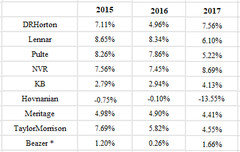
    Here is a table showing annual profitability of 9 of the nations top home builders (I was looking up 10, but couldn't find recent information for one of them). These are from audited financial statements submitted to the Securities and Exchange Commission.

    Beazer's 2015 was adjusted to remove their operating loss carryforward that was the result of large losses prior to 2013

    Just for reference the S&P 500 profitability was 7% in 2015 and slightly more than 8% in 2016 and 2017.

    ----------------

    Can we please put this to bed now? In reality the profit of tract builders is simply no larger than any other company. Their methods for arriving at that profit is something that I have reservations about, but to imply they are robber barons is simply not correct. In reality, they largely provide a product priced in-line with their quality.

    While it can certainly be argued that the world would be a better place if their quality was a bit higher and their houses had a bit more yard, even if they cost a little more, it can also be argued that they are responding to buyer demands. Unfortunately, we seem to be entering an era of disposable (or at least expected remodel) housing.

  • 8 years ago

    Upgrade to the biggest sink you want, because that will be the hardest to replace if you need to start cutting into countertops. Everything else can be replaced later.

    An FYI, I just did a $10,000 mini remodel on my kitchen, and my big single bowl sink is my favorite part. :)