Software
Houzz Logo Print
jack_vlazny

Help interpret Logan Labs soil report

8 years ago
last modified: 8 years ago
Hi!

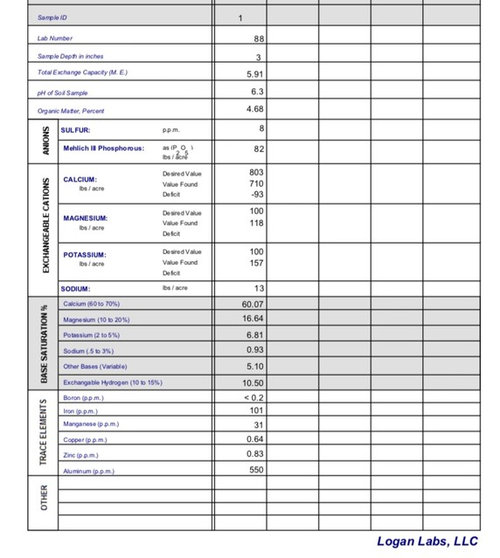
I sent a sample of my lawn soil into Logan Labs this spring as suggested by members of the forums. I took the sample first thing, before putting down any fertilizer or lime. I’d like help interpreting the results and advice on addressing any issues.

Here is a photo of the report:

Comments (9)

  • 8 years ago

    Thanks very much for your reply - very helpful! It is a northern lawn, sorry for not originally including that. I’ll follow these recommendations closely and im sure I’ll have success.

  • 8 years ago
    last modified: 8 years ago

    Are you having problems with the lawn?

    Would you classify your soil as sandy, clayey, or something else?

    And just where do you live? It's kind of important beyond just north/south.

  • 8 years ago

    Only having a couple problems with creeping weeds. I just want it to look the best it can and I want to make sure I’m applying the right amounts of fertilizer.

    I’d classify the soil as loamy, very dark and crumbly. I live in south central Pennsylvania.

  • 8 years ago

    Morpheus is in your back yard in eastern PA. He's the guy to listen to.

    Your description of your soil sounds good. The soil test is saying sandy soil that doesn't hold nutrients very well. I've seen the soil in Altoona, and it does not look like it would release nutrients. It looks very nice. Still I would use organic fertilizer as much as practical. My favorite is alfalfa pellets, but morpheuspa likes soybean meal and Milorganite. In PA you can get those at any feed store. In my area shipping for soybean meal makes it very expensive, so alfalfa pellets are good at $11 for 50 pounds this year.

    Creeping weeds? Let's get rid of those. Need a little more information. Creeping grassy weeds like crabgrass or creeping broadleaf weeds like creeping Charlie or violets? Do you have a fescue lawn or a mix with some Kentucky bluegrass? The best defense against these weeds is a dense turf. But if you already have it, it will spread and take advantage of every bit of sunlight. Furthermore some of these pests drop a lot of seed and will come back repeatedly unless you stop it EVERY time AS SOON AS you see it spring up. It can be frustrating if you don't keep after it, but once it is gone, it should stay gone with proper lawn care. We had a guy write in several years ago to tell us his neighbor's crabgrass lawn stopped dead up against his fescue lawn once he changed his mowing and watering, so it is possible to fight that stuff off.

    Jack thanked dchall_san_antonio
  • 8 years ago

    It’s mostly clover in the front yard and a few spots of onion grass. In the back, there’s some more clover along with some creeping Charlie and Indian strawberry along with a ton of onion grass at the very bottom of my back lawn. My front yard is pretty thick, here’s a picture to give you an idea:

    Yet clover finds a way to sneak in in spots. Mostly up toward the top (where you can’t see) it finds a spot of sunshine. I also have to go out and remove dandelions occasionally (I do this as soon as I see them). I don’t really have a crabgrass issue, I put down Halts every year. If I could eradicate the clover and the onion grass I’d be over the moon.

  • 8 years ago

    Also, I’ve heard people swear by Milorganite. I’ve been using Scott’s Turf Builder (a synthetic fertilizer) and results have been great. What’s the advantage of organic fertilizer like Milorganite?

  • 8 years ago

    What’s the advantage of organic fertilizer like Milorganite?

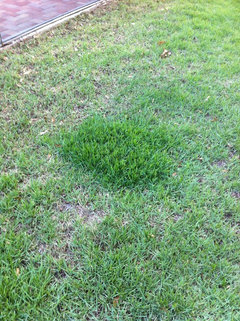
    Yikes! How many days do you have to read replies to that question? First I'd like to demonstrate that organic fertilizers produce results like chemical fertilizers. Here is a picture...

    That pic was posted here by mrmumbles in 2011 (thank you again for posting it). What he did was scatter a handful of alfalfa pellets into his zoysia lawn. He applied it in mid May and took the picture in mid June a month later. Clearly the turf is more dense, greener, and taller than the surrounding grass. So organic fertilizer works, but how?

    For the past multi billion years Mother Nature managed to grow stuff without the benefit of Monsanto, Bayer, and Scott's. Something must be going on. As it turns out nobody really knew what was going on until DNA testing became cheap enough to literally test dirt in the mid 90s. In the lab scientists were only able to grow maybe a dozen or so types of microbes from soil. What they found in DNA testing was roughly 100,000 different species of microbes including fungi, bacteria, protozoa, microarthropods, and other types of critters. People had seen improvements in soil and plants from compost, but they were not really certain of what caused the improvements. Suddenly with the DNA tests, everything they could see happening in soil could be explained by the enormous complexity of what has become known as the "soil food web." It is a food chain so complicated it has no beginning or end. Without being able to absolutely prove anything, this complicated underground biology could explain plant health, disease, and "self" protection. Further DNA investigation found at least 20 layers of microbes growing on the exteriors of plants in view of full sunlight. This environment had been considered to be too hostile to grow microbes, but apparently not. If you would like to read more about soil biology, search for the Soil Biology Primer, but Dr Elaine Ingham. It's about 50 pages long, so get comfortable.

    But what about organic fertilizer? Organic fertilizer is food. It is made from grains and animal byproducts and becomes food for the microbes when scattered on top of the soil. At the surface of the soil there live insects and microbes which specialize in decomposing stuff that falls on the ground. This would be dead plants and dead animals. Those surface species leave their own byproducts on or slightly under the surface for other microbes to come along and clean up. After going through 30,000 species or so, one of the microbial byproducts is natural plant food chemicals. If there are roots in the soil, the plants will absorb the plant food chemicals and improve their condition. Milorganite is made from "animal" (human) byproducts from Milwaukee. Some people have an 'ick' factor about that so they use other organic fertilizers. Other organic fertilizers include everything you see bagged commercially plus raw grains like corn meal, corn gluten meal, alfalfa meal/pellets, soybean meal, and any other ground up nut, bean, seed or grain you can find in a plain generic 50-pound bag at your feed store. Generally the application rate for grain type fertilizers is 15 to 20 pounds per 1,000 square feet. People have tried to overdose by applying double that rate or more on a weekly basis throughout an entire season, but there seems to be no limit as to the goodness you get. Well the practical limit is around 70 pounds per 1,000 square feet when you start to smother the grass under the mass of fertilizer. The drawback with grain type organics is that it takes 3 full weeks to see results. Don't expect to see anything overnight or even in 1 week. It really does take 3 weeks. By that time you're tired of expecting it and suddenly realize that it looks great.

    My personal experience with organic fertilizers started in 2002. I won't bore you with more detail about that, but I've used nothing else since. I had problems with my soil "crashing" from too much chemical fertilizer. Based on that and others with similar experience, I have come to recommend to pure Scott's users to either add to or replace an application of chemical fertilizer with one of organics. Do that once a year and your soil should never crash. My explanation of crashing is that the microbes become unbalanced from undernourishment over years (decades) of nothing but chemicals. The rebound on my lawn was very dramatic from the git go. Your lawn looks great already. Still I would give it one shot of organics per year. The organics and chemical fertilizers work so differently that there is no interaction. You can apply both at full bag strength on the same day.

    Is that more than you were hoping for?

    Jack thanked dchall_san_antonio
  • 8 years ago

    Thanks for that detailed explanation! I think you’ve convinced me. I’m hesitant to use Milorganite but I’ll defintiely use one of those others you mentioned. My lawn looks great now but I definitely don’t want my soil to crash out.

Sponsored
Wannemacher Interiors
Average rating: 5 out of 5 stars26 Reviews
Customized Award-Winning Interior Design Solutions in Franklin Cnty OH