Software
Houzz Logo Print
kingzt05

Sandy Soil

8 years ago

I have real sandy soil here in Michigan. I'm in zone 6 if that makes a difference. I am looking for ways to improve it. I fertilize with organic amendments every month to add organic matter. Is there any other ways to improve this. My goal is to help improve water retention if there is any secrets other than adding organic matter please let me know, thanks.

Comments (10)

  • 8 years ago

    I think you posted in another thread that I replied to. I lost track of that one. Mulch mow every time you mow. In the fall, collect all the leaves you can find and mulch mow them in. As long as your grass blades poke through all the leaves, they're fine. The more you do this the more leaves your lawn can handle. The only caveat is that if you have to steal leaf bags from neighbors, be selective. You don't want to import weeds from other lawns. I've managed to dump branches and even small chunks of concrete on my lawn by not being picky enough about which leaf bags I use. I tell my neighbors just to blow their leaves onto my lawn.

    I know lawniac or someone said trying to increase OM like this is a waste of time. I dunno, but things do work down into the soil over time. There's more to it than just OM. For instance, those leaves don't add a lot of nutrition but they break down into what is believed to be humus, which is a very stable organic material like peat moss. It works its way down into the soil and improves soil structure. Look up "peds." Also, leaves are made by trees whose roots are deep in the ground. The leaves contain minerals from the ground that you are now going to return to the surface of the soil to eventually work their way back down. It's like a recycling program.

    Also, worms and other critters will help the organics work their way down. IMO, I'd say put down as much as you can corn meal, soybean meal, alfalfa pellets, Equine Pine or similar wood pellets and the like, if you can get them at cheap prices. Encourage worms to live in your lawn. I saw one come out of a hole, grab a piece of mulched leaf, and yank himself back into the ground. He was fighting with the leaf because it didn't fit in the whole. Freakiest thing I ever saw in my yard, lol.

    z t thanked danielj_2009
  • 8 years ago

    The break down of organic products causes more humic acid in the soil, which helps hold nutrients in sandy soils. There are also humic acid products you can buy to speed up the process. Google it !

    z t thanked Tom
  • 8 years ago

    Thanks @danielj_2009(6b), I might of posted it somewhere else too, just taking advantage of these forums. Kind of obsessed too hahaha

  • 8 years ago

    @zt no problem! The only reason I mentioned your other post is that you asked me about mulch mowing and I never answered you over there.

    z t thanked danielj_2009
  • 8 years ago

    The best way to get organic matter down into the soil is to grow grass. Grass sloughs off about 1/3 of the root system every year. Those abandoned roots become the measurable organic matter everyone seems to be concerned about, but they are only temporary. When roots are alive and attached to the plant, they interact with the soil microbes (the unmeasurable organic matter). Once they are released from the plant, then they become food/fertilizer for the microbes. If you have been mowing high and watering deep and infrequently, then those roots are fairly deep in the soil.

    Also there is sometimes some discussion about mychorrizal fungi in the soil. These critters attach to the roots and become an extended source of both food and water for the plants they attach to. Then can become much, MUCH more effective than the roots themselves at gathering nutrients. For people with normal soils those fungi are already in the soil. That is not always true in sandy soils. I have tried them in my yards with normal soils and see no improvement at all. However, I have seen pictures of golf courses out in the desert southwest where the results are amazing. They don't cost that much and if you can get them as an additive to other products, that's fine. Those fungi will remain with the plants as long as they are not physically disconnected from the roots (plow or rototiller) or killed off (fungicide). I did not mean that last part to sound alarming, but it might be. Not all fungicides are the same, but I don't know of any research on which fungicides do not kill the michorrizal fungi. Personally I will do anything I can to avoid using a chemical fungicide, but y'all in the north seem to have diseases which go beyond the subtle cornmeal approach. Deep and infrequent watering helps prevent disease, but sometimes Mother Nature has other plans. I guess She thought there was not enough fungal disease in Pennsylvania this year ;-)


    z t thanked dchall_san_antonio
  • 8 years ago

    Thanks for the in depth post. Disease is bad right now by me in Michigan. It was 90 degrees for about 7 days straight then dropped to 70's over the weekend and more rain. So between fighting disease prior to the heat wave you have to water to prevent dormancy and back to fighting diseases.

    Next year I will use preventatives before disease sets in. I am curious about applying high brix growing methods to turf. Remineralization of the soil with high amounts of calcium and plenty of nutrients for the microbes.

  • 8 years ago

    @dchall_san_antonio I've applied nothing but organic ferts since I moved here in fall 2014. I alternate every month to diversify what goes in to my soil. I do spot spray and the only time I broadcasted a herbicide was when I moved in due to bad creeping charlie issue. I do believe in building the soil and not feeding the plants directly but when used appropriately these chemicals can help. I never used a fungicide up until this point and I think the diseases are bad for cool season grasses. My goal is to get as much organic matter into my soil and also remineralize it. My cheapest solution I can find so far is Azomite which I am skeptical with the higher amounts of aluminum. This week while it's still cool I am going to foliar feed some iron the right way also with some bio stimulants. I just laid down some Love your Lawn by Jonathan Green which is molasses to feed the microbes with calcium and humic acids.

  • 8 years ago

    That's good info. If you do have a disease it seems the lawn would be quick to recover after the issue is resolved.

  • 8 years ago

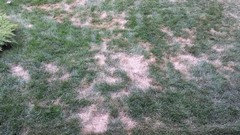
    @dchall: Hi Dennis! So I've been at this for about 5 years now and I've been doing the organic thing as much as possible on my NJ cool season KBG. It just makes biological sense to feed the soil and let the ecosystem take care of the lawn. However, when conditions are ripe for fungus, what to do? I read online that sometimes KBG becomes susceptible to some fungi after about three years, particularly when planted as sod, for some reason. Sure enough during season 3 I started seeing problems. I ignored them the first year figuring my lawn would fight back and be OK, but the following year (last year) here's what I got in the same areas:

    I had to replace some of the sod last fall, which seems to have taken nicely so far. So what do you do when you are under attack? Other than rip out the lawn and replace it with something hardier, all I can do is put up my strongest defense. There are no soil problems to speak of and watering is as recommended. Corn meal and other treatments don't work for my particular problem (or else I wouldn't have the problem). So I need to go nuclear and try the strongest anti fungal treatment I can find. Will it work? I hope so but who knows? I also see this as an opportunity to learn. If the lawn were perfect 100% of the time I'd never learn much.

    God forbid, I might even aerate half the lawn just to see what happens!! lol

Sponsored
Hope Restoration & General Contracting
Average rating: 4.7 out of 5 stars35 Reviews
Columbus Design-Build, Kitchen & Bath Remodeling, Historic Renovations