Software
Houzz Logo Print
dallashayden

Tree ID Help- Pinnately Compound Leaves

8 years ago
last modified: 8 years ago
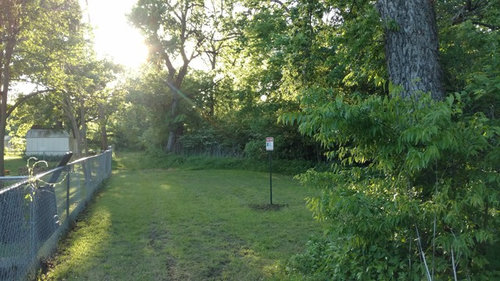
I am seeking help to identify 2 trees on my property in N Texas. I've gone through the standard online ID configurators and have even asked the neighbors without luck! Any assistance would be incredible.

Tree #1: Online ID configurators keep suggesting this is either a Black Walnut or Tree of Heaven. The problem is that the leaves are not serrated and do not appear to have the characteristic Tree of Heaven "thumbs". I have not found any walnuts or obvious samaras nearby. The bark of these (apparently) 100+ year old trees is heavily furrowed, gray in color, and unique. It doesn't look like online pictures of Tree of Heaven bark, however I'm not sure there are many great example pictures of a specimen this age. These appear to have been planted in a row near the edge of my property at around 1915. Mature specimens appear to range in height from about 45 to 90 feet. I am including a couple pictures- 2 showing the bark and 1 showing what I believe is a young volunteer growing next to the tree.

Houzz compressed my pictures severely and removed much detail. Please see 2 high-res copies on Imgur: https://imgur.com/a/IdVfOQx

Picture 1: Please see the mature tree on the right and adjacent "volunteer".


Picture 2: Bark at far right. Sorry, the tree wasn't my major focus here.


Picture 3: Close up picture of a "volunteer". I believe this is the same species.


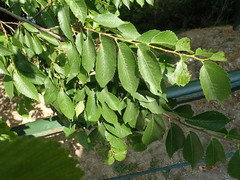
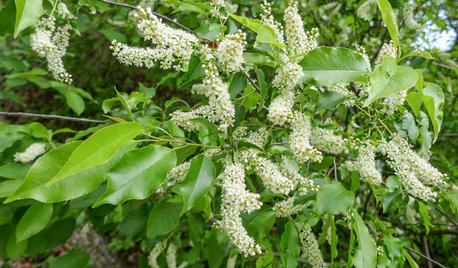
Tree #2: Online configurators indicate this tree is a member of the hickory family. Serrated, larger leaves that are fewer in number. See included picture.


As a bonus, I will see if I can find a picture of my large Catalpa tree. As I deal with the rampant poison ivy and Japanese Honeysuckle deluge, I might uncover some more interesting specimens (or noxious invasives). Let me know if more pictures would help. Thank you!

Comments (18)

  • 8 years ago

    Try the Tree form or Name That Plant forum.

    tech biker thanked laceyvail 6A, WV
  • 8 years ago
    last modified: 8 years ago

    Probably an elm (its leaves are not compound). And with rough bark and suckers probably English elm.

    For best results with plant identification questions show entire plant habit in addition to close views of all significant parts present. With elms in particular, which often ripen their wafer-like fruits in spring good close views of these can be important.

    tech biker thanked Embothrium
  • 8 years ago
    last modified: 8 years ago
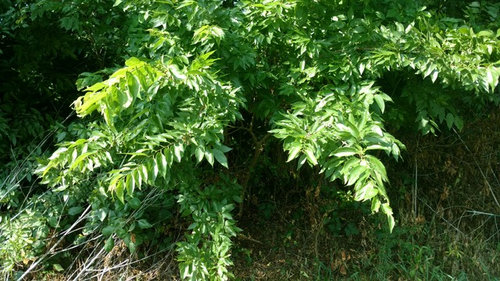
    Thank you for your help lacey. If I can find some more pictures, I will repost on the Name That Plant forum. Looks like Houzz has locked the original post. Worst case, I will be back out within a week and will take more.

    Embothrium, I apologize for the lack of pictures. I was taking some when my neighbor struck up a 45 minute conversation- great to speak but I lost my train of thought afterwards.

    -Did my Imgur picture link work? The pictures there are much higher resolution.

    -Unfortunately I am not sure tree #1 is an elm (unless you know of an elm with nonserrated leaves). I also did not see any samaras this spring on these trees. I have some American Elms a few miles away and was watching when they put on their spring show. If it helps at all, the mystery tree appears to have been planted fairly frequently in some parts of town about 100 years ago. While they aren't present in the newer neighborhoods, they still line a few of the streets paved back in ~1900. Apparently a fairly hardy tree!

  • 8 years ago

    The bark looks very similar to Sugarberry bark, however the leaves are not serrated. Odd!

  • 8 years ago

    Sugarberry seems to not always have serrated leaves. Do a google search and you will see.

    tech biker thanked Huggorm
  • 8 years ago

    Thanks a bunch, it looks like these are possibly Texas Sugarberries. https://courses.missouristate.edu/pbtrewatha/texas_sugarberry.htm

  • 8 years ago

    Sugarberry for #1 and the leaf descriptions I've seen say that leaf serration is not always present. Bark is unmistakingly Celtis. Virginia Tech Dendrology

    tech biker thanked Smivies (Ontario - 5b)
  • 8 years ago

    Actually the twigs are wrong for English elm too, which usually produces winged or ridged ones.

  • 8 years ago

    Embothrium, I guess you learn something new each day! I just read that Sugarberries are in the same family as cannabis... O.o I guess I have something to brag about to my friends in Colorado now! lol

  • 8 years ago

    The cannabis connection is actually pretty recently discovered, before that sugarberry and other celtis was believed to be related to the elms. But I guess the hops used in beer are closer related to cannabis than hackberry/sugarberry are.

    tech biker thanked Huggorm
  • 8 years ago
    last modified: 8 years ago

    #1 = Sugarberry (Celtis laevigata?)

    Note that it may have totally unserrated leaves...

    And as mentioned, it was previously thought to be in the Elm (Ulmaceae) family...but after recent DNA testing, may actually be in Cannabaceae (Cannabis).

    #2 = American Elm (Ulmus americana)

    tech biker thanked blakrab Centex
  • 8 years ago
    last modified: 8 years ago

    blakrab, interesting! I did not think #2 was another American Elm. Apparently I have a few (and none that I can see are showing signs of DED). In fact, American Elms seems to grow prolifically here.

  • 8 years ago

    ^ There are many American Elms in Texas. DED doesn't seem to have struck here much (yet?)...

  • 8 years ago

    Come of think of it blak, I recently cut down a couple very dead trees (please see pictures at the following Imgur link). Looking at my pictures of the bark and their form again, I wonder if these were elms? If so, do you think these succumbed to DED?

    I'm also including a picture of one of my other properties. You can see the ~40' American Elm at the edge of the forest. Very graceful trees.

    https://imgur.com/a/vl9rrpu

  • 8 years ago
    last modified: 8 years ago

    ^ Dunno, I have no personal experience with DED? As I think it hasn't become "epidemic" in TX yet:

    "Very little research has been conducted regarding Dutch elm disease in Texas and little is known about how the disease will progress through the state. Early observations indicate that the disease is not slowing down, and is causing damage on both public and private land."

    "Dutch elm disease, a fungus related to oak wilt, which destroyed as many as 40 million elms. The fungus, which came to the United States from Europe arrived here in 1930 and was confirmed in Texas in 1970."

    BTW, I wonder if #2 could also possibly be a Slippery Elm (Ulmus rubra)? The 2 are very similar, except the Slipper Elm's leaves are almost the same as American Elm, but are much scratchier due to high silica content in the leaf.

    tech biker thanked blakrab Centex
  • 8 years ago
    last modified: 8 years ago

    ^ Isn't it odd that DED seems to have slowed down/stopped when it hit Texas? If the disease hasn't slowed, why aren't all my elms dead? Some of them are easily 40 years old (visible on aerial photos). I read that the disease ravaged the rest of the country within ~50 years of introduction. Yet, it has taken almost 50 years to see any significant outbreaks past the state line? Perhaps there is a naturally resistant local variant of the elm here? Maybe the hot summers are an unfavorable environment for the beetles?

    The next time I am out at the property, I will examine the leaves of that tree more closely to see if they are scratchier.

    Thanks again!

  • 8 years ago
    last modified: 8 years ago

    ^ Yea, I wonder if DED may not be as much of a threat here due to the hotter climate, or something?

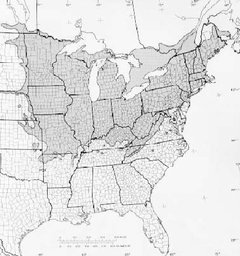
    According to this map, it looks like it's been most prevalent north of the Mason & Dixon Line?

    Or who knows? I just know that I've seen a lottt of healthy Elm trees out in the wild around here...

    For example, I just took this picture today of an American Elm (leaves weren't scratchy). Of which, I'm guessing yours is likely also an American Elm then, too...

    tech biker thanked blakrab Centex