Software
Houzz Logo Print
tom123_gw

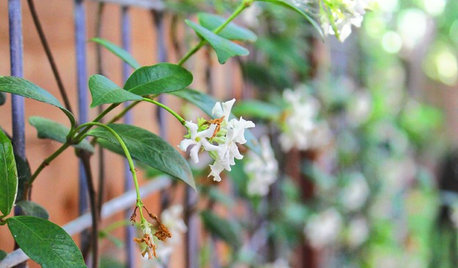
White Cestrum or Day Blooming Jasmine

8 years ago
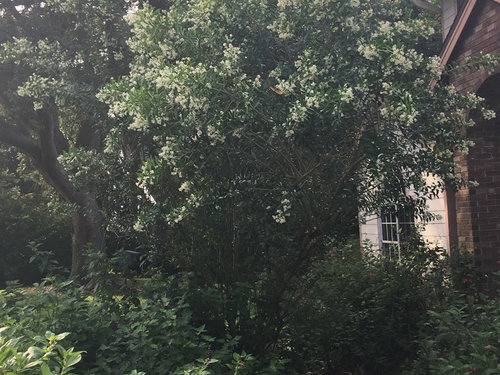
Hopefully this will load.


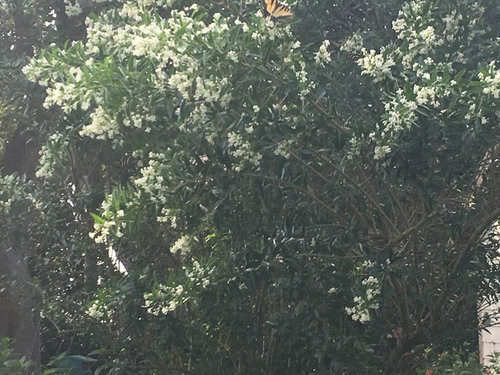
This tree is about twenty feet high and perhaps fifteen feet wide. The picture below is a little more close up and there is a tiger enjoying the blooms.


According to Almost Eden it is hardy to 8b. It lost some limbs from the freezes last year, but it has come back well. It is also called a Day Blooming Jasmine. It is extremely fragrant and it is a pollinator magnet when it is in bloom---which it does on and off as long as there isn't a freeze.


My hummingbirds fight over it. I have a male now and he has claimed it as personal property. I am very excited to have a male at this time of year. Normally they are gone by now, although at times I will see them in the fall and winter months.


Yesterday, I saw five different types of butterflies on it at the same time. The tigers really seem to love it, although it is a huge favorite with the Zebra Longwings also. This morning early I counted ten Zebras visiting the tree. This is only the second time I've had a major bloom this year. I think the freezes set it back. I should get two or three more bloom cycles this year. Each bloom lasts for about about two or three weeks, with the first week having the most blossoms.

Comments (12)

  • 8 years ago

    This is a great looking tree. Fragrant and attractive to pollinators? I am jealous!

  • 8 years ago

    That is gorgeous!

  • 8 years ago

    I love it

  • 8 years ago

    It's gorgeous, but cestrum diurnum is, alas, listed as a category II invasive, FWIW.

    https://plants.ifas.ufl.edu/plant-directory/cestrum-diurnum/

  • 8 years ago

    Yes. I have noticed that. Category 2 isn't as serious as category 1, but it still is a concern. One has to use good judgement on plants like this. I live in a suburb of Orlando and it has a limited possibility of "escaping." I've had this for perhaps five years or so and no other plant has come up on my property.

    Thanks for the link.

  • 8 years ago

    Yes, I wasn't thinking of you so much as all the folks who are so taken with what a spectacular plant it is. We have a few feral ones around here. The first time I saw one, I thought, "Wow, how come nobody uses this amazing native plant in landscaping?"

  • 8 years ago
    last modified: 8 years ago

    From the page linked to above:

    Seeds dispersed by birds
    (Morton 1982). Fruits poisonous to humans and other mammals, affecting the nervous
    system (Kingsbury 1964, Krook et al. 1975, Morton 1982).

    which means that if your plant is fruiting

    1) Birds could be planting it all over the place, including sites miles from your lot

    and

    2) You have a plant whose fruits are a human health hazard right off of and over what appears to be your front walk

    Florida has just about the worst problem with invasive alien plants and animals escaping from captivity and cultivation in the Lower 48. Central Florida has plenty of native plants with decorative features you could grow instead (I've been to the Orlando area and seen some of them myself). And as during my trips to Hawaii I found the native plants more interesting than the exotic ones - when a body travels to various places there is a tendency for the same garden favorites to be seen repeatedly within shared climate zones. Whereas local floras vary regionally, may often include intriguing plants that have little or no presence in large scale commercial horticulture.

  • 8 years ago

    Tom,

    It's absolutely gorgeous! I remember seeing hummers darting in and out of it. I haven't seen a tiger swallowtail in a long time so I am very jealous :)

    Tom thanked Rhonda
  • 8 years ago

    Tom, that is a great specimen, never seen one so large. We grow it and other Cestrum here at Leu Gardens. Our C. diurnum never gets berries and have never seen seedlings. But the common C. nocturnum, Night Blooming Jessamine comes up as strays a lot. Most of the Cestrum are also very nematode susceptible on our poor sandy soils. Ours grow great for 7-10 years then decline. That is awesome you have gotten yours to thrive.

  • 8 years ago

    Hi, Eric. I am a member of Leu Gardens. I always take visitors there to see the wonderful plants. I have been going to the spring plant sale for over ten years now. It's terrific.

    Interesting what you say about nematodes and cestrums. Mine is probably around seven years old now and I bought it at one of the plant sales at Leu Gardens. I remember the vendor telling me that it was excellent for hummingbirds. I asked him about the other cestrums he was selling and he said they weren't visited nearly as much as this one.

    Is there a list somewhere for plants that are very susceptible to nematodes? I know that most roses and gardenias need to be on grafted rootstocks and I have had terrible experiences with buddleias. Most lantanas don't seem to do well for me. I'm not sure why. Would it be nematodes?

  • 8 years ago
    last modified: 8 years ago

    Gardenia jasminoides is very susceptible to nematodes but Gardenia thunbergia is resistant, thats what G. jasminoides is grafted on to. Many of the Lantana camara cultivars/hybrids seem susceptible after a few years. But the old wild form of L. camara doesn't seem bothered by them. Some other plants I know that are very susceptible; most Chamaedorea palms, bananas, heliconia, many gingers( especially Hedychium), Tibouchina, Buddleja, and Hibiscus.

    I am going to plant a Cestrum diurnum in my yard now for the hummingbirds!