Software
Houzz Logo Print
whineconnoiseur

Please speculate on this vent situation (pic attached)

7 years ago
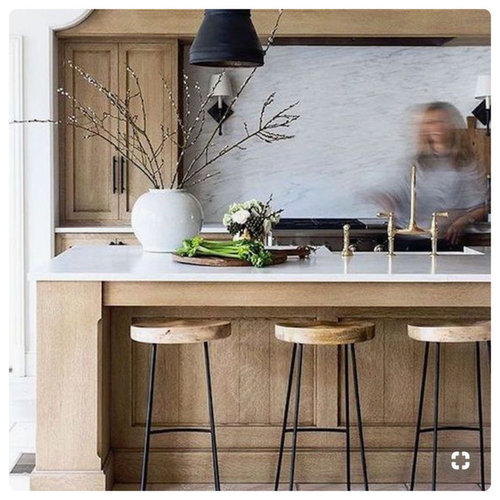
I found this inspo picture-- but my cabinet guy laughed and said the hood is too high and worthless. The interior designer said, it's an in ceiling vent and it works just fine most of the time (not if you are trying to fry fish) . Thoughts please?

I love the look of the streamlined tall space here and would like to recreate something similar. My induction cooktop will be in a range alcove/ niche with 30" on either side of the cooktop. (Not my primary prep area)

kitchen inspiration · More Info


Comments (24)

  • 7 years ago
    last modified: 7 years ago

    I've seen that for island cooktops, but why would you do that for a range against a wall?

  • 7 years ago

    For the look/ open feeling

  • 7 years ago
    Love the look...you would just be breaking the rules on recommended distance from cooking surface. I think my hood is way overkill for the way I cook.
    Marci thanked hemina
  • 7 years ago
    last modified: 7 years ago

    I would not want to spend the amount of money that arrangement will need, all to have it be ineffective because it is too high. The comment from your "designer" about fish is funny - isn't that when you want the most for the exhaust to work? That's like saying, "sorry, your A/C will only work if the outside temps stay below 80 degrees." Sure, that's great!


    Your designer does not sound like she understands how kitchens work, or that she thinks things through, sorry. I'd be interested to see the kitchen's layout - I have a feeling there are other problems.


    If you are willing to spend that amount of money for that arrangement, then you have the money to spend for a proper hood. The bottom of the hood should be 30-36" from the cooktop.

  • 7 years ago

    I understand what you are saying Shannon, but the designer's point was that you would fry fish outside, not in the house anyway. For most of the time, it would be fine. Maybe it is a trade-off of "the look" for not being able to vent really smelly stuff. I was hoping that there was a vent solution that didn't require it to be so low.

    I just posted my kitchen layout (which she really hasn't had her hand in yet)-- I'd welcome your opinion.

  • 7 years ago

    If you aren't venting the really smelly stuff, you also aren't properly venting the less smelly stuff; you just won't notice it as much.

    The hood has a wider (much wider) capture area than your typical hood (or at least it could--that one looks flat on the bottom beyond the range itself, which certainly limits its ability to funnel fumes). A wider capture area seems like it should partly offset the higher position. But you can't make that argument on depth.


  • 7 years ago

    Do you happen to have the original source of the photo handy? Those cabinets are gorgeous!

  • 7 years ago

    Take it from me. That’s way too high. My vent hood hasn’t been installed yet but I have two vents in the ceiling right above the stove. Despite running the fan and the sanitizing system for the smell, every time I cook I have smoke, grease and smell everywhere including my bedroom closet which has a door. Our doors and windows are open for cross ventilation as well.

    Keep in mind, I have a separate system for the kitchen with separate ducting.

    The only time you won’t have grease spread throughout your kitchen is melting chocolate or boiling water. From personal experience, even soup smells. If you go for looks, you’ll need to change your cooking style.

  • 7 years ago

    I think if you get a really oversized and overpowered hood insert, you can get away with it most of the time. Remember you'll need make-up air.

  • 7 years ago

    Commercial hood bottom edges are typically 7 ft from the floor, and the baffles are at 8 ft. or higher. But these hoods pull at least 85 CFM/sq. foot of entrance aperture area actual air flow. And their aperture area overlaps the cooking surface by a significant amount, or they use side skirts to restrain the expanding cooking plumes. A duct register is not suitable unless followed by a filter, because the requirement is for the hood assembly to have a means of collecting grease before it collects onto the ducting. Also, the baffles or mesh filters act as a fire stop, so one of these filter types, or the apparently approved Vent-a-Hood systems, must be used.

  • 7 years ago

    House's website shows a lot of beautiful kitchens, most with what look like effective (and obvious) ventilation hoods, and a few "what were they thinking?" examples. The article noted above may be in the paywalled section. In any case, with enough staff any deficiency can be overcome.

  • 7 years ago

    Sammy-- the original design was Dana Wolter Interiors. I think I found the pic on instagram.

  • 7 years ago

    goluscombe-- I searched and searched and didn't find the article. If you run across it again, please post the link


  • 7 years ago
    Why not use a pop up downdraft behind the induction top? You will need a deeper cabinet. Induction tops do not need to be vented as much as gas tops, and the newer pop up ventilation units rise much higher than the older ones did. We have one behind our 36-inch induction top and it works just fine for odors, grease, smoke.
  • 7 years ago

    There are island hoods and ceiling mounts meant to be mounted this high and this one has the added benefit of an enclosed capture area that an island does not have. With a wide enough capture area and high enough CFM I don't see how this could be completely ineffective.

    The thing that this cabinetry does not have that I would add is stainless on the underside of the entire thing, because the undersides will pick up some of the sticky particulate that gets drawn into the fan.

    We roast a lot of stuff in the oven including brussels sprouts and we run the exhaust for that even though the oven is not strictly in the capture zone, and it removes a great deal of the smell despite that.

    I am all for adequate ventilation and I don't care much for cooking smells (I run the fan and spray Lysol after I feed the cat her wet food), but really soon people are going to start saying nothing short of a high velocity vacuum hose fitted over the top of the cooking vessel will suffice.

  • 7 years ago

    Here is the article I was thinking about [Minimizing range hood[(https://www.houzz.com/magazine/disappearing-range-hoods-a-new-trend-stsetivw-vs~89270400)

    My bad.

    I am doing a downdraft venting system in my kitchen re-do.

  • PRO
    7 years ago

    I'm doing this. It has to be a minimum of 24" from the countertop, per specs of both my vent and cooktop. I'm using the Faber Cristal Slide-Out Hood. This was my inspiration:


    Greenwich Street · More Info

  • 7 years ago
    last modified: 7 years ago

    The Minimizing Range Hood article repeats an error I have been preaching against for years here because it leads to misunderstanding of hood requirements. The article states, in part, in the portion titled In the ceiling.

    "Another option for above an island is to select a range hood or exhaust system that can be built in flush with the ceiling. These hoods are generally more expensive, as they need to be extremely powerful to suck up greasy air and odors from such a distance."

    Hoods that anyone could stand in a kitchen environment do not suck up the cooking plumes beyond a fraction of the hood's shortest base dimension. They utilize the cooking plume's upward velocity to get the effluent to them where they can collect it. Then they use their blower strength to get the effluent past the filter and expel it from the house. Otherwise the plume would mostly reflect off of the filter and flow back into the kitchen. This is why the size of the hood entry aperture is important. In a ceiling application, "extremely powerful" is still correct, but it is due to the large area where the air velocity has to be high enough to get the effluent past the filter area. The large area results from the expansion of the cooking plumes as they rise. What the ceiling application touts do not make note of is the effectiveness in the presence of inevitable cross drafts, and inconvenience of filter cleaning, particularly when the cooktop is Ceran, and the counters are stone, and concentrations of human weight put them at risk.

  • 7 years ago

    Beautiful inspo renov8or! Thanks for the lead on the hood type. I'm off to investigate!


  • 7 years ago

    I guarantee it will work better than the island ranges with pop up ventilation.

  • PRO
    7 years ago
    last modified: 7 years ago

    @Marci, Miele and Bosch make them too. They're called slide-out or pull-out hoods. I chose the Faber because you can customize the strip that shows to be the finish you want or to match your cabinets.

    If you happen to be using 15" deep wall cabinets, as I am, there's a metal strip that you can order to cover the exposed section of cabinet. It's called a cabinet spacer kit:

    https://www.geapplianceparts.com/store/parts/spec/JXS56SS

    Marci thanked Renov8or
  • 7 years ago
    I have a Miele slide out hood. I specifically chose it for the streamlined and minimal look in my modern kitchen. I think it's about 600 CFM. I think it works really poorly and I have my second service visit scheduled for This Friday. The vent is supposed to automatically turn on when you slide out the hood, but the internal button is stuck in the off position. No way to clean it without dismantling the thing. Super annoying.
  • PRO
    7 years ago

    Val B - that is good to know. Thanks for the info, and good luck with your repair.