

Add insulation? Worth it?
Add insulation? Worth it?
Thinking of adding insullation in attic. It’s currently about R30, lower in some places, especially around eves. Daughter’s bedroom has vaulted ceilings and some batts of insulation above it but little blown in above it (probably around R25). That is the only room that is usually a bit cooler/warmer than rest of house. My HVAC system is not zoned but I keep the stat at 70 and the whole house stays at that, except daughter’s room. Rest of house is comfortable due to duct balancing. I looked in to adding another supply in daughters cool room when my contractor put in our new furnace and it is not possible without major renovations. I have a new 2-stage trane SV92 and XR16. Energy bills are not bad. Just looking to get daughters room more comfortable and insulation contractors say that I could definitely benefit from adding more insullation.
I live in Chicagoland area and so it gets cold/hot.
Do you thinking adding blown in cellulose to bring attic to R49 would be worth it by saving on energy bills? (Cost would be $1200 to add to entire attic, obviously less if I DIY).
Would upstairs get too warm in winter?
Would adding this insulation help save in cooling season?
Any thoughts on blow in fiberglass v cellulose? I have read on pros/cons but curious as to your thoughts.
Would be interested in what you all have to say about this.
Thanks.
Comments (28)
 7 years ago
Because of the vaulted structure it seems more batt draped over the ceiling area would remain in place and be easy to install. You can add until the room temp matches the rest of the house.
- 7 years ago
In my milder climate, going from R30 to R49 was estimated to be about $40 a year on our 2200 sqft upper floor. For new construction, the extra was $250 and so I did it. I would expect Chicago to be 50% higher based on climate and some inflation.
If batts were easier/cheaper - I think that makes some sense. Batts are way easier to do DIY. That might be why insulation contractors mention blowing. Batts make sense only over other batts of course.
Generally, air sealing is a cheaper and more effective route than additional insulation. Maybe not here but something to look at.
When drywall installers cut out holes for lights/fans/vents etc, there is no attention to detail. As long as visually it looks good, they are gone. With many lights, there isn't much air getting by it. But check out a bath fan. Check out behind fluorescent lights. The easy way is caulk from below, the harder way is from above - remove insulation and then caulk/foam/tape.
Do you have duct work in the attic? How many windows in daughter's room? Good windows? Insulated blinds are pretty inexpensive.
Related Professionals
Galveston General Contractors · Waycross Home Remodeling · Coldwater Home Remodeling · Leominster Bathroom Remodelers · Burlington Bathroom Remodelers · Sacramento Bathroom Remodelers · Morgan City Architects & Building Designers · Memphis Architects & Building Designers · Gainesville Home Builders · Hagerstown Home Builders · Jacksonville Home Builders · Norfolk Home Builders · Salisbury Carpenters · Wausau Carpenters · Salinas Carpenters- 7 years ago
Getting back to your original question whether it is worth it or not. If the insulation makes you more comfortable then you have to decide whether spending $1200 is worth it or not.
If you are asking whether you will see a return on investment, then you will have to calculate your annual heating and cooling costs. The energy savings is probably in the 5%-10% range. There are just too many factors to accurately predict the savings for your house.
As for you other questions, I highly doubt the upstairs would get too warm. The extra insulation would actually save more on cooling costs than heating costs. My preference is fiberglass batts. However adding blown in cellulose may work better in your attic if there are places where it would be difficult to install a batt.
 7 years agolast modified: 7 years ago
You can use this calculator to get a sense of the savings possible. As noted above, you can also reduce energy bills by air-sealing.
But if saving, say $30-$50+ a month, is no big deal to you, why bother.
dva79
Original Author7 years agoThanks. There is not much to air seal as I have no can lights or fixtures in her room and the ones that are on other rooms and the fixtures were sealed when we installed them.
I have no air ducts in the attic (thanfully).
I would love love to be able to seal all the top plates but that would require moving a lot of insulation and I just don’t think it’s worth it. Hoping 7-8 in of cellulose will help with any air leaks. I not it doesn’t stop them but supposedly better than fiberglass.
It’s a pretty tight space above the cathedral ceiling but I have room for some extra blown in.
Here is a pic: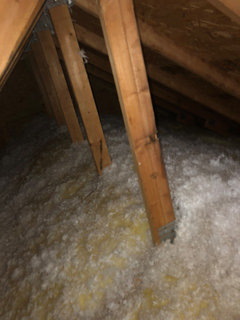
- 7 years ago
DVA79 " seal all the top plates but that would require moving a lot of insulation "
You could use those foam in a can and apply it from the ceiling below- thats what i did....
- 7 years ago
How do you do this without opening up the walls around the perimeter of every top plate?
 7 years ago
Go for it. Good Insulation always pays back especially in colder climates. I could not believe what 24" of R49 blown insulation in the ceiling could do for our new home which is a very large home. The only ceiling space we used batts were in the front garage ceiling since it has the media room above. Both center and rear garages' 16' ceilings also have over 24" of blown insulation with R38 in crawl space ceiling. No doubt we have two Trane 2-stage SV92's, and heated tiled floors, however it's primarily the insulation that keeps the heat in ; the home seems to heat almost instantly and although we've only been month since we moved in, our first gas bill was surprisingly low.
- 7 years agolast modified: 7 years ago
mike_home What i'm referring to is to remove light\outlet covers' holes etc and with the foam can squirt foam into the small holes and gap between the box and the drywall.
Although in canister lights, be carefull because if it is pretty hot, some use the hole and draft for cooling. Sealing may lead to some smoke....
i did the same to all perimeter switches sockets etc to stop any draft. It seems to help in that the switch boxes don’t feel as cold as before.
- 7 years ago
The first inch of insulation saves the most and every additional inch saves less and less energy. When you already have a significant amoun of insulation, like R-30, you're saving over 95% of what can be saved. Bringing it up to R-49 will only allow you to save a couple more percent. I'm al for being energy efficient, but don't have unrealistic expectations of what more you can accomplish.
- 7 years ago
upup_and_away, I was referring to top wall plate. Adding insulation behind electrical outlet plates on exterior walls is a good practice. I usually stuff some fiberglass batt insulation in the gap.
Here is how Air sealing top plates in attics is done. If you find insulation in the attic that is dirty compared to the rest of the insulation, then that is a good indication of air infiltration.
 PRO7 years ago
Glad to see importance of air-sealing in an insulation thread. Nice top plate link Mike, might reference that in the future myself. Air sealing often has a more measurable and meaningful impact than insulation.
It's common for spray foam sales people to use the "diminishing effects" of insulation argument but never seen it taken as far as Kudzu. R-value is a measurement that does not include any sort of diminishing value. R-60 performs 2X better than R-30.
R-30 is an inadequate amount of roof insulation for all North American building climates. Certainly there is an argument for diminishing amount of energy dollars saved for insulation dollars spent but with dirt cheap cellulose, it's probably going to be north of R-60 for most lengths of homeownership. People advocating for less than code minimum makes me happy for government oversight. Now only if we can start enforcing blower door test minimums..- 7 years ago
air sealing always comes before insulation.
and kudzu is right.
I too would like to see enforcement of blower door
testing minimums. and an independent verification of findings.
below is link to the most comprehensive air sealing document I've comeacross. easily understandable to everyone, especially with diagrams
of where to seal.
https://www.dca.ga.gov/sites/default/files/appendix_a_2008ga_energycode.pdf
best of luck - PRO7 years ago
Well naturally we agree on the air sealing stuff. But R49 saving only a couple % over R30 is not correct. R49 performs ~40% better than R30. If someone is building new or adding to existing insulation, R-value prescriptive minimums should be the minimum target.
- 7 years agolast modified: 7 years ago
Springtime Builders-
Your statement about R-49 saving much more than R-30 is simply wrong....it's based on a common, but incorrect, understanding of the thermodynamics. It's true that R-49 will prevent more heat loss than R-30, but there is so little left to save at the point where you have already gotten to R-30 that it doesn't mean much from a practical sense. If R-30 stops over 95% of the heat loss -- which I will prove later -- then saving 40% of the remaining available 5% that could be saved would give you less than another 2% savings. You can't save more than 100%!
Many people think, for example, that doubling their insulation will save double the energy, but, when you have already saved 95%, doubling the insulation obviously is a marginal thing. I'm not saying its unwise to put in a decent amount of insulation; I'm just saying that people shouldn't expect amazing results in energy savings when they already have quite a bit of insulation in place.Here is a graph showing the diminishing effects of increased insulation:
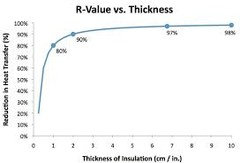
You can see from this graph that the first bit of insulation saves a dramatic amount of heat, and then the savings curve starts to flatten out quickly as more inches are added.
For those who want to understand the thermodynamics, here is as simple an explanation as I can make:The amount of heat transmission through a surface like a ceiling or wall is directly proportional to the U-value, which is simply the reciprocal of the R-value. The lower the U-value, the less heat is lost:
- 1/2" of sheetrock (an uninsulated attic) has an R-value of about 0.5, so its U-value is 1/0.5 = 2
- 8" of fiberglass insulation has an R-value of about 30, so its U-value is 1/30 = 0.033
- 13" of fiberglass insulation has an R-value of about 49, so its U-value is 1/49 = 0.020
So the heat transmission through R-30 insulation compared to uninsulated sheetrock is: 0.033/2 = 0.0165, or 1.65 % heat loss...about 98.3% savings
And the heat transmission through R-49 insulation compared to uninsulated sheetrock is: 0.020/2 = 0.01, or 1% heat loss...about a 99% savings
We can quibble about the R-values used, such as batt insulation vs. blown-in insulation, etc., but the thermodynamic curve is the same general shape when you are comparing the effects of adding similar insulation material to an existing installation.
For those who want more info, here is a nice explanation with some additional graphs which are similar to the one I showed above: The diminishing returns of additional insulation
dva79
Original Author7 years agolast modified: 7 years agoOP here: Speaking from a real word point of view, I went from about r30ish to R55ish above my room in question and really haven’t notice much difference.
I think adding thermal curtains probably had the biggest effect.
- 7 years agolast modified: 7 years ago
Kudzu - do you think that percentages get confusing for many?
Lets say you have uninsulated sheetrock and that costs $100,000 for heating per year. Then the R-30 to R-49 saves you $700. Comparing to something that never really happens - ie uninsulated sheetrock - would confuse a lot of people.
Obviously doubling insulation does not save double the energy? Because that is a meaningless statement. Double compared to what? It is all semantics to some extent. Yes - R-60 performs twice as good as R-30. But that in no way means that a house would be 50% less to heat if you doubled insulation over code.
Going thicker on attic insulation blocks the thermal bridging in the wood which is the largest benefit and is completely ignored in Kudzu's calculations and by code in most jurisdictions.
For the OP - you will not notice a huge (or probably significant) comfort change by going from R-30 to R-60. You will save more than the cost of insulation over a reasonable payback period. Thermal curtains will save big money especially if your windows aren't great.
- 7 years ago
dva79, you improved the area that had the most insulation (R30 to R55) but did not do anything to improve the areas that have the least (windows and walls). The thermal curtains will be help since the windows are the biggest source of heat loss and air infiltration.
David Cary, what is your definition of a reasonable pay back period? Whatever it is, it needs to occur before the homeowner moves.
- 7 years ago
Forgive me if someone did mention this but the r rating is at a certain temp. The Rating is not the same with the full temp range.
also, the real problem is the windows with a whole r6ish efficiency so the ceiling is not the real problem.
- 7 years ago
David-
I think you missed my point. I tried to keep things as simple as possible without adding in thermal breaks, etc. But my conclusions are still perfectly valid about the effects of adding increments of insulation. I used to do building energy calculations as part of my engineering work, and I do understand thermodynamics, but I also understand that thermodynamics can make some people's eyes glaze over. So I'm not going to go over everything again in more detail. And, no, R-60 does not perform twice as well as R-30 in any practical sense because it only stops a trivial amount more of heat loss; and saying it does without explaining the characteristics of heat flow is what actually confuses people.
I agree with you that adding more insulation will be unlikely to make a difference in comfort, and I agree that a lot of loss goes through windows.
A payback period could be calculated with more detail about the construction of the house, the present and possible future energy costs, and the exact kind of added insulation; however, that is a job that might better be performed by an energy auditor of the utility's energy conservation department than us throwing out speculative numbers. There might also be entirely different suggestions provided to the OP by an energy audit that might have better payback periods than simply adding insulation. - 7 years ago
upup_and_away-
You are correct that R-value varies based on temperature range, and it complicates energy loss and payback period calculations. However, this variation does not change the conclusions one draws about the diminishing effects of adding insulation increments.
- PRO7 years agolast modified: 7 years ago
The math and graph Kudzu posted is very misleading. It doesn't include energy quantity nor type (cost) of insulation. The posted graph uses a baseline of zero, an irrelevant starting point for roof and wall assemblies. That graph wrongly suggests there is little benefit in adding more than two to three centimeters/inches of any type of insulation in any application.
From the more appropriate link to diminishing insulation returns article focusing on upgrading walls, the author's point was to pay more attention to this graph:
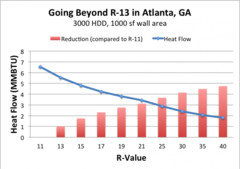
Notice by doubling R-value from R19 to R40, heat flow is cut in half. Roofs lose more heat than walls and experience much higher delta T in summer. Small percentages of misleading math can still represent good investment opportunity.Whether an insulation upgrade is a good investment depends on much more than flippant percentages. Meaningful calculations would include climate, costs of insulation and energy costs possibly accounting for effects of tax deductible mortgage payments for the insulation and after-tax energy payment savings. There is also the case for a non-volatile hedge against energy price inflation. Reduced mechanical needs could be significant.
The idea that high performance homes should have a short term payback is questionable anyways, dare I agree crazy. Housing is a long-term durable good and lower operational costs is better for all society. Insulation minimums influence moisture, durability and indoor air quality.
Passive house modeling often points to much higher levels of insulation than current building codes. Comfortable mean radiant temperatures of the exterior envelope surfaces are noticeably better than code minimum. I'm not advocating here for passive house levels of insulation but they have good reasons other than simple payback for including so much R-value.
There will always be performance trade-offs like investing in PV instead of envelope upgrades. Decisions based off of accurate energy modeling could be a better investment than simply adding more inches of insulation or PV capacity. It seems most sophisticated energy modeling attempting this balancing act suggests insulation levels called for in prescriptive minimums, if not higher. Cold climate builds should pay attention to the BSC's recommendation of R-values of 5:10:20:40:60. R-60 being roof insulation.
Arguing against prescriptive code minimums like Kudzu has, usually comes from the spray foam industry (irrelevant first graph probably from spray foam sales brochure). It's harder to financially justify thick applications of foam compared to cellulose. The issue discussed extensively in Icynene says it's ok to skimp on insulation shows how these misleading performance claims and resulting press has hurt the foam industry's reputation among the high performance building community. Traditional vented attics have never been so appealing.
As a builder always on search for savings, I could pick apart many codes that add costs with no apparent value but dismissing building codes is short sighted. Outside of spray foam proponents seeking a more level playing field for competitive roof bids, most energy experts suggest that current prescriptive minimums are the starting point for cost-effective insulation amounts. Many suggest exceeding code, for attic cellulose, continuous insulative wall sheathing and especially blower door results. Would link to current prescriptive minimums but government shutdown has appropriate websites closed :(
To OP and others researching attic insulation, it seems too late but sealing the ceiling plane is a more important part of the weatherization work. Existing insulation should be removed or pushed aside to address all air leakage pathways. A flash coat of spray foam over the attic floor is possible good use of that product, followed by thick levels of more affordable fluffy stuff. Air seal attic hatches and eliminate recessed can leakage. Recessed cans should never be foamed or sealed directly over vent holes and wiring knockouts. To avoid overheating and possible increased fire danger they need custom built enclosures or use a product like tenmat.
After air-sealing, uninsulated framing has the most opportunity for improvement. For my personal existing home I spent around $800 air-sealing and adding attic cellulose achieving R50 (in R38 required climate). This cut my yearly $800 fuel oil needs in half so the work had a simple payback of roughly two years and the house is much more comfortable. It reduced mechanical load, probably extending life of aging furnace which broke down two years ago. I abandoned it and now heat the entire house with the most efficient mini-split on the market, probably undersized for the heating load. I eliminated oil costs, added year round comfort and have barely noticed the increase in electricity usage. The additional levels of very cheap insulation are helping this situation, even though I started out with a whopping five inches of attic insulation.
- 7 years ago
Springtime Builders-
I feel like you have misinterpreted what I wrote. First and foremost, I'm not arguing against minimum codes. I spent years working in the energy conservation industry and I'm entirely supportive of saving energy; I was simply cautioning the OP to not expect miracles by going from R-30 to R-49, especially when it's not clear that simpler, cheaper approaches, like better air sealing, have first been done.
Second, my graph is not misleading, nor was it intended to be. I did not start at the origin (which would be 0 R-value). But I did start at an R-value approximating a ceiling with no insulation to illustrate that the first couple of inches of insulation save 80-90% of the energy available to be saved. And I'll repeat my point because it's true: you can't save more than 100%, and, when you get beyond the first several inches of insulation, you're talking about what part of the remaining 5-10% you can save. I'm not saying one shouldn't go after some of that, but you have to see how much it costs vs. what is actually available to be saved, and decide whether the payback period makes sense for you.
As far as the graph you chose for your argument, it's accurate for what it shows...which is illustrating what happens when you start with R-11 insulation and add some more. But you are wrongly implying that it is showing large amounts of energy being saved. The OP is asking about going from R-30 to R-49. If I look at the heat flow (the blue line) in your graph, you can see that the curve gets flatter and flatter as you add each increment of insulation, and the saved energy is getting tinier and tinier. That's because, as I said before: you can't save more than 100%.
Here is another graph from the same report we are both referring to which illustrates this: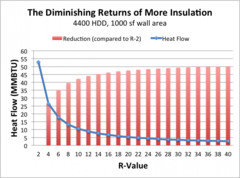
In your own example, you said did air sealing and additional insulation. It's entirely possible that the air sealing is responsible for the large majority of your savings, so the effect of adding more insulation (and you don't say how much you added) is not possible to determine. I'm glad you saved money, but you can't simply assert it's primarily the result of more insulation: that would be misleading. I'm not trying to get in an argument so much as talk about the reality of what goes on when one simply adds more insulation to a pretty significant amount that is already there. My point is not to discourage people from increasing energy efficiency, but I think some reality needs to be injected, and you paint a rosier picture than I think is merited for the specific type of question the OP asked. My advice to the OP is to make sure that he has first taken care of all caulking, weather stripping, foundation sealing, and electrical outlet sealing, as well as dealing with thermal bridging if possible, before looking at more insulation.
Lastly, I agree with you on looking at different types of insulation and taking an array of measures when doing new construction, or when it's an easy option with existing construction. That's helpful for people who are in a situation where they can take advantage of those measures. - PRO7 years ago
Thanks Kudzu I think we mostly agree on big picture. To be clear, the graph you just posted has a misleading, irrelevant starting point of R-2. It was used to illustrate your point about the flattening curve but also used as the article's cautionary example that "could lead to the wrong lesson".
Based on your last post, it is unclear if you read the entire diminishing returns article link.
The later graphs, like the one I posted, are much better graphics of the actual situation. A graph zooming in on roof insulation levels, using R-30 as the starting point would look similar, nothing like the two graphs you posted representing a zero insulation tent and uninsulated wall.
We simply disagree on the potential savings. The "don't expect much from" R-30 suggestion saves 40% less heat than prescribed code minimum (cheapest construction allowed by law). Cheap insulation would probably have a very reasonable simple payback, even if your misleading math makes the potential % of heat look very small.
In my earlier BSC link for OP's Chicago climate, Dr Joe recommended R60, that's double the amount of R30 you seem to think is ok. Dr Joe is a frugal engineer with better than average knowledge on cost-effective energy efficiency and his recommended roof minimums are typically R50 and higher for cold climates. He would agree with us both that air-sealing comes first.
In my personal example, I included that addressing thermal bridging (uninsulated framing) and air-sealing was part of the work. Still, my results would be much worse had I wrongly believed that the pre-retrofit ~R20 insulation was capturing such a "high percentage" it's good enough. - 7 years ago
I think I'm going to leave it there. We disagree on the math and the implications. My main issue was to alert people to the fact that energy savings is complicated and they shouldn't naively think that adding a bunch of insulation to a house that is already pretty well insulated will have a huge effect. Readers of our dialog will just have to decide for themselves what makes sense. I've posted my concerns and I'm done....
dva79
Original Author7 years agoThanks all for the comments. Really interesting discussion that I learned a lot from.
- 7 years ago
yesss more insulation worth it. utility company and/or feds might give you a rebate/tax credit.



dva79Original Author