Software
Houzz Logo Print
ihatethesethings

I need ideas on how to hide duct work

7 years ago


Comments (29)

  • 7 years ago

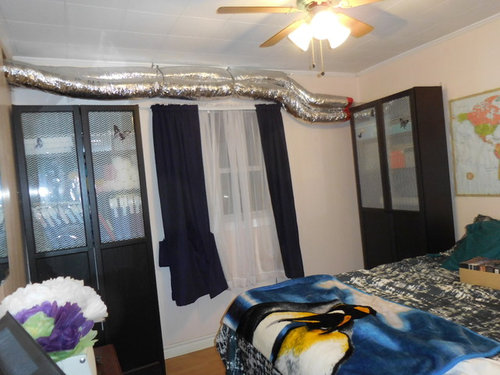
    The black cabinets are free standing. I came home today after work to see this. We had a HRV put in and this is the duct work. Yuk.

  • PRO
    7 years ago
    last modified: 7 years ago

    I'd move. "Came home to find"...........................what did you think it was going to look like? Paint it wall color and sleep elsewhere I guess. Or do away with cabinets, mount a ceiling track, and a wall of curtains to bypass and hide it.

  • 7 years ago

    wow. rental or own? (so many questions, so little space!) were you handed a bill for this mess?

  • 7 years ago

    We own. I am really upset. I was told duct work would go across the ceiling to outside, but I was thinking it would require a small bump out...


  • 7 years ago

    We were having moisture problems in house, and had mould in closets and along ceiling. The Chief Building Official recommended we put one of these to control humidity. Cost over three grand... hubby was home when they did it, but didn't tell me how bad it looked.

  • PRO
    7 years ago

    Have you paid, what was the reason for this ? That is unacceptable no matter what but just curious about what kind of company would think this was okay.

  • 7 years ago

    It is 15" intrusion... hard to put a track & curtains on that...


  • PRO
    7 years ago
    last modified: 7 years ago

    RIP IT OUT. You OWN this mess? Mold is prettier, albeit not safer! What "Chief Building official" Is it a condo, what is it? Who arranged for the work? What "small bump out" and how? A soffit? Fine! Where was the contractor in conjunction with an HVAC specialist for framing and drywall and a plan?

    The whole story, please, as thus far it is one ridiculous story. Is this even the USA?? If it is the ONLY answer, it needs to be ceiling tied, clear the windows and a soffit built. Still ugly.

  • PRO
    7 years ago

    From the spelling (mould) and language, I'm sure this is not in the US. No matter where it is, it's a disaster.

  • PRO
    7 years ago

    You got that right, Diana

  • 7 years ago
    Ouch! Looks like you need to have it raised a bit more on the right and install a bulkhead to cover it. Or make it more industrial with metal casing and paint in. I hate it when have a little work done creates a bigger problem.
  • 7 years ago
    There’s no attic space to run this through? Is it required to be this large, for proper air movement and capacity? If no attic space, and it has to be this size, have a contractor come in and build a drywall bulkhead around it. It’s still not going to look that great, but it will look better.
  • 7 years ago
    For the love of all that is holy...that is an abomination. And the fact that you had to pay thousands for it just adds insult to injury. That cannot be the completed job...?
  • 7 years ago

    Ok it's a mess ..but there is no need to be so rude about it !!

  • 7 years ago

    thanks Snaggy... It is done... I just want ideas on how to make it not so ugly... the reason it is lower on one side, is that we have a large overhang surrounding the exterior of the house... it is just nasty... it is a bungalow without basement, only crawlspace. It is our only asset and we wanted to save it from mould. I am in Canada.


  • 7 years ago

    a few weeks ago, hubby had a contractor fill our attic with insulation, and it could not go up there... grrrr... I am so freaking frustrated and mad...


  • 7 years ago
    I don’t understand why you can’t run it through the attic. It’s common to have insulation and ducts in an attic.
  • 7 years ago
    Omg I feel bad whoever did that should be put away and locked up
  • 7 years ago

    Surely, that is NOT the way that it should have been done! That is not acceptable.

    Is there some reason that you could not just run some dehumidifers? I can't imagine any place in Canada being that humid, not even on either coast.

    If you are having that much of a mold problem, you might have some correctable problem that is causing it. It is difficult to imagine you having mold in closets and mold on the ceiling without there being some identifiable source of it. Maybe you have some leak in the roof or some very small pinhole leak in a water pipe, or some vent pipe, maybe, that is building up condensate on it that is wicking into absorbant materials? Water and moisture will creep and transport along many unsuspecting avenues. It sometime takes a lot of investigative work to find the source, but I highly suspect that there is a common element that is causing your problems in both the ceiling and in the closets.

    I looked up "HRV" and it is a Heat Recovery Ventilator. Apparently it is used on houses that are built to be air tight to bring in fresh air. Instead of opening a window and letting in outside air at the temp of the outside, it brings in outside air and conditions it before it is blown into the house. So, there is an intake and an exhaust duct.

    We, essentially, have a system much like this on our gas appliances that were installed years after building, There is no gas vent pipe through the roof. Both our water heater and our furnace vent combustion gases out the side of the house and the heater has some sort of system that recaptures the heat. Even air conditioners have a system to capture and drain the humidity from the house. There is a little pump that empties the water to outside the house.

    If you are having mold only in certain areas of your house, it would be wise to think that, maybe, there is some common reason for it, especially if it is along the ceiling and in the closets. I would wager to bet that you have an exhaust or a plumbing problem somewhere. You could not possibly have that much of a mold problem in Canada, in a heated home, that you would have these problems without there being some definite cause for it. Only a small leak can emit moisture that travels and wicks into adjoining materials, and I highly suspect that is what you have. It is probably traveling along the ceiling joists and down the studs between the walls where it is getting trapped in your closets. Just the fact that is along the ceiling should be throwing up red flags. It takes a lot of moisture and water to grow mold on a ceiling. If it were overall moisture problems of a magnitude to cause ceiling mold, you would see it manifest itself in many ways throughout the rest of the house. I suspect that it is more localized and not part of a house wide moisture problem.

    You probably have either a pinhole plumbing leak, a roof leak, or condensate building up and wicking on something in the space above the ceiling.

    I am sorry that you are going to have to deal with this and the folks who installed it Surely, it is not what you bargained for. I don't think you will find anyone who will comment that this is acceptable. Maybe, if it were your garage or an unfinished basement space, but NOT your home.

    Is your house known to have been built as an air tight space? Unless you know that to be true, you may have been sold something that you did not need. Apparently, there is an advantage to having some air leaks in your house. It keeps it ventilated.


  • PRO
    7 years ago
    last modified: 7 years ago

    I think you need an HVAC guy, and asap. In fact, I'd be worried that you now have an attic, blown full of insulation, perhaps with a mold, or a roof issue behind all of it. Honestly, your answers are not here. I understand the cosmetic issue, but honestly? I think you have bigger issues to deal with. Get off the computer, and solve the real problems. My bet is there are more.

  • 7 years ago
    This makes me want to cry.
  • PRO
    7 years ago
    last modified: 7 years ago

    JAN MOYER has a good point. The biggest problem in our area that we see (which is Northern Montana) are insulators who don't remove existing insulation, but just add more onto existing, thinking that this is always a good thing. However, the fact that you had mold along the ceiling of your closet makes me concerned that the issue originated in your attic. If your attic was not properly sealed initially, the moisture from inside your home could have been leaking into your attic, which happens at every point your ceiling is "compromised" (i.e. lighting, where walls and ceilings meet, vents, fans, etc.) This leaks and builds over time, creating mold. I'm wondering if the problem was originally in your attic and started to spread into your home/closet.

    I'm concerned that you just added more insulation, which could exacerbate the original issue. Insulation should be removed, then sealed with spray foam at areas of "compromise", then reinsulated. Without these things addressed first, adding more insulation creates the perfect scenario for more moisture to build up and create more mold in your attic and roof (kinda like a giant sweaty water bottle).

    I'm just concerned for your home as a whole and the larger issues that might be at hand. However, an HRV will help the moisture balance inside your home assuming larger issues are addressed. As for the aesthetics of your new ducting, I would build a soffit around it. So sorry you are dealing with all of this, but please get someone inside your attic to inspect for mold underneath all that insulation, especially where your walls meet the ceiling.

    I would contact someone in your area who is experienced with sustainable building design, building science, high-performance builder, etc. These professionals are well addressed in building science and are *generally* not in it to make a dollar, but are more concerned with the integrity of the structure long term and the health of its inhabitants.

    Hope this helps and good luck!

  • PRO
    7 years ago

    Glo makes a good point but I would add: Is this safe/up to code? I know you're looking for ways to hide this and none have been mentioned, but I think it's really important to find out what's wrong and correct it. Good luck!

  • 7 years ago
    last modified: 7 years ago

    I am so afraid now, I spent $7,000 in drainage work outside too... contractors keep telling us this will fix things

  • 7 years ago

    I am so sorry, but I think that you are being led down the wrong road.

    And, THAT is no way to install ANYTHING in anyone's home.

    Obviously, I am not the only one who thinks that you have something that is causing that mold in that place and that the problem is coming from above.

  • 7 years ago

    Yep, check your attic. Our first house had the beginning of mold in one spot on our bedroom ceiling. Found out the attic ventilation holes (don't know correct name for them) in the eaves were blocked by insulation, which then became damp insulation. Once that ventilation area was cleared, the mold was cleaned up and never returned. Good luck with these frustrating issues.

  • PRO
    7 years ago
    last modified: 7 years ago

    I would stop hiring contractors and get a real expert on building science in there. They will be able to direct your money to the proper issues. I am so sorry!

    For example, we have quite a few insulators locally who will continually blow in more insulation and our company (our business started as a high-performance insulator and HVAC prior to high-performance windows) fixed a lot of the mold issues that they created in homes. Just because someone is able to do a trade does not mean they are educated on the overall effects of what they are doing.

  • 7 years ago

    This is why nothing happens in my house when my hubby is there without me. I've had too many incidents in the past where he was there and it was mucked up. I feel for you and hope it all works out.