Software
Houzz Logo Print
b_cz10

Multiple succulents in one pot?

7 years ago
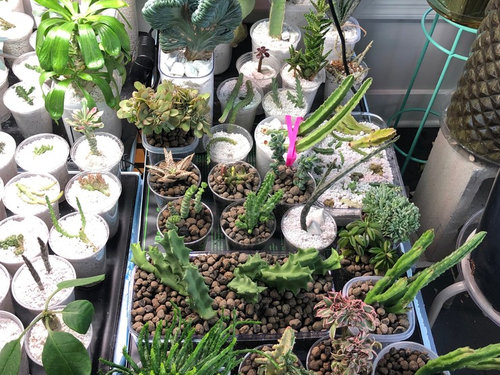
Does anyone know if it's ok to pot multiple succulents into one larger pot? I have a lot of smaller pots in semi-hydro on heat pads, and it'd be much easier to only have to fill one container. I'd also like to organize them all and design it a bit, so that they just look nicer grouped together.


I've read some conflicting opinions that roots can be invasive, or that if one plant has a rot problem, it can spread to all the others. But I'm hoping that there is a way to pot similar to how people do large soil pots of succulents and cacti.


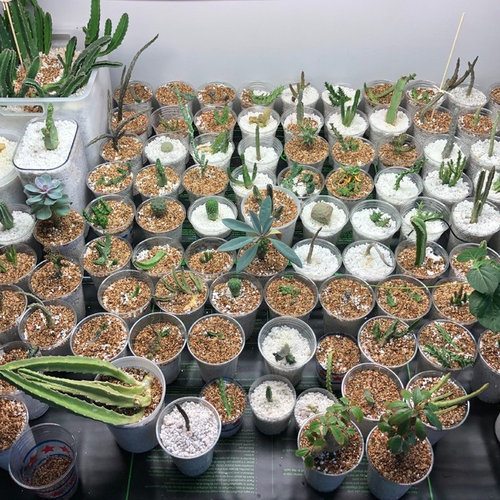
Thanks for any tips, here is a picture of how they're currently set up-


Comments (15)

  • 7 years ago
    last modified: 7 years ago

    Of course you can! Mixed pots are really pretty, but do some research and pot together the plants which appreciate similar water and light conditions. Does not even have to be "mixed," but multiples of the same plant. You have a lot of plants, and maybe larger pot groupings would be easier care.

    You'll just want to be sure to use pots with holes and a fast draining mix. Are some of your plants in sand?

  • 7 years ago
    last modified: 7 years ago

    Around here, folks tend to discourage community pots of mixed succulents, cause is too difficult to match their compatibility re water & light needs as mentioned above, it's harder to do than it sounds.

    I'm the only one I know who grows succulents hydro (or semi), like a Sans I grow in Leca stones & water. More recently I've started some Xmas cactus in same hydro set up.

    I think trying it in hydro (or semi) might be even more confusing. If anything, maybe try Socks' idea of multiples of the same plant planted together.

    But roots getting tangled up together is really unavoidable, that's just what they do.

  • 7 years ago

    Thank you both!

    That makes sense regarding the lighting and water.

    Socks, there is tiny gravel on the top layer of some of the cups job that photo. But I took it off as it was keeping the top too damp. Most of my plants at this point are in cups of pure perlite. I water them every three to four days and leave about an inch or two of water on the bottom of each container. They’re all on heat pads, temps of perlite inside cups is 80-85 degrees F.

    Most of them seem to be doing well, but the top layer still stays damp a little too long for my liking. I’m testing some newer plants in Hydroton but same water reservoir at the bottom. I like the hydroton better so far because the top layer of pebbles dried very quickly. So it’s less damp around the plants stems and top. So far the plants I’m testing in this seem to be growing bright white new roots.

    So eventually, hopefully soon, I’d love to put a lot of the small ones in one big container of hydroton. I’ll have to think about it some more though to make sure I’m ready to design a setup where they each get the right amount of light they need though. Could get tricky.

  • 7 years ago

    Check out Debra Lee Baldwin's books or website. She does a lot of nice succulent arrangements. When they get overgrown, or if one dominates, you repot. Of course, she lives in zone 9 or 10, so plants can be kept outdoors year round and heating pads aren't an issue.

  • 7 years ago

    You certainly can mix different plants in one container, especially if they have similar light and heat requirements. You might have to be more on top of repotting from time to time, if one of the plants dominates and threatens to crowd the other plant(s) out too badly.

  • 7 years ago

    Yes, don't ever let rules weigh you down. Gardening is a mix of science, instinct and art. Above all else gardening is learning by making mistakes. The best gardeners kill plants. Maybe thousand in a lifetime of gardening. If you did it all 'the right away' from the beginning what fun would that be. When it's your prized plant, then be more diligent, but do not let killing plants discourage you. You can not predict or be ready for everything. You also can't let your spirit of creativity out, following other people's rules. What works for them may not work for others. I read enough 'expert' books & blogs to know the experts don't always get it right.


    I personally would do some research on what goes well with what. Maybe just maybe something works for you that doesn't work for many. It looks like you have already figured the plants that grow in the same substrate, same light conditions and same watering routine. I can guarantee most of the advice you read will not be from people growing semi-hydro with heat. For that reason, I would not even try to give you suggestions on plant combinations.


    Good luck. Please share any updates.

  • 7 years ago

    Keep all Opuntia out of it, unless it's a slow-growing species / sub-genus, like Tephrocactus. But a community pot isn't that hard at all, but you have to know what you can, but more importantly because they're less numerous, what you can't put it.

  • 7 years ago
    last modified: 7 years ago

    I never tried hydro or semi...could you experienced ppl tell me what is the advantage of growing succulents semi-hydro? I have seen many photos Karen posted, and also some others, before. Plants look just fine to me...even if doesn't seems to be way to grow them - according to how they grow in habitat. It may be interesting to try some.

  • 7 years ago

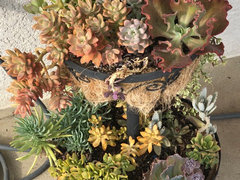
    Most of my succulents are clumped together in mixed containers. The one plant I’ve purchased multiple times is echeveria black knight and it has continued to either burn or rot. So I’m done trying to force it into a community. Next time I purchase it’s going into its own pot. I have never had a problem with tangled roots. I have four of these three tier baskets all with different combinations and they have worked for me. they’re about two years old and fully acclimated to over 100 degree temps and the occasional 32 degree temps we have I throw a frost blanket over them on cold nights but they don’t have a shade cloth in the summer

  • 7 years ago

    And the New World Crassulaceae aren't averse to growing nicely in confined conditions - if you need to cut their roots when removing from a community pot, it's not usually detrimental to their future growth.


    Bc _zone10b thanked cactusmcharris, interior BC Z4/5
  • 7 years ago

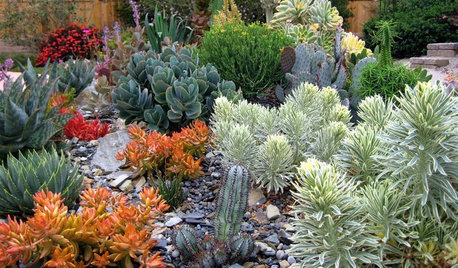
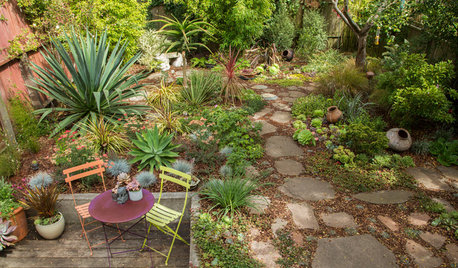
    J- that is beautiful. That is the kind of sculptural landscape I'm hoping to achieve one day. I really like all the variations of colors in that one picture. Hopefully I'll be able to achieve something similar.


    A lot of my plants are really small stapeliad types that I hope one day will grow into bigger clumps. But there are too many cups for them, and it's starting to drive me crazy hah.


    IGteacher I will look her up now and check out some of her containers :)


    GC, I realized a couple of months ago that this is good advice. Not to listen to anyone's one way of growing these plants. Everyone's environment/conditions are different and over the last few months I've slowly realized what these plants seem to want (water and heat) at least in my house. I was constantly taking advice from growers in much hotter climates, a lot who grow their plants outdoors. After killing quite a few of my own, I realized what is working and what is definitely not.


    Hi Rina :)

    I've been trying to read as much as I can online about people who grow stapeliad/pseudolithos and what their tricks were. I grow all of these plants in the above pictures indoors, so it can be warm, but dry which was helpful. But I was learning that the soil was stay too wet, or too dry, and root loss was happening no matter how much I tried to find the perfect watering schedule.


    The few plants that grew the best for me indoors over the course of the summer were my Cubiformis, my dorstenias, my euphorbias, and my Larryleachia. All of these plants were in pure grit, basically pure pumice or small river stones and gravel. I would drench them with water once a week and they seemed very happy and grew two or three times their original size.


    I began reading on another forum (Daves Garden) about a woman who changed all of her succulents to semi-hydro, with Hydroton balls. She was using the same method as Firstrays and their orchid methods.


    I tend to over water and over baby my plants, and I also wasn't seeing new growth on most of my stapeliads and it was bumming me out. I know patience is key but I am not the best with it. After seeing some cuttings in my cuttings box do really well with rooting and growing new arms quickly in pure damp perlite on a heat pad, I decided to take her method of leaving a water reservoir at the bottom of the plant container and trying it, but without drainage holes and on a heat pad under light. Basically I'm trying to create the same setup as my cuttings box but for each individual plant.


    A few people I've shown this experiment to seem to think I will quickly kill all of my plants. But so far, they seem to love it. They're growing bright white roots and lots of new growth on most of them. My cubiformis for example has two flower clusters developing at once now. My Rhytidocaulons have anywhere from 5-10 flowers at any given time and lots of new branch growth. I was lucky if I was able to see one flower before when they were in soil/grit mixes. Most of the time the buds would dry out and fall off before even opening.


    So...after all that (sorry for the long response!) what I'm learning, at least for now, is that even these desert plants that are supposed to be kept mostly dry, love water and heat. They also probably love it dry too as that is their natural habitat, but for my conditions they seem to do much better with heat pads and water in their cups at all times.


    The temperature inside my cups is anywhere from 83 to 90 degrees. If I wasn't able to keep it that warm, I think all of these plants would rot/die from cold feet.


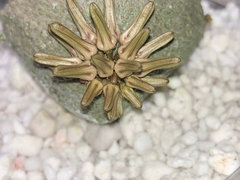
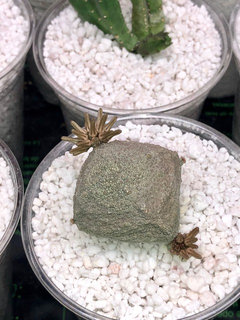
    Here are some current pictures of my cubiformis :) All four flower growth points (two tiny ones and the two larger) are new since keeping it in this setup.


  • 7 years ago
    last modified: 7 years ago

    Those are gorgeous planters. I love them. I think my black knight problem has to do with it burning very easily. I have minimal shade here at my house. Since I moved in I’ve been trying to incorporate more trees and such but in the meantime most of my succulents hace to adapt to a full sun situation. I do have a carport on the east side of my house and it does very well for bright shade the problem is I have little room for Planters. Im also afraid to post pics of my planters sometimes because some folks can be very judgemental. Gardening should be a fun therapeutic practice and what works for some may not work for others.

  • 7 years ago

    GC those are really beautiful. That’s how I’d like to group succulents. So they can be planted together like yours and J’s. I think they’re much nicer to look at than my individual cups.


    The cups I use are just solo cups, clear plastic so that I can see the water level st the bottom. They dry out every 4 days or so on the heat mat. But the plants seem to love the bottom heat. Give it a try with something easy to find again in case you kill it, or duplicate plants.


    I use filtered water in mine and add Schultz cactus and succulent food at half strength every other watering or so.

  • 7 years ago
    last modified: 7 years ago

    Brendan

    Thank you for the explanation. Maybe I'll give it try with a plant or two :) I just do not want to create more work for myself - and have only 1 small heat pad. Well I actually have another one that seems to keep wormer, it is from someone who used to have a reptile. My plants have to be indoors for approx. 6mo/year, and I keep them in medium temps: lows about 14*C, high maybe 17*C. If I kept them wet, I am afraid that they would have 'cold feet'. But heat pad would take few pots, so maybe...