Software
Houzz Logo Print

I got a hundred red onion starts from a local nursery abut 10 weeks ago. Not sure if long/short/neutral day, but I assume they were right for this locale - probably short. The plants get full sun, and are doing great, but NO BULBS are forming. When should I expect those to appear? My soil has plenty of P. I was struck that the recommended spacing is 4-inches, which is what I did. Sounds kinda dense. I have not grown bulb onions before, so I'm really not sure what to expect.

Comments (30)

  • 7 years ago

    Onions do their own thing on their time table. You can adjust growing conditions to effect size but when they start storing energy. They are triggered by increasing daylight. There is some variation in variety but short day onions are triggered by 10-12 hours of daylight. They begin in March but show most of their growth in April with longer maturing varieties going well into May.

    Intermediate day onions start at 12- 14 hours (April)) Long day onions need 14 -18 hours (May-June) Remember they need the daylight hours specific that variety to trigger bulbing.

  • 7 years ago
    last modified: 7 years ago

    Thank you. That's clear. I guess the point is that they don't even start to bulb until the days get long enough. Now, I believe the accepted time-to-harvest is something like 120 days, so that would also point to April.

    Now, I want to plant summer stuff in that bed, but the onion rows are two feet apart, so I'll just plunk some melon seedlings in between them in a few weeks, and by the time the melons take over the sunlight in the bed, the onions should be well along. Unlikely that there will be any root competition. Though the onions will largely stick up above everyone else. That's the main justification for going with short-day.

  • 7 years ago

    Farmerdill is right about the bulbing. Your plants are making leaves now and the more leaves you get the larger the bulbs will be. For each leaf that develops you will get another ring on your onion bulbs.

  • 7 years ago

    I guess the terminology is that green stems are leaves. Each of my plants has about six right now. That's fascinating that onion rings are connected to stem count. I understand also that the larger the stems the larger the rings will be. I also see that short-day onions don't store as well as long day onions do. I'm a novice at growing bulbing onions!

    What soil amendments/fertilizers are recommended for bulbing onions? I know P is important, and my soil has a lot of that. I may just throw on some extra N. Is mulch desirable? Weeds are not an issue.

  • 7 years ago

    Onions have similar requirements as green leafy vegetables. Lots of N. They need to bulb with the top exposed so mulch or puling up dirt around with impede their growth. Short day onions have a higher water content than storage onions which does hinder their storage abilities. Grano types I can pull in May and have some last until Christmas. By December they are beginning to sprout. Granex types don't hold so long, about 4 months.

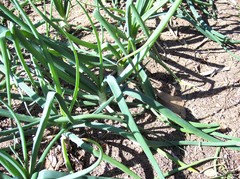
    Rio Roho at end of March

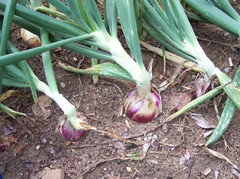
    Rio Roho- early May

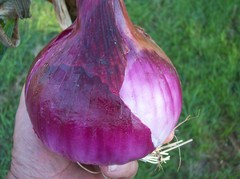
    Rio Rojo harvested.

  • 7 years ago
    last modified: 7 years ago

    Onions are true bulbs (in the botanical sense) and each scale or layer is actually a part of the leaf it’s attached to. The layers are “modified” leaves.


    Edited to add ... others have already mentioned this.

  • 7 years ago

    That makes sense that, to the extent that bulbs are just extensions of the leaves, fertilizing for leaf production (e.g. nitrogen) makes better bulbs. Of course, that's not the case with beets or carrots, but I think it is for turnips. Root veggies are not alike!

  • 7 years ago

    Turnips are roots, like carrots and beets. They're not bulbs. Cutting one in half shows you that. There are no layers.

  • 7 years ago

    But turnips want nitrogen, and beets and carrots don't. That was my point. Yes, formally, onions aren't "root vegetables", except they form as roots. That's inescapable.

  • 7 years ago

    I have read about leaving the top of the bulbs bare. I have moved some dirt around them some in the past and...........no harm done that I know.

  • 7 years ago

    Dan, I didn't realise that comment was posted. I wrote it but then reread your post and saw I had misunderstood what you were saying. You were saying turnips differed from carrots in N requirements, not in botany. I thought I had erased it. Please Ignore it.

  • 7 years ago

    Thank you, floral_uk. You are correct that it is botanically simplistic to consider onions to be crops like beets, carrots, and turnips. But now that I think about it, all are considered to be "root vegetables" in agricultural and culinary usage. Root vegetables can be bulbs (like onions) or taproots (like beets, carrots, and turnips). The thing we eat is actually a storage organ for the plant, making a damaged top replaceable. But I do find it strange that different taproots have very different nutritional requirements.

  • 7 years ago
    last modified: 7 years ago

    Interesting thread. When planting transplants how deep should one try to plant bulbing onions? Does planting transplant too deep make smaller onions?

  • 7 years ago

    I just take the plant between thumb and forefinger and stick them in the ground, but I do at most 1000 plants. End result is probably about a half inch.

  • 7 years ago
    last modified: 7 years ago

    Not sure that a cook considers onions to be simply root vegetables. They are in a category of their own being an essential base element in building a dish in a way other roots are not. In some ways used more like a flavouring than a vegetable. In agricultural terms too they are treated differently being in a rotational group of their own and not included in either Brassicaceae or Apiaceae in the rotation.

  • 7 years ago

    Not to high jack this thread but I think when you grow the long day they start bulbing when it's hot in my area so you need to keep the moisture right or they will bolt. I also wonder if the Nursery really knows what variety is truly the best for your geographic area or are they just randomly distributed. That being said you should do your research and plant your own seeds. Onions are easy to grow from seed and a lot cheaper than buying sets at the nursery.

  • 7 years ago
    last modified: 7 years ago

    At my nursery, 100 sets were $2.75. Big bundle with a tie around them. Hard to argue with that. A packet of seeds would cost the same. Maybe I was just lucky. Probably not much profit margin on those.

  • 7 years ago

    ... and the answer is .... onion bulbs do not grow along with the foliage. That's an important lesson to novice growers. The foliage will get huge, and no onion bulbs will be produced. Zero. Ziltch. Then *suddenly* they bulb up. I planted out on December 1, and was out of town in early April. When I left, huge and lush foliage, and no bulbs. I return ten days later and KABOOM - big bulbs all over the place. We made the mistake that week of buying a sack of onions at the grocery store. I am now up to my ears in beautiful onion bulbs. They look exactly like yours, farmerdill.

  • 7 years ago
    last modified: 7 years ago

    In my experience the onions bulb from a combination of heat and day length, at least for the long day types. As others said, for growing purposes they are basically all greens, the bigger the greens the bigger the bulb. They are very slow to start, so indoor starts and/or a long growing season are essential.

  • 7 years ago
    last modified: 7 years ago

    farmerdill, in March the tops of your onions are not visible, but in May they are. Did they grow that way, or did you help them? I've been trying to grow intermediate day cippolinis in Nor Cal for years, and find the ones I can see the tops of seem to be doing better.


    One of my pictures here from 2005!

    Not sure if I can see the tops BECAUSE they are doing better, or the other way around. What does bare tops have to do with it?


    I too, wanted to use this spot for something else, so I transplanted a few onion seedings this weekend, but would like to better understand planting depth.

  • 7 years ago

    OK, my onions are all cured and strung up. They will live in a converted garage that, during the summer, stays around 80F, 60% RH. Not great for storing veggies, but fabulous for doing starts. Out of almost 50 onions, I managed to drop one or two, and they got a bit dinged. Is that going to affect storage life time? If so, I'll restring with those dinged on top.

  • 7 years ago

    I just use the bruised one first. I keep a half bushel or so that I don't string up .

  • 7 years ago

    Thank you. I was wondering, does stringing them up really improve storage lifetime? I could just pile them up in a basket instead.

  • 7 years ago

    i'm still using onions i grew last year that have been kept in a bushel basket in the basement. stringing them up seems to be just a way to dry them.

  • 7 years ago

    After curing I store mine in mesh bags hung up in my 65-70 degree basement. About 6-8 per bag depending on size. Air flow around the bulbs is what you're looking for and the mesh bags make it easy to keep an eye out for sprouting or spoilage. Like apples, one bad onion can spoil the bunch.

    Putting them in a basket will work fine but a single layer would be best. Use any damaged or bruised bulbs first as Farmerdill mentioned.

    I expect my intermediate day onions (Candy, Red Candy, Superstar, and Patterson) to be finishing up by early July. Some are already large enough to start eating but so far I've resisted the urge to pull any. I have a few Vidalia onions left that I will use first.

  • 7 years ago

    That makes sense. Stringing somewhat improves airflow, compared to a pile, and makes individual inspection easier. What is the advantage of a mesh bag? I don't need a mesh bag to string them up, unless the stems are going to give out, making the onions fall.

  • 7 years ago

    I use the mesh bags just because I have them. Some people use old pantyhose. No real advantage over stringing them up but I have occasionally had some bulbs fall out of a hung bunch while curing as the stems dry out. Probably not much of an issue after the curing process is complete and you retie them.

  • 7 years ago

    Good to know.